Hemory Team
On this page
Hemory can help you remember the reasons behind decisions, commitments and their conditions, what customers care about, unfinished ideas, and details people have shared with you. It makes that information available from captured conversations, so you can return to it when it matters—even if you did not recognize its value at the time.
TL;DR
- Recover the context behind an outcome. Find why an option was chosen, what someone committed to, and which conditions still matter.
- Keep the meaning behind people’s words. A customer’s explanation or a colleague’s feedback can be more useful than the label it received in meeting notes.
- Give unfinished thinking another chance. Earlier ideas, objections, and spoken reflections can help you continue work when circumstances change.
- Use the same background yourself or with AI. You can pick up a conversation with more context, or let a connected agent draw on relevant discussions for its task.
Five kinds of information that stay useful after a conversation
The value of remembering a conversation depends on what it helps you understand or do later. A decision, a request, and a passing observation serve different purposes.
| What Hemory can help you remember | What becomes easier later |
|---|---|
| The reasoning behind a decision | Revisit the choice with an understanding of the original trade-off |
| Commitments, scope, and conditions | Follow through on what was actually discussed |
| People’s needs, concerns, and explanations | Respond to the problem they described |
| Ideas and how they developed | Continue earlier thinking without starting from scratch |
| Details connected to a person or relationship | Resume a conversation with continuity |
These details do not all arrive in formal meetings. A useful explanation might come after a review, over lunch, during a customer visit, or in a voice note you record for yourself.
1. Why a decision was made
A decision log may tell you what the team chose. The discussion can explain why the choice made sense.
Suppose a team considers three pricing tiers, then chooses two because customers in early interviews struggle to distinguish the middle tier. Months later, someone proposes a third tier again. Remembering “we decided against it” offers little help. Recovering the reasoning lets the team examine the actual question: does the new tier offer a distinction customers can now understand?
Hemory can help you return to the captured discussion about the options, objections, and reasoning behind the choice. You can revisit the trade-off instead of repeating the same debate from memory.
The payoff is a better starting point for a new decision. An earlier choice does not have to remain permanent for its reasoning to remain useful.
2. What someone committed to, including the conditions
A broad recollection such as “the client was happy to proceed” can hide a detail that changes the next step.
In a pilot discussion, for example, a client might say they can approve the work once legal signs off on the data retention approach. The useful memory includes both the intention to proceed and the approval condition. Remembering only the positive response could lead you to promise a start date too soon.
Other details can matter just as much: which sites the pilot covers, what a colleague offered to send, or whether a proposed date was accepted. A commitment can exist without a stated deadline; a suggested date can exist without an agreement.
Hemory gives you a way back to what was captured, so you can prepare a follow-up or proposal with those distinctions intact. Any progress since the discussion still needs to come from a newer conversation or another current source.
This is especially useful when several conversations shape the same agreement. You can keep the earlier context in view while understanding what was later clarified or changed.
3. What people actually need, in their own terms
The label attached to feedback can be less informative than the explanation behind it.
Imagine a customer request summarized as “a better dashboard.” In the conversation, the customer explains that the team’s review is on Monday, but the figures they need are not ready until Tuesday. That background points toward a timing problem. A visual redesign alone might leave the need unresolved.
Returning to the conversation helps you distinguish the customer’s proposed solution from the problem they are trying to solve. Their examples, priorities, and reasons can inform a requirements brief, another interview, or a response that addresses the actual concern.
The same applies to internal feedback. “Communicate earlier” becomes much more useful when you can recover the situation your colleague meant and what information was missing.
Hemory preserves access to the captured discussion beyond the short label in a recap. You or a connected AI agent can use that background when analyzing feedback, without first asking everyone to explain it again.
4. Ideas that were not ready to become tasks
An idea does not need an owner or a deadline to be worth keeping.
A brainstorm might explore an interactive product demo, raise concerns about the work involved, and move on. Later, a new capability or a change in priorities makes the idea practical. The earlier discussion may already contain an audience, an example interaction, or an objection the new approach needs to address.
Your own spoken thinking can hold similar value. You may explain a problem to yourself on a walk, notice a connection, or sketch the beginning of an article. There may be nothing to deliver that day.
With Hemory, captured ideas remain available for another question or task. You can return to the thinking that already happened, including alternatives that never made it into an action list.
An idea can also develop across several exchanges. Revisiting those discussions can show how a vague suggestion became more specific and why some versions were set aside. That gives you material to build on, rather than a blank page.
5. Details that help you pick up with a person
Continuity often depends on small details connected to a person, rather than a formal decision.
A colleague describes a skill they want to develop. A collaborator mentions the kind of project they hope to take on next. Someone recommends a book and explains which chapter relates to a problem you are working through.
Later, remembering the reason behind the recommendation or the goal behind a request helps you resume the conversation. You can ask a relevant follow-up, connect an opportunity to an expressed interest, or return to advice without asking the person to repeat it.
Hemory can help recover those details from conversations you chose to capture. The value is in remembering what the person shared and the circumstances around it. A personal goal or preference is something to discuss in context, rather than assume remains unchanged.
This extends beyond work. Learning discussions, recommendations, and your own reflections can be worth returning to even when they never become a report or a task.
A conversation can become useful in a way you did not anticipate
When you take notes, you naturally select information for the task in front of you. Hemory also keeps the captured discussion available for questions that have not arisen yet.
Consider a customer interview. Today, the main result might be a feature request. Later, a new question may make the customer’s description of their working day more important. Their explanation of who uses the result could help with onboarding, while a phrase they used could help you explain the problem more clearly.
The conversation has not changed; the reason to revisit it has.
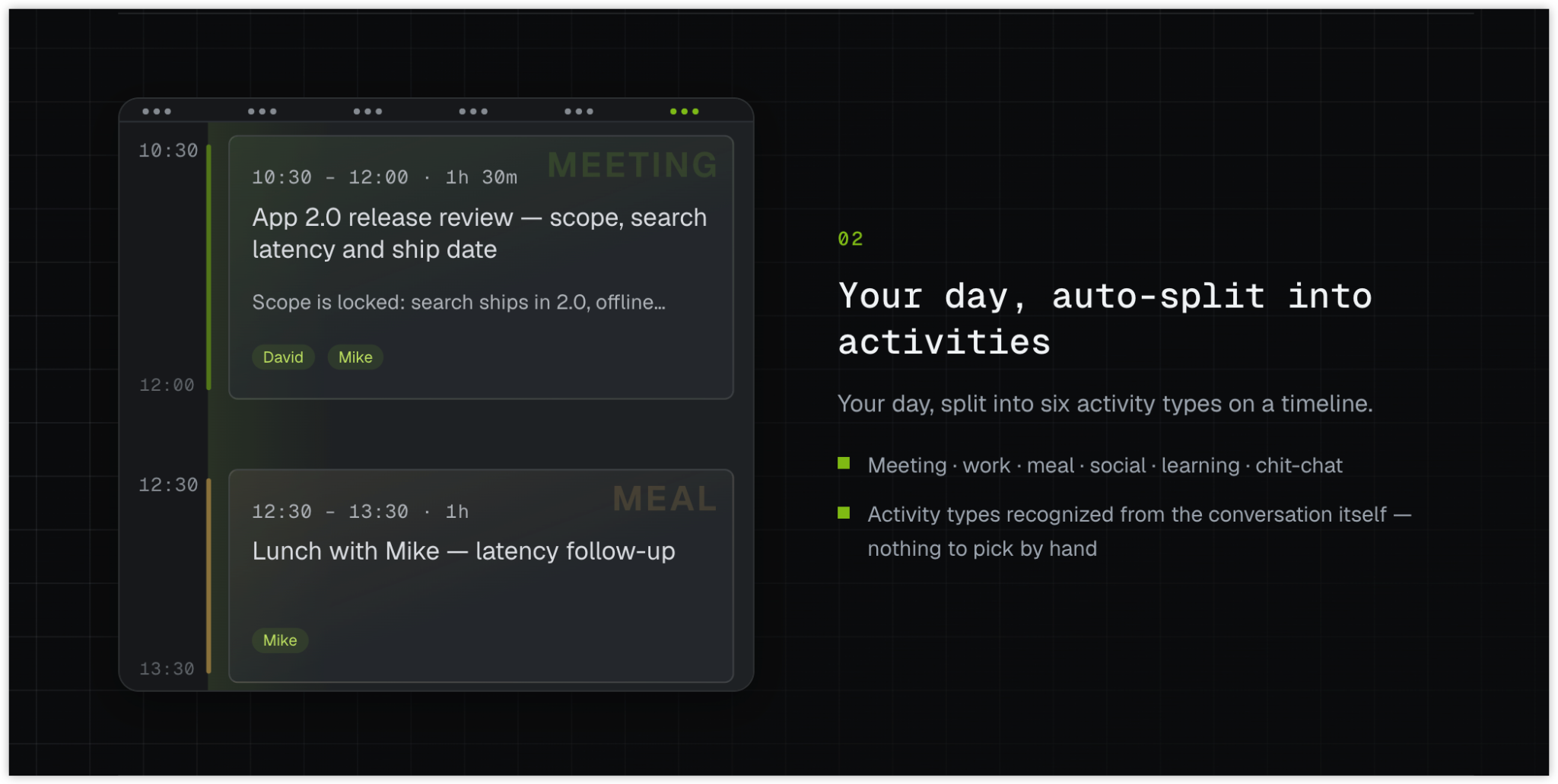
This is why Hemory’s value goes beyond producing a recap immediately after a meeting. It reduces the work of keeping spoken context available, including material you would not have selected for a document at the time.
You still choose which conversations to capture. You do not need to predict every future question or turn every captured idea into an action item.
Bring past understanding into the next task
Sometimes the useful result is simply knowing why a decision was made or what someone meant. At other times, the remembered detail becomes part of new work.
A connected AI agent can draw on captured discussions when helping with a requirements brief, a customer response, or an outline. The background you recover can shape the work without requiring you to reconstruct every conversation first.
The important difference is continuity: a new task can begin with the understanding you have already built. Hemory makes recorded context available; you and the AI tools you use decide what to do with it now.
FAQ
Does Hemory only help with decisions and action items?
No. Captured explanations, concerns, recommendations, unfinished ideas, and personal reflections can also be useful later. A conversation does not need to produce a formal decision to contain something worth remembering.
Can Hemory help connect details from different conversations?
You can ask about captured discussions across sessions. That can help you revisit how an idea developed or what someone said about the same issue at different times. The connection comes from the content of those discussions; a later mention does not by itself establish that an earlier agreement changed.
Is it useful outside work meetings?
Yes. Conversations while learning, informal exchanges, recommendations, and personal voice notes can provide useful background. What matters is whether the captured information helps with a later question, reflection, or activity.
Do I need to know how I will use a conversation before recording it?
No. You can choose a conversation to capture without deciding which detail will matter later. Hemory keeps the recorded content available for later recall, so an idea or explanation can become useful when a new question arises.
Think of something you wish you could remember
It might be why the team rejected an option, what a customer was really concerned about, or an idea you never had time to develop. Those are the kinds of details Hemory can help you bring back from captured conversations.
Explore Hemory and give those discussions a chance to be useful again.