Hemory Team
On this page
A polished meeting summary can be useful the day it arrives, but that does not tell you whether you can find a specific detail three months later or reuse it in another task. Those outcomes depend on more than note quality: the record must still be available, its contents must be retrievable, and any AI tool you use later must have access to the relevant material.
TL;DR
- Assess capture, record availability, retrieval, and downstream AI access as separate capabilities.
- A summary’s quality does not establish how long the source material remains available or whether you can search across meetings.
- Test with a realistic task that needs details from an older meeting; check what the system finds and what it misses.
- Hemory’s built-in Q&A can retrieve from past conversation sessions, but that capability does not establish a retention period or guarantee complete recall.
Four layers determine whether meeting material can be reused
“AI meeting notes” can refer to several different things: the recording or transcript, a generated summary, a way to search stored material, or a connection that lets another AI tool use it. A product may offer one or more of these; do not assume that having one means it offers all the others.
| Layer | What to find out | What it does not prove by itself |
|---|---|---|
| Capture and transcription | Whether the meeting is captured and what record is produced, such as a transcript or summary | That the record will remain available later |
| Retention and availability | Whether the material you need is still accessible at the point you need it | That you can find a particular detail quickly |
| Retrieval | Whether you can search a single record or ask questions across multiple meetings | That another AI tool can access those results |
| Downstream AI access | Whether a connected agent can use relevant records, and what its connection permits | That the agent has access to every meeting or can act in other systems |
Keep the distinctions concrete. A summary may contain decisions and action items, while a transcript may preserve more of the original discussion. Neither format alone tells you whether it will still be available later. And a record that exists is not necessarily easy to retrieve or accessible to the AI tool you want to use.
Check retention and retrieval separately
Find out what remains available
Start with the material your future task would actually need. That might be a structured summary, transcript, or both. Ask how long each remains available and whether that applies to the plan and settings you would use. If deletion, export, or other data-handling details affect your decision, confirm those separately rather than inferring them from a product’s note-taking features.
Do not treat the presence of a recent note as evidence of a particular retention period. If you can test only records that are currently available, the result shows what you can access now; it does not guarantee how long future records will remain available.
Find out what you can retrieve
Retrieval also has different scopes. Searching one meeting is not the same as asking a question across several meetings. For later work, cross-meeting retrieval can matter when a decision, explanation, or customer request was discussed more than once.
Use a question tied to a real task, such as: “What constraints did we discuss for the launch plan, and did any of them change in a later meeting?” Evaluate whether the answer distinguishes the relevant conversations and preserves changes or conditions. Shared keywords are useful clues, but they do not by themselves prove that two discussions refer to the same project or decision.
A failed search is not proof that the discussion was never captured. The record may be unavailable, access may be limited, or the wording may not match the clues you tried. If a detail is important and you cannot find it in the available record, check another source or ask a focused follow-up.
Test the route from an older record to a useful answer
Before choosing a tool, identify a task you might realistically do after the meeting—for example, prepare a project update that needs an earlier decision and its conditions. Then assess each layer in order:
- Choose an older, relevant record. Use material you are allowed to access. A single recent meeting will not test whether older records are available.
- Check what the record contains. Determine whether the information needed for your task appears in a transcript, a summary, or both. A generated summary may omit detail that matters later.
- Try the retrieval scope you need. If your task depends on multiple meetings, test a question that requires connecting them. Review whether the response keeps separate discussions and later changes distinct.
- Try downstream AI access if it matters to your workflow. Confirm which records the connected tool can use and what its connection permits. A product’s support for an AI connection does not establish identical access or permissions for every agent.
- Judge the answer against the task. Look for relevant conditions, dates or sequence when they matter, and points the result cannot establish. An answer is useful when it gives you enough supported context to take the next step—not merely when it produces fluent prose.
If you cannot test a months-old record, note that as an open question rather than treating a short trial as proof of long-term retention. Make your decision against the retention and access requirements your work actually has.
Where Hemory fits
Hemory’s product information describes timestamped transcripts and a built-in Q&A Agent that supports follow-up questions grounded in transcripts and retrieval across past conversation sessions. That gives readers a way to consider cross-session retrieval, not evidence of a guaranteed retention period, exhaustive recall, or access to every meeting in every connected tool.
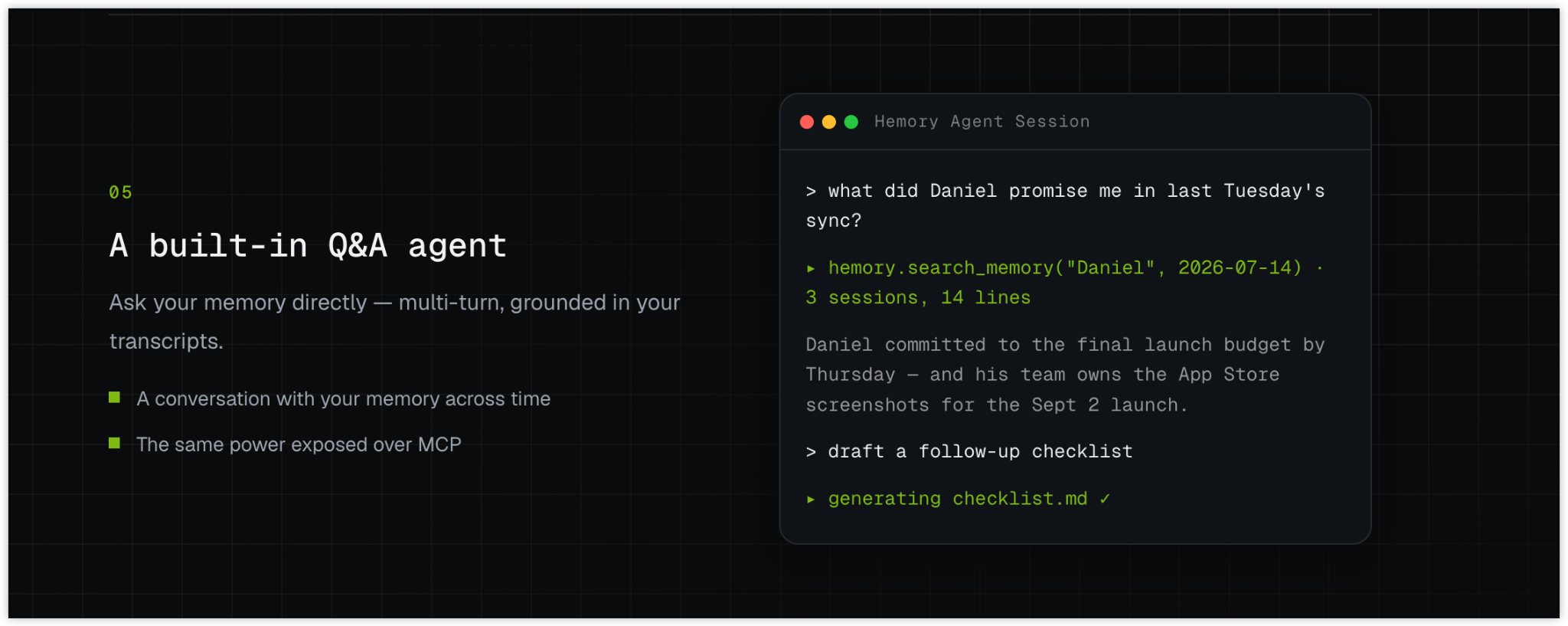
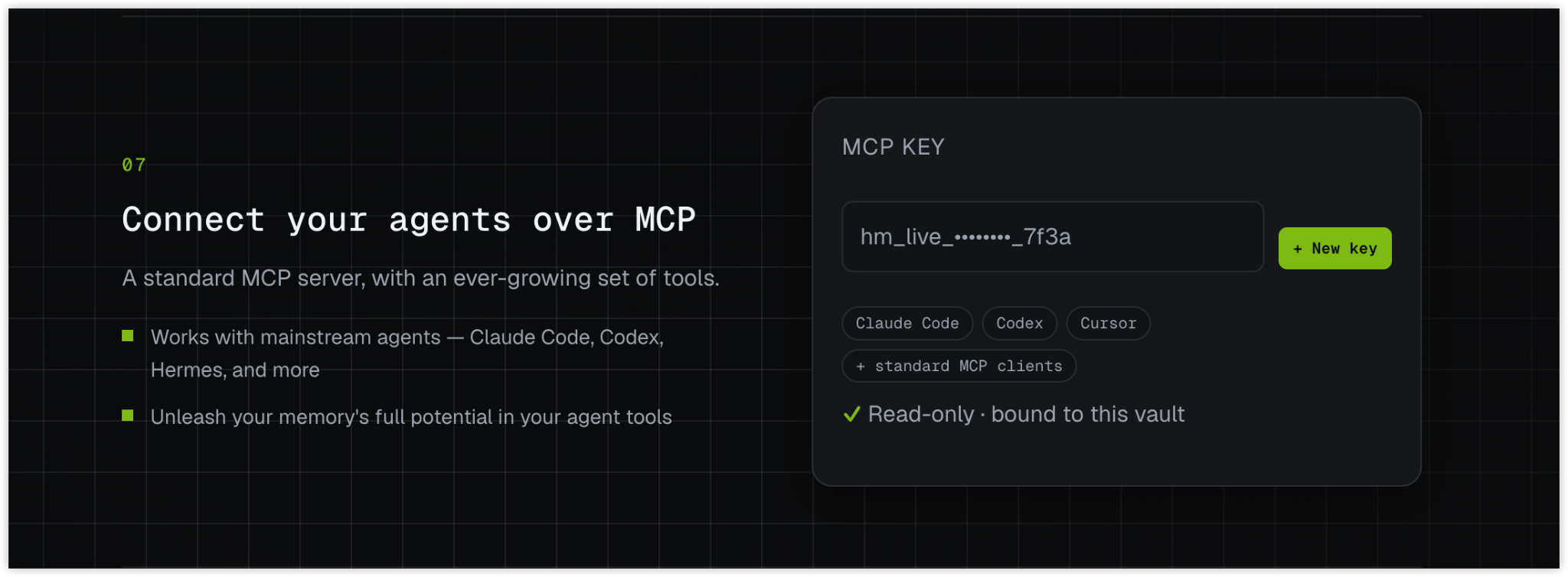
For example, if relevant discussions were captured in Hemory and are accessible to its Q&A, you can ask about a topic across past sessions rather than first compiling a manual chronology. The response can help locate context for a task; review the consequential details before relying on them. Hemory’s product information also lists an MCP connection for external agents. Check the access and permissions for the specific agent and workflow you plan to use instead of assuming every connection has the same scope.
This distinction matters during the meeting, too. When discussions are captured and organized for later retrieval, you may have less need to choose and write down every potentially useful detail while trying to participate. You still need to supply your current goal, judge what the retrieved material supports, and review any output before using it.
Choose based on the work you need to do later
A tool that produces strong summaries may be enough if your work mainly depends on each meeting’s immediate notes. If you need to revisit older conversations, compare retrieval scope and record availability. If an AI agent must use that history, check its actual access as a separate requirement.
Do not rank tools by summary quality alone—or assume that all meeting-note products retain or expose information in the same way. Use a realistic later task to test the layers that matter to you, and keep unresolved retention or access questions visible in your decision.
FAQ
Does a good AI meeting summary mean I can search it months later?
No. Summary quality describes the output, not how long the record remains available or what retrieval options exist. Confirm availability and search scope separately.
Is searching one transcript the same as searching across meetings?
No. One search may be limited to a single record; cross-meeting retrieval can draw on multiple sessions. Test the scope your future task requires.
Can a connected AI agent use all my meeting notes?
Not necessarily. Access depends on the product, connection, and agent. Confirm which records and tools are available to the specific agent rather than assuming a connection grants complete access.
Does Hemory specify how long meeting records are retained?
The supplied Hemory product information describes transcript-based Q&A across past sessions but does not specify a retention period. Confirm the current policy if a particular duration is important to your decision.
Next step
Choose one piece of work you expect to do after a meeting and evaluate the records, retrieval, and AI access it would require. If Hemory is a candidate, use captured conversations that are available to its Q&A to assess whether cross-session retrieval helps with that task; verify retention separately.