 Hemory Team
On this page
A final summary can tell you what a team chose, but not always how it got there. If you need to explain why one option won, who raised a concern, or whether an issue was left open, you need the history behind the outcome.
TL;DR
- A decision history traces how a choice developed; it is more than a record of the final answer.
- Look for the decision’s status, contributors, alternatives, rationale, conditions, changes, and unresolved questions.
- A discussion, proposal, or recent mention does not by itself establish agreement or supersede an earlier decision.
- Captured conversations can help you find the material to review, but no record or search should be treated as a guarantee that every relevant exchange has been found.
What is a decision history?
A decision history is a record of how a decision developed over time. It connects the relevant discussions and shows what people proposed, what alternatives they considered, what was accepted, why it was accepted, and what changed or remained unsettled.
The key idea is the path, not just the destination. A useful history helps someone understand the decision in context without mistaking discussion for agreement or assuming that the latest mention settled the matter.
What does a decision history include?
A decision history can include these elements, when the available evidence supports them:
| Element | What it tells you |
|---|---|
| The question or scope | What choice was under consideration—and which related issues were outside it. |
| Proposals and alternatives | The options people raised, including alternatives that were discussed but not selected. |
| Contributions | Who participated and what they contributed. Being mentioned or present does not automatically mean someone agreed or accepted responsibility. |
| Decision status | Whether the group reached an agreement, made a conditional choice, deferred the decision, or left it unresolved. |
| Rationale and conditions | Why an option was chosen and what assumptions or prerequisites mattered. |
| Changes over time | How later discussion affected the decision, and which parts changed or stayed in force. A later mention alone does not prove a change. |
| Open questions and next steps | What still needs an answer, approval, or action. Keep an unresolved issue distinct from a decision that was made but not carried out. |
Not every decision history will have a clear entry for every element. If no agreement was reached, the history should say that rather than manufacture a final choice. If a deadline or owner was never established, leave it unstated.
Why is a final summary not always enough?
A summary is usually a compact account of what matters at the time it is written. That makes it useful for quick reference, but it may leave out alternatives, objections, conditions, or the sequence in which views changed.
For a simple, settled choice, a concise summary may be all you need. But if someone asks how the team arrived at the outcome, whether it was conditional, or whether a later discussion changed it, the summary may not answer the question. You need enough of the underlying record to distinguish the outcome from the reasoning and the unresolved parts.
A decision log can serve as a current reference, while the decision history explains how that reference came to be. Neither format is automatically complete or authoritative; consider its scope, date, approval, and supporting evidence.
How can a decision change without the record becoming confusing?
Consider a team discussing a product launch. In one conversation, a broad launch is proposed, but concerns about support coverage are raised. The discussion ends without an agreement. In a later conversation, the group agrees to begin with existing customers once a support rota is confirmed. After that condition is met, the group explicitly agrees to broaden the launch. The exact launch date remains open.
A useful history would preserve those distinct states: the first proposal, the concern, the conditional agreement, the accepted change in scope, and the remaining question about timing. It would not label the first conversation a decision, treat the condition as irrelevant, or infer that the date was settled just because the launch scope changed.
When comparing entries, ask whether they concern the same scope and whether a later statement was accepted as a change. A newer timestamp is a clue about sequence, not proof that an earlier agreement was replaced. Preserve parts of an agreement that were not explicitly changed.
How can past conversations help you trace the history?
Start with the question you need answered: for example, “What alternatives were discussed, and did the group agree on one?” Look in the records available to you—such as notes, documents, or captured conversations. Then review the relevant material for status, scope, rationale, conditions, and changes.
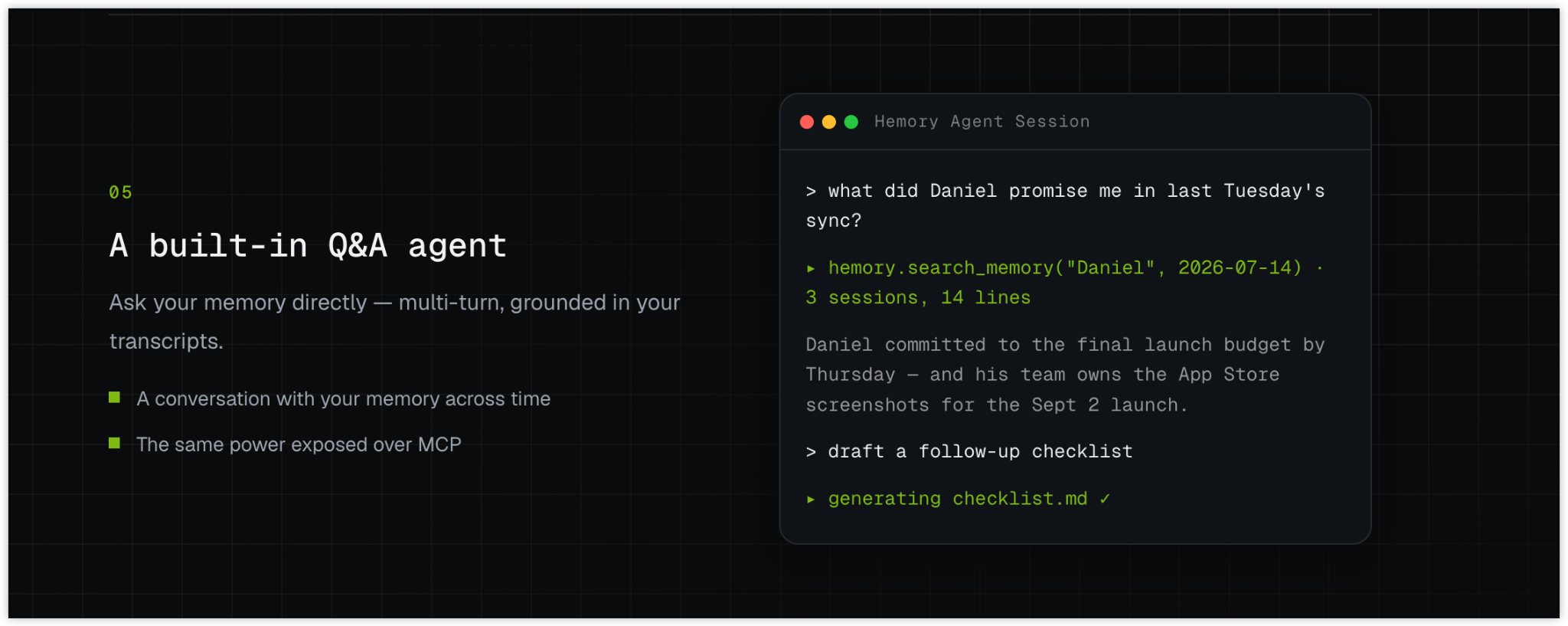
If the discussions were captured in Hemory, its built-in Q&A supports questions about your Memory, including transcript-based follow-ups across conversations. You can use it to look for discussions related to a decision and then review the relevant records. Treat what you find as material to examine, not proof that every relevant exchange has been retrieved or that a proposal was accepted. If an important detail has no usable record, consult another source or ask a focused follow-up.
The goal is not to turn every conversation into a formal log. It is to retain enough context to explain what was decided, how it developed, and what remains open when that explanation is needed.
FAQ
Is a decision history the same as a decision log?
Not necessarily. A decision log commonly gives a concise reference to decisions and their current status. A decision history also traces how a choice developed, including alternatives, rationale, and changes over time.
Does every discussion produce a decision?
No. A discussion can end with a proposal, a deferred choice, or an unresolved question. Record that status instead of implying agreement.
Does the newest mention replace an earlier decision?
Not by itself. Check whether the later statement addresses the same scope and was accepted as a change. A newer mention may add context without replacing the earlier agreement.
Can a summary show the full decision history?
Sometimes, if it preserves the relevant path and status. But a summary that records only the outcome may omit alternatives, conditions, or changes needed to explain how the decision developed.
To trace a decision, start with one specific question and gather the records that bear on it. Separate what was proposed, what was accepted, what later changed, and what is still open; that distinction is the foundation of a useful decision history.