

 Hemory Team
On this page
You are walking between two meetings when a useful idea arrives: a fix for the onboarding flow, a sentence for a proposal, a question to raise tomorrow. Typing it means stopping and looking at a screen. Sorting it into the right note or project is more than you want to do right then. By the time you reach a desk, the idea has shrunk to a vague sense that you had one.
This guide compares five low-effort ways to get a spoken idea down and judges each on three things: the effort it takes in the moment, how easily you can find the idea later, and how much control you keep over when capture starts and stops.
TL;DR
- Capture first and organize later. The best method is the one you will actually use within a few seconds, with your hands mostly free.
- A plain audio recording is the fastest to make and the hardest to search. Text from dictation or a transcript is easier to find but may cost more attention at the moment of capture.
- Start each spoken idea with a short label and use the distinctive words you would search for later. Those words become your retrieval clues.
- Prefer methods where you start and stop capture yourself, and stay mindful of anyone within earshot.
- A tool that captures and transcribes conversations, such as Hemory, makes sense when you want spoken ideas and the discussions around them searchable in one place. Only what you chose to capture can be found.
What a capture method has to do
An idea captured away from your desk has two jobs to survive: getting out of your head, and coming back when you need it. Most frustration comes from methods that do the first job well and the second badly.
| Criterion | What to ask |
|---|---|
| Effort at capture | How many taps, screens or decisions stand between the idea and the first spoken word? Can you do it while walking, with gloves on, or with one hand? |
| Finding it later | Can you search by what you said, or only scroll a list of files? Does the idea carry enough context that you will understand it in a week? |
| User control | Do you decide when capture begins and ends? Is it obvious when it is running? |
A fourth question is quieter: how much sorting does the method demand at the moment? Choosing a folder, naming a file or picking a tag are exactly the steps that make an idea fade. A good method lets you skip them.
Five ways to capture a spoken idea
The first four options are general approaches that most phones support in some form. The details vary by device and app, so treat the comparison as typical tendencies and check how your own tools behave.
| Method | Effort at capture | Finding it later | User control |
|---|---|---|---|
| Voice recorder app | Low: open, record, stop | Hard unless you name the file or the app transcribes it | Clear start and stop |
| Dictation into a notes app | Medium: needs a screen and a quick check | Good: it is searchable text | Clear start and stop |
| Voice message to yourself | Low if the chat is already open | Mixed: depends on whether the app transcribes and how crowded the chat is | Clear start and stop |
| Assistant or shortcut that creates a note | Very low once set up | Depends on where the note lands and how well it heard you | Triggered by you |
| Capture-and-search tool such as Hemory | Low: start listening, speak, stop | Searchable transcripts and question-based search over captured Memory | Manual start and stop |
Voice recorder app
This is the simplest option. You press record, speak and stop. Nothing is sorted and nothing needs to look right.
The cost arrives later. A list of audio files named by date tells you little, and unless the app produces a transcript you must replay recordings to find the one you want. If you use a recorder, say a label at the start of every recording and rename the file when you next have a moment. Otherwise it works best for ideas you expect to replay soon rather than search months from now.
Dictation into a notes app
Dictation turns your voice straight into text, which is searchable the moment it exists. That is its strength.
Its weakness is attention. You usually need to open the right note, watch the screen to see whether the words came out correctly, and fix names or terms the recognizer got wrong. It suits a quiet moment at a bus stop better than a brisk walk. It also tends to work best for one tidy thought, not for thinking out loud with false starts.
Voice message to yourself
Sending a voice message to yourself in a chat app is quick because the app is already on your phone and the gesture is familiar. For some people it is the lowest-friction option.
Retrieval is the catch. Voice messages sit among everything else in the thread, and whether you can search them by content depends on whether the app transcribes them. If your chat app does not, you are back to scrolling and replaying. If you use this approach, keep a dedicated chat with only yourself and begin each message with a label.
Assistant or shortcut that creates a note
Phone assistants and custom shortcuts can turn a spoken phrase into a note or reminder, with no screen needed. Once set up, this is as low-effort as capture gets.
The trade-offs are setup time and fidelity. Assistants are often built for short commands, so a long, rambling idea may be cut off or reworded. Check where the note actually ends up and read a few results before you trust the method with an idea you care about.
A capture-and-search tool such as Hemory
Hemory captures spoken conversations and turns each listening session into a timestamped transcript with speaker labels. You can then ask questions about your own Memory, including across sessions. Supported platforms include iOS and Apple Watch, and macOS, Windows/Linux, a web app and self-hosting are listed as coming soon.
For a spontaneous idea, the sequence is: start listening, say the idea, stop. In Manual Mode you start and stop listening yourself. Schedule Mode lets you set listening times and sends reminders with one-tap start and stop. In both modes the control stays with you, and nothing here means the microphone opens on its own.
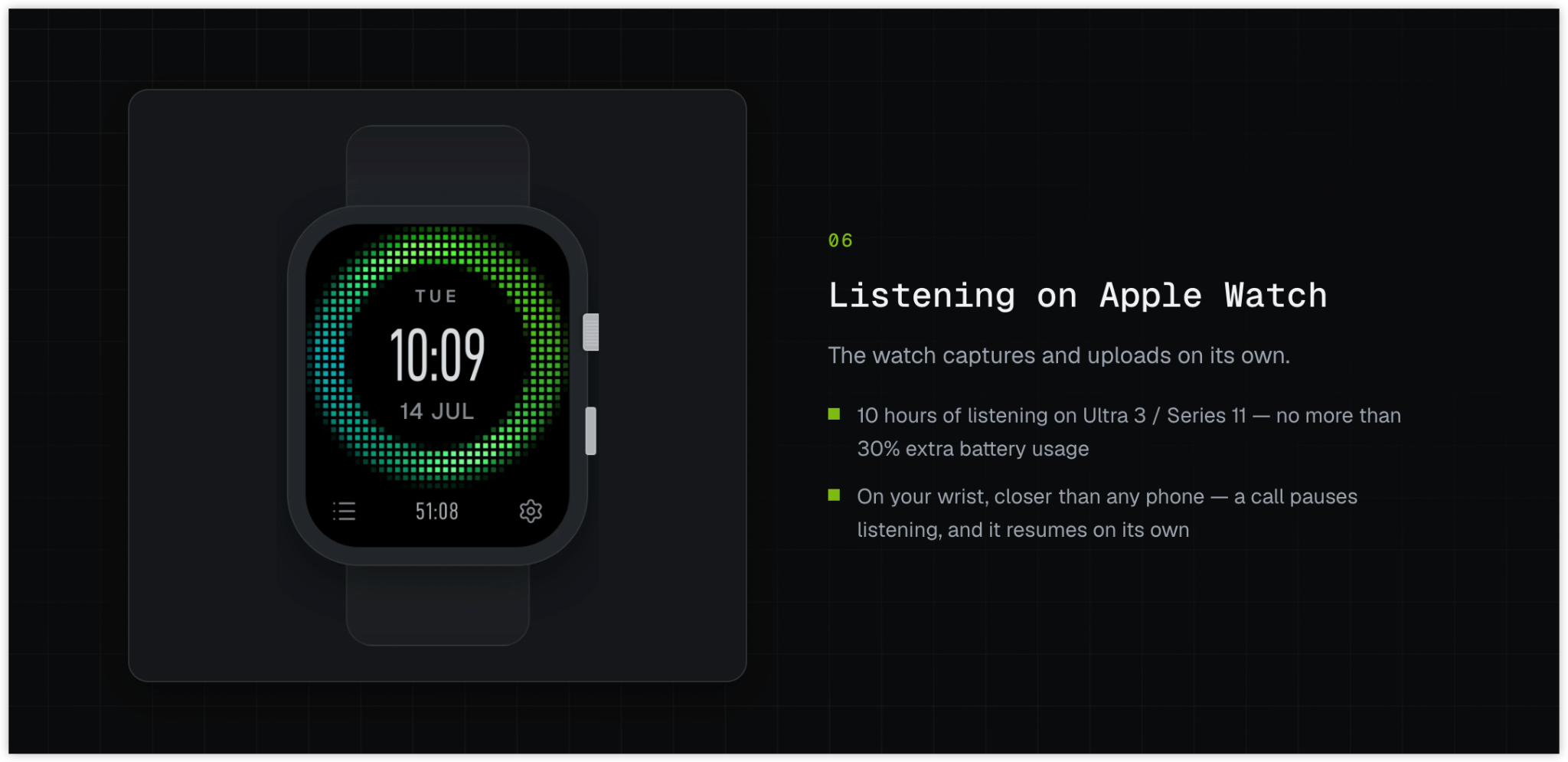
On Apple Watch, listening and upload can run independently of the phone, so you can capture without taking the phone out. Listening pauses during a phone call and resumes when the call ends.
The benefit is the same as with a transcript from any source, plus one extra: because your idea sits in the same searchable Memory as your meetings and other conversations, you can ask a question about it later instead of remembering which file or note it went into. The limits matter, though. Hemory can only search what was captured. It does not guarantee perfect transcription, and the quality of transcription in noisy streets or on transit is something to test for yourself before depending on it.
Make a spoken idea easy to find later
Whichever method you pick, the words you say decide how easily the idea can be found. These habits take a few seconds and cost no organizing effort.
- Open with a label. Say something like: Idea, onboarding emails. A label gives both you and a search a handle.
- Say what triggered it. One phrase of context, such as: after the call with the support team, saves you wondering later what you were reacting to.
- Use the words you would search for. If you will look for it by a project name, a customer, or a distinctive phrase, say it out loud rather than saying it or that thing.
- Name the next step if there is one. Say: follow up with Sam about this, or say that there is no action yet. Not every idea needs one.
- Do not stop yourself mid-thought to tidy. Thinking out loud is the point. A messy capture you can find beats a polished one you never made.
When you next sit down, skim what you captured. There is no required schedule. Open it when you want to work on something or when you suspect you have had a related idea before.
Searching by what you remember
With text or a transcript you can search for a word you remember saying. With a tool that supports question-based search, you can describe the idea instead. A question such as: What was the idea I had on my walk about onboarding emails? gives the search a topic and a setting. Treat the result as a lead, then read the surrounding transcript lines to confirm it is the idea you meant. If the transcript is unclear, replay the audio on the listening device where that is available.
If a search finds nothing, it does not prove you never had the idea. The capture may not have happened, the words may have been transcribed differently than you expected, or you may be using different terms than you spoke. Try a different word from the same moment.
Choosing a method
- You want the quickest possible capture and will replay it soon: a voice recorder, with a spoken label at the start.
- You are somewhere quiet and want clean, searchable text: dictation into notes.
- You are already in a chat app and want minimal change in habit: a voice message to yourself, in a dedicated chat, if your app transcribes.
- You want hands-free capture and are willing to set it up: an assistant or shortcut, checked against a few real ideas first.
- You want ideas, meetings and other conversations searchable together: a capture-and-search tool such as Hemory, using a platform it supports, accepting that only what you captured can be found.
Control deserves the last word. Choose a method where you decide when capture starts and stops, and where you can tell it is running. If other people are nearby and their voices could be captured, be considerate about it. Capturing your own thinking aloud is a different situation from capturing a conversation.
FAQ
Is dictation better than recording audio?
It depends on what you value. Dictation gives you searchable text immediately but asks for more attention while you speak. A recording is faster to make but is only easy to search if it is transcribed or well labeled.
Do I need to organize ideas when I capture them?
No. Skipping organization is what keeps capture quick. A spoken label, a clue about the context, and a few distinctive words are usually enough to find the idea later.
Does Hemory record all the time?
No. In Manual Mode you start and stop listening yourself. Schedule Mode sets listening times and sends reminders with one-tap start and stop. Only conversations and ideas that were captured can be searched later.
Can I use Hemory from my watch?
On Apple Watch, listening and upload can run independently of your phone. Check the current list of supported platforms for your specific watch and phone, because the listed platforms and device details can change.
Next step
Pick one method and try it on your next walk or commute. Judge it not by how pleasant the capture felt, but by whether you can find the idea when you next need it. If you cannot, change the method or the label you speak before changing anything else.

