

 Hemory Team
On this page
A useful detail from a conversation is easy to lose if you rely on memory or scattered notes. Building a searchable record starts with capturing the conversations you may need later. From there, transcripts and organized Memory give you material to search, and a careful review helps you decide whether a result answers your question.
TL;DR
- Capture the conversations you may want to revisit; an archive can only help with material that was recorded and is accessible.
- Hemory creates timestamped transcripts and organizes captured material into activity-based Memory. You do not need to sort every conversation manually.
- Use Hemory’s built-in Q&A to ask about your Memory across sessions. Refine a question with real clues, then review the transcript when wording, attribution, or status matters.
1. Choose how to capture conversations
Start by deciding which conversations are likely to matter later: for example, a planning discussion, a useful exchange with a colleague, or an idea you want to return to. You do not need to capture every interaction to make a useful record. A specific future question—such as what was proposed or why a choice was made—can help you decide what is worth preserving.
Hemory supports listening on iOS, Apple Watch, Android, and Wear OS. In Manual Mode, you start and stop listening yourself. Schedule Mode can remind you when it is time to listen and lets you start or stop with one tap. Choose the approach that fits the conversations you want to preserve and keep control of when listening is active.
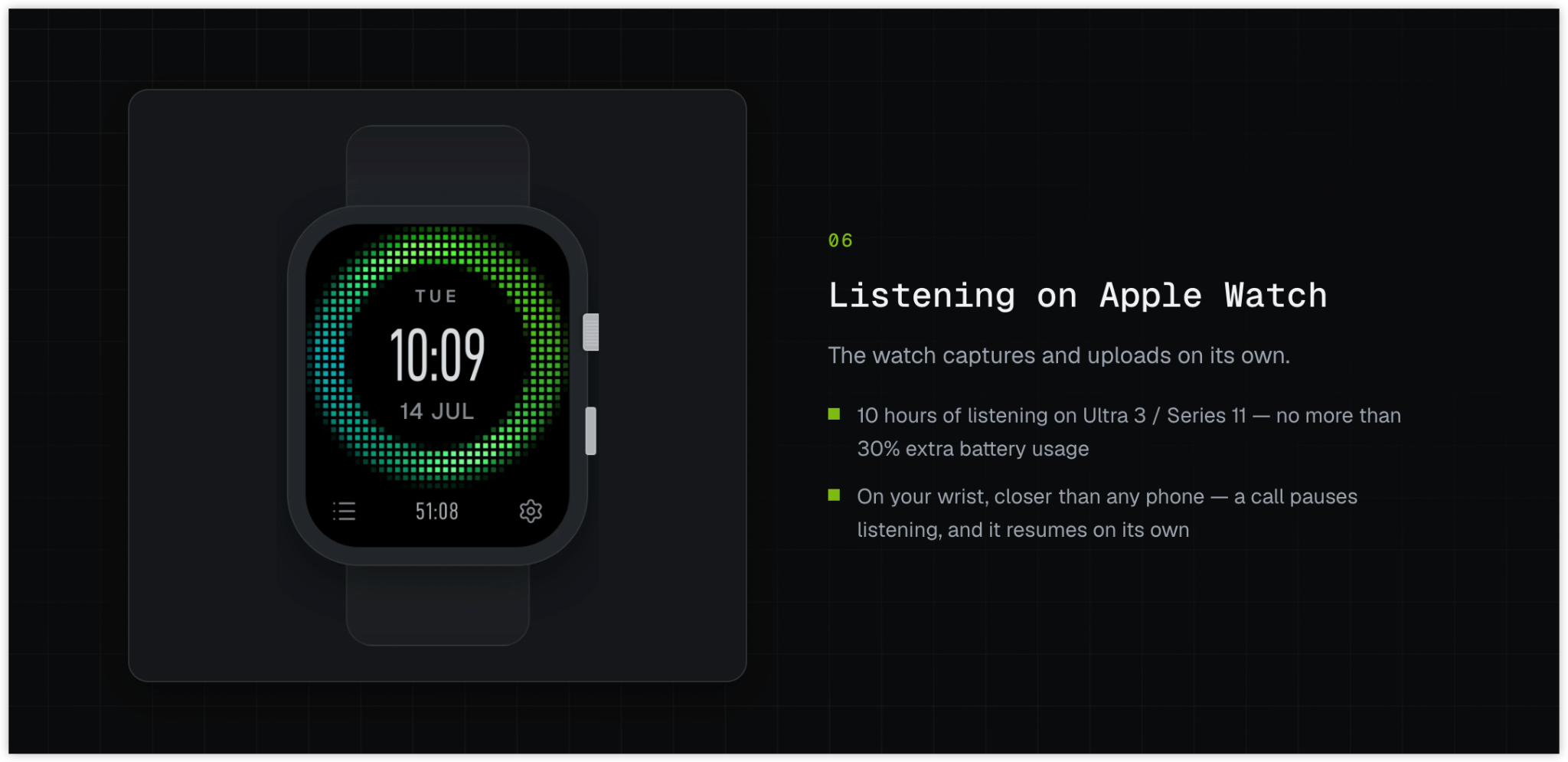
Hemory listening interface shown on Apple Watch.
Only captured and accessible conversations can appear in a later search. If you need information from an older conversation, do not assume it is already in Hemory; use a record or source that is available to you.
2. Let transcripts and Memory form
Once a listening session has been captured, Hemory produces a timestamped transcript with Speaker labels and organizes daily material by activity type. It also varies its summaries by activity: a meeting may receive structured notes, while a lighter conversation may receive a shorter summary. This gives you more than a pile of unlabelled text without requiring you to classify each item yourself.

Revisit daily conversations in an activity timeline.
During a conversation, focus on participating rather than trying to write down every potentially useful detail. The transcript and organized Memory can preserve points you might not think to note at the time. They are aids to recall, not a guarantee that every word or event was captured perfectly.
3. Ask a specific question across sessions
When you need something later, open Hemory’s built-in Q&A and ask about your Memory. It supports transcript-based questions and follow-ups across conversation sessions. Start with the person, topic, or detail you remember, and describe the question plainly rather than trying to reconstruct exact wording.
For example, you might ask, “What did Maya say about the launch date?” or “Which conversation mentioned the access issue?” Treat these as starting questions, not guaranteed search filters or promises that a match exists. If the answer is incomplete, refine it with a clue you genuinely remember, such as the project or the surrounding topic.
A useful lookup often needs only a couple of steps: ask the main question, then narrow it based on what the result brings back. Avoid adding guessed names, dates, or quotes just to make the query sound precise; an inaccurate clue can point you in the wrong direction.
4. Review the result before relying on it
A useful answer is a lead to the underlying record. If the detail affects a decision, quote, responsibility, or next action, open the relevant transcript and review the surrounding context. Check whether the speaker label is certain, whether the wording supports the conclusion, and whether a later conversation changed the status.
Timestamps help locate a point in the session, and transcript-line playback may be available on the listening device. Speaker labels can help with attribution, but they should not be treated as absolute proof of who spoke. Transcription and capture can also be imperfect, so review consequential details rather than treating a summary as a verbatim record.

Find individual statements in a searchable transcript.
If a search does not find what you need, that alone does not show whether the conversation was never captured, the clue was too broad, or the relevant detail was expressed differently. Try a different clue or consult another available record. If the point still cannot be established, ask someone with direct knowledge instead of filling the gap with a guess.
5. Make the archive useful for the next question
After a lookup, notice which clue helped you find the record. A project name, a person’s name, or the subject of a decision may be useful next time. You do not need to create a detailed index in advance: capture relevant conversations, ask about the information you need, and use the result to guide the next search.
The goal is a record you can return to—not a claim that every conversation is searchable or every answer is complete. Hemory can reduce the work of taking notes, organizing them, and retelling the background to yourself. You still decide which conversations to capture and whether a retrieved detail is reliable enough for the task at hand.
FAQ
Do I need to capture a conversation before I can search for it?
Yes. Hemory’s Q&A works with accessible captured Memory; it cannot retrieve an exchange that was never recorded there.
Does Schedule Mode start listening without any action from me?
No. Schedule Mode can send a reminder, and you use a one-tap action to start or stop listening. Manual Mode lets you control the start and stop directly.
Are transcripts and speaker labels always exact?
No. Transcripts and labels are useful aids, not guarantees of perfect wording or identity. Review the transcript context when exact wording or attribution matters.