 Hemory Team
On this page
You remember a customer explaining a budget constraint, but the wording matters now: was spending paused, or did a larger purchase need approval? A proposal is waiting on the answer.
Start with the people, topic, or time you remember and ask for the relevant discussion. Then follow one of two paths: recover the wording for a quote, or establish what was agreed and whether it changed for a decision. You do not need to reconstruct the whole meeting to recover the part you need.
TL;DR
- Use the clues you already have: who was involved, what the discussion concerned, and roughly when it happened.
- Ask a direct question first where conversation Q&A is available. Add keywords or a narrower time window when the result needs refinement.
- A quote needs accurate wording and attribution. A decision needs its outcome, conditions, and any later change.
- Hemory preserves and organizes captured conversations, so you can look for details you did not know you would need when they were spoken.
- Keep the useful result with enough source context to use it again; a full search log is rarely necessary.
Start with the detail you need
A vague request such as “Find the client conversation” leaves too much open. Combine the detail you need with whatever you remember:
What did Sarah say about the renewal budget in late August?
Or:
Why did we decide to keep manual invoice review for the first release?
These questions do not require the exact phrase, date, or meeting title. A person’s name, a project nickname, or an event such as “before the proposal went out” can provide a useful starting point.
In Hemory, the built-in Q&A agent lets you ask about saved conversation content and refine the request through follow-up questions. Its organized topics, people, and timeline also provide context for locating the discussion. Treat those details as search clues; you do not need to prepare a separate worksheet before asking.
If you already know the meeting, its summary can be the quickest route to the relevant topic. Open the surrounding discussion only when you need more detail than the summary provides.
Refine the search when the first result is too broad
Add one useful clue at a time. If you receive several renewal discussions, specify the customer or the approximate period. If the result covers the wrong issue, explain which aspect you mean: pricing approval, contract length, or the rollout date.
| What you remember | A useful follow-up |
|---|---|
| A person, but not the date | “Focus on Sarah’s comments about renewal approval.” |
| An event near the conversation | “Look at the discussions before we sent the first proposal.” |
| The topic, but not the wording | “I mean the restriction on new spending, even if nobody called it a budget freeze.” |
| A decision, but not its reason | “What concern led us to keep that step manual?” |
| Several possible matches | “Which discussion concerned the existing account rather than the new pilot?” |
Keyword search is useful when you remember a distinctive term or when a direct question has not located the passage. Try a project name, a specific deliverable, or a likely alternative phrase. If the client said “spending pause,” searching only for “budget freeze” may be too narrow in a tool that relies on literal matches.
For a long transcript, search within the relevant session rather than repeatedly scanning the whole archive. If an overly specific combination returns nothing, remove a term or widen the time period. The aim is to reach the right discussion, not to maintain a permanent inventory of successful queries.
For a quote, preserve wording and context
A usable quote includes the sentence, the speaker, and enough surrounding information to avoid changing its meaning. Read the exchange around the sentence, especially when it contains a number, a condition, or a reference such as “that option.”
Suppose a customer says:
“We can renew at the current level. Any increase needs finance approval.”
Summarizing this as “the customer has frozen the budget” would lose the distinction between renewal and additional spending. The full quote is more useful because it tells you what kind of proposal the customer can consider.
A compact record could look like this:
| Field | Example |
|---|---|
| Quote | “We can renew at the current level. Any increase needs finance approval.” |
| Speaker | Sarah, customer operations lead |
| Conversation | Renewal planning discussion, 27 August |
| Context | Asked whether the proposal could include additional seats |
| Use in the proposal | Present the current-level renewal separately from an expansion option |
Hemory’s transcripts include speaker labels and timestamps, making it easier to locate the surrounding exchange. If you need to reproduce exact wording externally and the original audio remains available locally, replay the key passage. When exact wording cannot be established confidently, use a clearly attributed paraphrase rather than quotation marks.
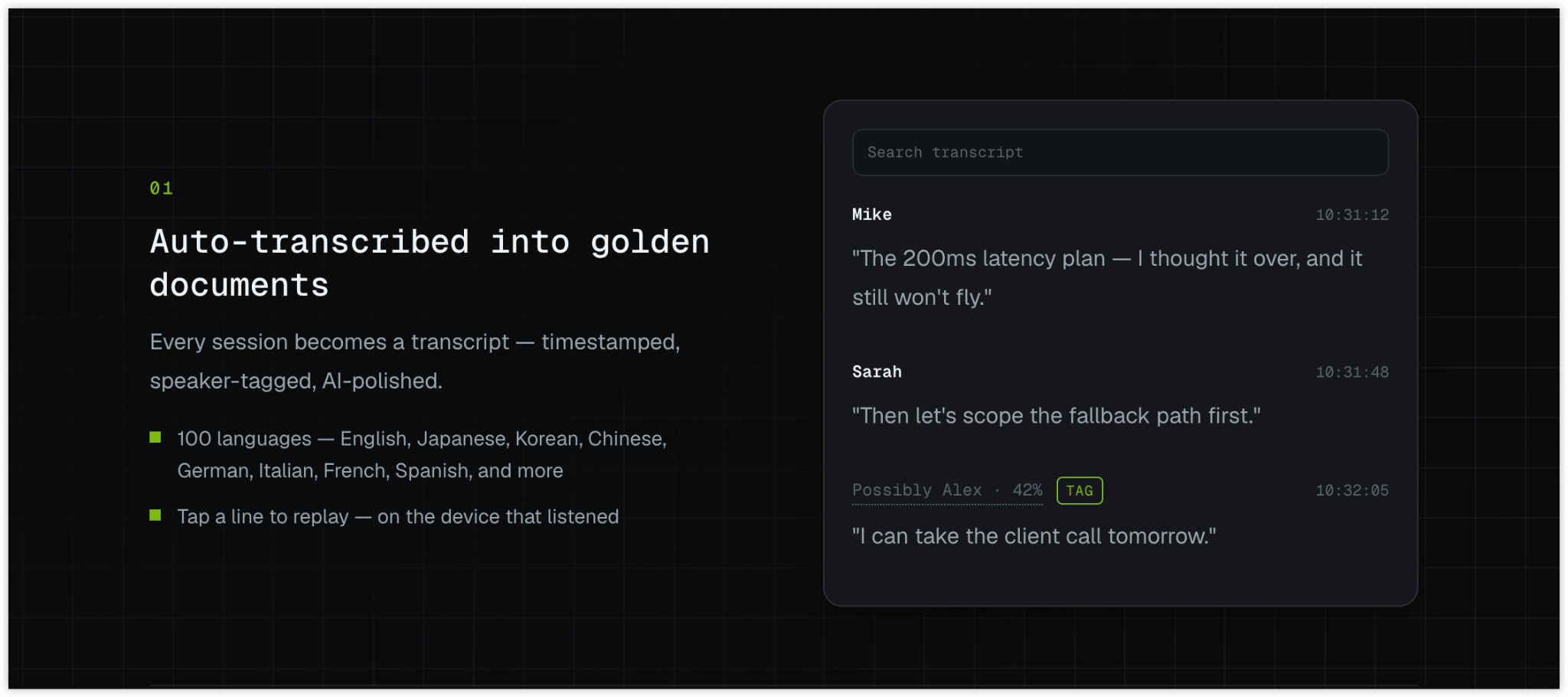
Do not turn every useful remark into a direct quote. A short paraphrase often works better in an internal brief. Reserve quotation marks for wording you intend to preserve exactly.
For a decision, establish what was agreed and what changed
Finding a sentence that sounds decisive is only the start. “We should use the existing supplier” could be a suggestion; a later reply may reject it or make approval conditional.
Look for the outcome of the exchange and preserve the reason where it affects later work. Then consider whether a subsequent discussion changed the decision.
| Part of the decision | What to capture |
|---|---|
| Outcome | What the participants agreed to do |
| Reason | The constraint or trade-off that shaped the choice |
| Condition | What must happen first, or what would prompt reconsideration |
| Date and source | When and where the agreement was made |
| Later change | A subsequent decision that replaces or modifies it |
For example, “keep manual invoice review for the first release” is incomplete without its condition. If the reason was an unresolved approval threshold, the team may revisit automation after that threshold is settled.
A useful follow-up request is:
Was that approach changed in a later discussion? Show me what changed and when.
Do not treat a lack of later results as proof that no change occurred. When the decision affects a current commitment, confirm unresolved changes with the responsible person. Often the saved discussion will be enough to explain the original reasoning; the extra check is needed only when the current position remains unclear.
Keep a result you can use
Put the recovered information where the current task already lives: a proposal note, a decision record, or a follow-up brief. Include enough source information to find the exchange again.
For a quote, keep the wording, speaker, and surrounding meaning together. For a decision, state the agreed action, its reason and conditions, and any relevant later change. A useful decision note might read:
Keep invoice review manual for the first release because the approval threshold is unresolved. Revisit automation once that threshold is agreed. Source: release-planning discussion on [date].
That note gives the next reader a usable answer without sending them through the whole meeting. If the discussion also assigned follow-up work, add the owner and timing to your action list.
An AI agent connected to Hemory can also use the retrieved discussion in a proposal or brief. That is a next use of the information; the retrieval task is complete when you have a quote or decision you can accurately explain and reference.
To turn that context into a plan for your next conversation, use it to prepare a client follow-up call.
If the conversation was never captured
Use the records that do exist: meeting notes, a follow-up email, a message, or a colleague’s recollection. Make the source clear. A note saying “Sarah raised budget concerns” is useful background, but it is not enough to present an exact quotation.
For an important unresolved detail, ask a focused question: “Was the restriction on all renewal spending, or only on an increase?” That is easier to answer than asking someone to retell the whole conversation.
Going forward, capture appropriate discussions as they happen. With Hemory recording and organizing the exchange, you can stay involved in the conversation instead of deciding which sentences might be needed months later. The information that turns out to matter can then be recovered when a real task calls for it.
FAQ
What if I remember the topic but none of the exact words?
Describe the topic in a direct question and add any person, project, or approximate time you remember. In a keyword search, try alternative terms. In Hemory Q&A, explain what you mean and refine the question if the first answer concerns a different discussion.
Should I use a quote or a summary of the decision?
Use a quote when the person’s wording matters, such as a customer requirement or objection. Use a decision summary when the reader needs to know the agreed action and its conditions. A single sentence can serve as evidence without being the clearest way to communicate the whole decision.
What if the transcript and my notes disagree?
Read the surrounding exchange and check whether one record reflects a later change. If audio is available, replay the disputed wording. When the difference still affects an active commitment, ask the person involved to clarify it. Keep the uncertainty attached to that detail rather than treating the entire record as unusable.
The next time a detail seems just out of reach, start with the question you need answered. Hemory keeps captured discussions available for that moment, helping you move from a vague recollection to a quote, a decision, or a draft you can use.