Hemory Team
On this page
A spoken commitment is easy to misremember when no email or task records it. You may recall that someone offered to do something, but not whether they agreed, what conditions they mentioned, or when they said they would do it. The useful next step is to find the exchange and check its wording before assigning work or following up.
TL;DR
- Search only conversations that were captured and are accessible to you. A search cannot recover an exchange that was never recorded.
- Treat a search result as a lead. Read the surrounding transcript to distinguish an accepted commitment from a suggestion, request, or open question.
- Record the owner, action, conditions, and deadline only when the conversation supports them. If any detail is missing, leave it open and ask rather than guessing.
1. Search for the likely conversation
Start with what you remember: the project, topic, people involved, approximate time, or a distinctive phrase. You do not need to know every detail. The point is to narrow the search enough to find a likely exchange, not to reconstruct the conversation from memory first.
The material might be in a CRM, notes, a transcript archive, or another record. If the conversation was captured in Hemory and is accessible there, you can ask its built-in Q&A Agent a focused question about your Memory. For example:
Find the conversation where we discussed the revised launch figures. What did anyone agree to do, and was a deadline stated?
Include a useful clue if you have one, such as a project name or approximate period. Hemory’s built-in Q&A supports questions grounded in transcripts across past sessions, but a result is a place to investigate—not proof that every relevant conversation was found.
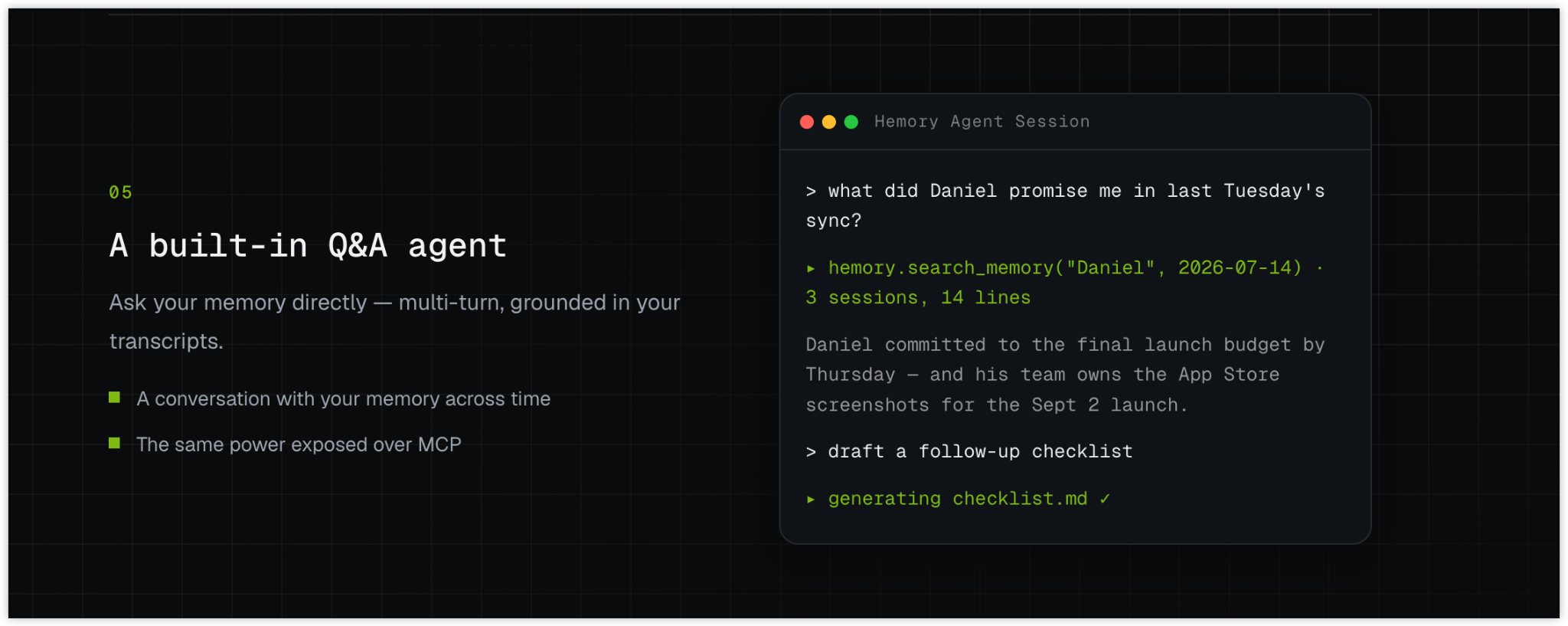
If the search returns a likely session, open its transcript. If it returns nothing useful, try a different clue or check another available source. A failed search does not establish that no agreement was made; the conversation may not have been captured, may be hard to identify, or may not be accessible through that search.
2. Read the exchange in context
Find the relevant passage and read enough of the surrounding conversation to understand what the speakers meant. A short answer or summary can help locate a topic, but the exchange may include a condition, a correction, or a later clarification that changes what you should do.
Hemory produces timestamped, speaker-labeled transcripts, and transcript lines can be played back on the listening device. Transcription and speaker labels can still be imperfect. If the wording or attribution matters and playback is available, use it to check the passage. Otherwise, preserve uncertainty instead of treating a transcript as infallible.
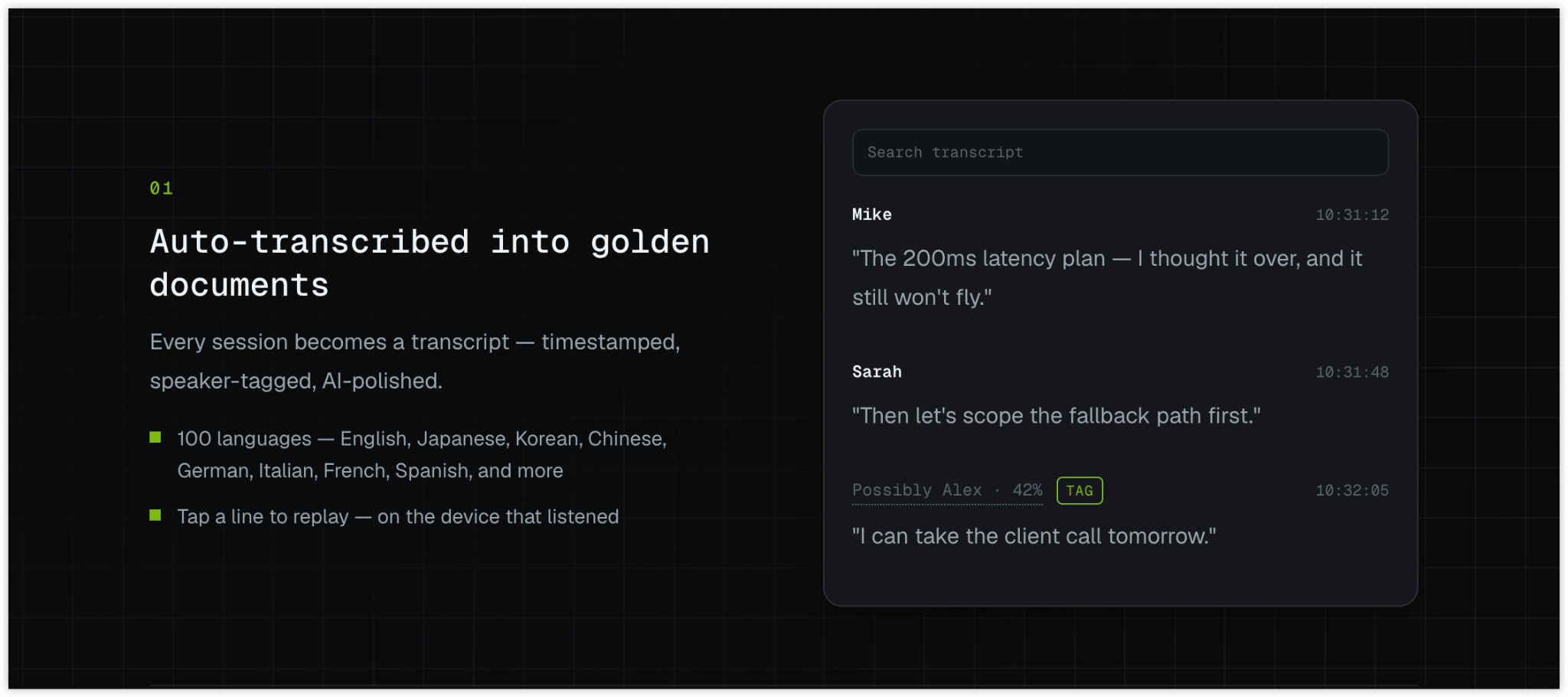
Ask these questions as you read:
- Was there an accepted commitment? A suggestion, request, or “we should” is not necessarily an agreement. Look for evidence that the person accepted the action.
- Who accepted it? A person being mentioned or attending the conversation does not make them the owner. Check who actually undertook the work.
- What exactly did they agree to do? Keep the action specific enough to distinguish it from the broader topic.
- Was the commitment conditional? Preserve prerequisites or limits. “I’ll send the revised figures after finance approves them” is different from an unconditional promise to send them.
- Was a deadline stated? A commitment can be real even when no date was given. Do not turn “soon” or “after approval” into a calendar date.
3. Record what the conversation supports
Once you have checked the exchange, write a compact record that separates established details from unresolved ones. For example:
| Field | What to record |
|---|---|
| Action | The work the person accepted |
| Owner | The speaker who accepted it, if clear |
| Deadline | The stated date or timing; otherwise, “not stated” |
| Condition | Any prerequisite or limitation |
| Evidence | The conversation date or a useful transcript reference, if available |
| Open question | Any detail that needs clarification |
Consider an exchange where one speaker says, “I’ll send the revised figures after finance approves them,” and no date is mentioned. A careful record would be:
Action: Send the revised figures. Owner: The speaker who said “I’ll send,” if their identity is clear. Deadline: Not stated. Condition: After finance approves the figures. Open question: When approval is expected, if timing matters.
This record preserves the commitment without inventing a due date or implying that finance has already approved the figures. If the speaker is unclear, leave the owner unresolved too.
4. Confirm what is still uncertain before acting
Use the record to decide what the next step should be. If the action, owner, and timing are clear enough, add the commitment to the appropriate task or follow-up process. If an important detail is missing, ask a focused question—for example, “You agreed to send the revised figures after approval. What date should I plan around?”
Keep the states distinct: prepared is not sent, sent is not received, and received is not approved. A past commitment also does not establish that the work has since been completed. Check a current update before describing its status.
If someone needs to act on your finding, share the relevant details in the usual work channel. A conversation reference alone may not give them access to the source, so include the action, condition, and any unresolved question they need.
Make spoken agreements easier to recover
When conversations are captured, organized transcripts can reduce the need to rely on memory or write down every potentially useful detail while people are speaking. Later, a focused search can help locate an exchange; checking the transcript helps you decide what it actually supports. This works only for captured and accessible conversations, and you remain responsible for confirming the commitment before acting.
Start with the next commitment you are unsure about: find the likely exchange, check the wording and context, and record only what is established. If the conversation does not settle the owner or deadline, make that uncertainty explicit and ask the person directly.
FAQ
Can I tell whether someone made a commitment or only suggested an idea?
Look for whether the person accepted a specific action. A suggestion or request alone does not establish agreement. Read the surrounding exchange and preserve uncertainty if acceptance is unclear.
What if the conversation has no deadline?
Record “not stated.” A missing deadline does not erase an accepted commitment, but it also does not give you a date to infer. Ask for timing if the work needs one.
Can Hemory find a conversation that was never captured?
No. This method relies on conversations that were previously captured and are accessible in the source you search. For an uncaptured exchange, check another record or ask someone who was there.
Does a search result prove that I found every relevant commitment?
No. A result can point you to useful evidence, but it does not establish that every relevant exchange was captured or found. Check the likely conversation and use other available sources when the record remains incomplete.