

 Hemory Team
On this page
A weekly report can be easy to write and still leave out important work. Personal recollection is selective, notes capture only what someone thought to record, and meeting summaries may not cover conversations outside formal meetings. The right source depends on what the report must explain and which gaps would matter.
TL;DR
- Use recollection for a quick personal recap, but support consequential claims with records.
- Personal notes and meeting summaries are useful when their coverage matches the report; neither should be assumed to contain every relevant detail.
- Retrieved conversation memory can reduce the need to retell captured discussions to an AI agent. It cannot supply conversations that were never recorded or are outside the agent’s access.
- For recurring reports, choose sources by section, then review the draft for missing context, current status, and claims that need confirmation.
Compare the four source approaches
| Source | What it can contribute | Main omission risk | Effort and best fit |
|---|---|---|---|
| Personal recollection | A quick account of what stood out and what seems important now | Details fade or are recalled unevenly; something memorable may not be the most useful evidence | Low preparation effort. Works for a short personal update, especially when the stakes are low. |
| Your own notes | Details you chose to record, such as progress, blockers, or follow-ups | Selective or sparse notes may miss the reasoning, conditions, or developments behind an item | Moderate effort during the week. Works well when you already keep concise, relevant notes. |
| Meeting summaries | Structured records of formal discussions, such as topics, decisions, and action items | Informal conversations and other work between meetings may not appear; a summary may also omit detail you need | Low effort if summaries are available and cover the report’s subject. Useful for decision- or meeting-centered updates. |
| Retrieved conversation memory with an agent | Details from captured conversations that the connected agent can access and retrieve for the task | Uncaptured conversations and material outside the agent’s access remain unavailable; retrieved context still needs review | Less manual retelling when relevant context is already captured and accessible. Useful when a report draws on several discussions. |
These are tendencies, not guarantees. A well-maintained note or project record may be more useful for a particular report than a transcript or summary. Compare sources by what they actually contain, how current they are, and whether the right people can access them.
When each source is a good fit
Personal recollection: fast, but best for a light recap
Start from memory when you need a short account of your own week and the details are familiar. It can help you identify what deserves attention, but it is a weak sole source when the report needs exact decisions, conditions, dates, or status changes.
If you remember an important outcome but not its details, consult a record or ask someone who was involved. A confident recollection is not the same as a current confirmation.
Your notes: useful when they match the report’s scope
Notes can be an efficient primary source if you regularly record the information your report requires. Before relying on them, consider what you tend to capture: completed work, unresolved blockers, decisions, or next steps. If the report asks about a category your notes rarely cover, fill that gap from another source rather than treating silence as proof that nothing happened.
Keep notes brief if that makes them sustainable. The goal is not to record every conversation twice; it is to preserve the details that would be costly or difficult to reconstruct later.
Meeting summaries: strong for formal discussions, limited to their coverage
Meeting summaries can make formal decisions and action items easier to find. But a week’s work may also include quick conversations, work sessions, or informal exchanges that do not produce formal meeting notes.
A summary is useful only for the material it covers. If an item in your report depends on a conversation outside that coverage, find another record or ask a focused follow-up. Do not assume that a missing point was never discussed simply because it is absent from the summary.
Retrieved conversation memory: helpful when reports draw on captured discussions
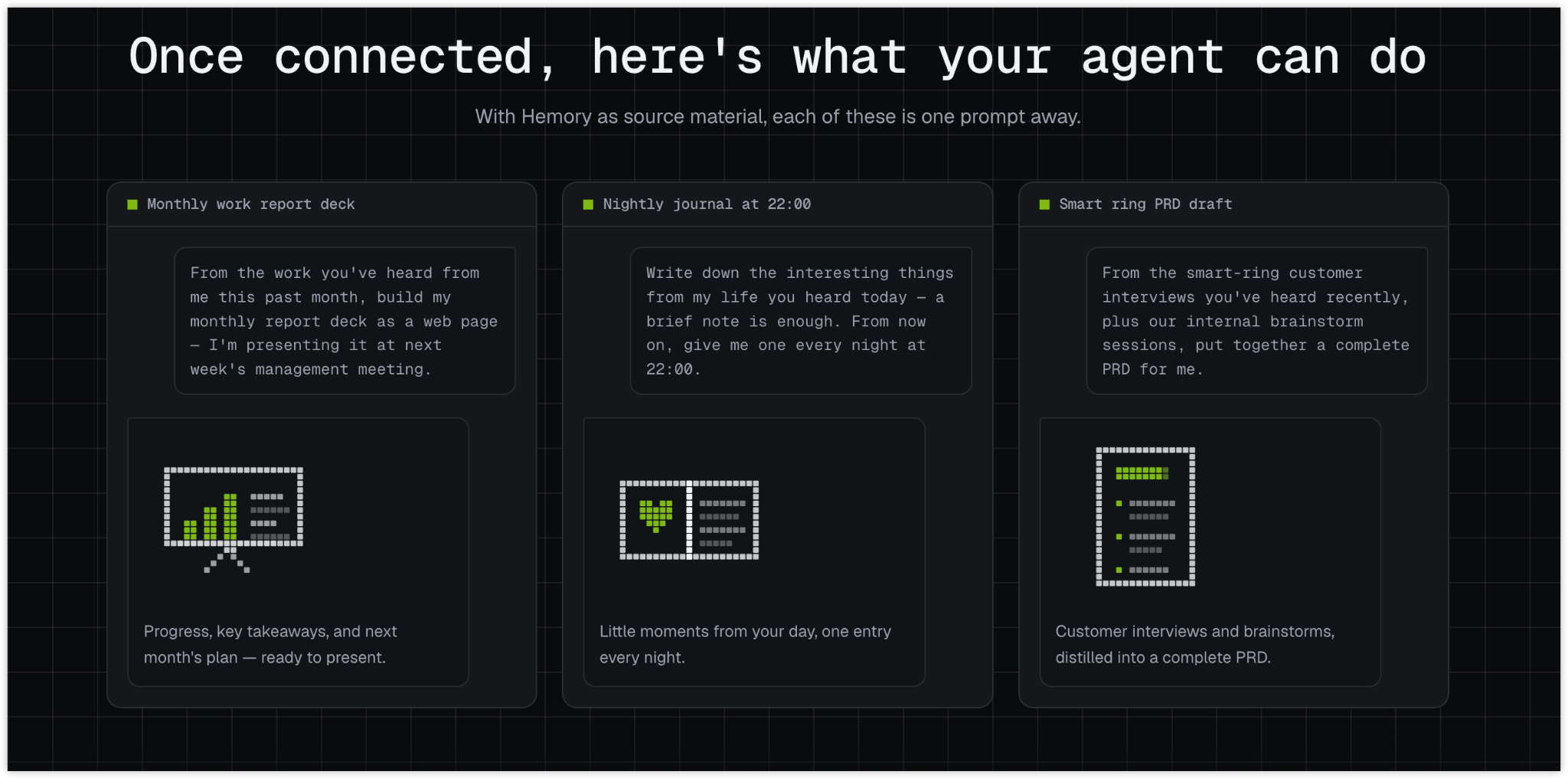
If relevant discussions were captured in Hemory, its Memory can give a supported connected agent conversation context to retrieve through MCP, within that agent’s access scope. The agent can use the accessible context while drafting, reducing the need for you to assemble and retell every discussion manually. The agent generates the report; you provide the reporting goal and current information, then review the result.
Turn saved context into reports, journals, and product requirements.
Hemory classifies captured daily content into activity types, with different levels of summary: meetings may receive structured notes, while lighter activities receive lighter records. So do not assume every conversation becomes formal meeting minutes or contains the same level of detail. Retrieved material also depends on what was captured and what the connected agent can access. It is not a guarantee that every relevant exchange or omission will be found.
Choose sources by report section
A weekly report often combines different kinds of information. For each section, ask what evidence would support it and which source is most likely to contain that evidence.
| Report section | Useful source questions |
|---|---|
| Work completed | Is there a current work record, a note, or a captured discussion describing what was actually finished? Does the evidence distinguish work in progress from completed work? |
| Decisions and changes | Where were the decision, its conditions, and any later accepted changes discussed? Is the record current enough to describe the present state? |
| Blockers | Does the source explain what is blocked and what dependency remains, or merely mention a problem? |
| Next steps | Is an owner or deadline actually established, or would the report be turning a suggestion into a commitment? |
The best source may differ by section. A project record might confirm current status, meeting notes might explain a decision, and retrieved conversation context might restore the reasoning or detail behind a change. Use sources that add evidence; avoid repeating the same account in several forms without a reason.
Use a lightweight weekly reporting workflow
- Define what the report needs to say. Use a consistent outline if it helps, such as progress, decisions, blockers, and next steps. Keep only sections that serve the report’s readers.
- Start with the records you already maintain. Check relevant notes, meeting summaries, or project documents. They may already cover the week well enough.
- Find consequential gaps. Look for sections with missing evidence, unclear conditions, or a status that may have changed. A blank source is a reason to investigate, not proof that no work happened.
- Retrieve conversation context where it can fill a gap. If relevant discussions were captured in Hemory and are accessible to a supported connected agent, ask the agent to use that context for the report. Supply the reporting period, audience, and any current instructions or metrics it cannot retrieve. Do not assume the agent can access every record or an uncaptured exchange.
- Review the draft before sharing. Check whether each claim is supported, whether proposals are distinguished from accepted decisions, and whether “prepared,” “shared,” or “approved” describes the actual state. Confirm current status with the responsible person or system when the report will guide action.
If one source already supports a simple update, use it. Add another source when it is likely to change the report’s meaning or resolve a consequential gap—not just to make the process more elaborate.
Choose a source mix, not a universal winner
For a short personal recap, recollection and a few notes may be enough. For a report focused on formal decisions, meeting summaries can be a practical starting point. When the report spans informal conversations and several work discussions, captured conversation memory may help an agent recover context without requiring a complete manual retelling. For current metrics, ownership, or approvals, consult the relevant current record or person.
Try the approach on one reporting cycle. Note which sections were difficult to support and what extra work you had to do. Keep the sources that reliably provide useful evidence, and change the mix when the report’s audience or purpose changes. If you use Hemory, the benefit is less manual compilation of captured discussion context—not a guarantee that the report is complete or correct.
FAQ
Do meeting summaries cover everything needed for a weekly report?
Not necessarily. They can help with formal meeting topics, decisions, and action items, but they may not cover work or conversations outside those meetings. Check whether their actual coverage matches the report’s sections.
Is personal memory enough for a weekly report?
It can be enough for a brief, low-stakes recap. For decisions, conditions, current status, or other details that matter to the next action, consult a relevant record or ask for confirmation.
Can an AI agent write a weekly report from conversation memory?
An agent can draft from conversation context it can retrieve, but the discussions must have been captured and accessible through its supported connection. Provide the reporting goal and current information the agent cannot retrieve, then review the draft before sharing.
Should I summarize every conversation before asking an agent to draft?
No. If a supported connected agent can retrieve relevant captured context, you do not need to compile a complete manual summary first. Supply the task and necessary current details, and check the draft for gaps that could change the report.
For your next report, start with the sources you already trust, identify one meaningful gap, and add another source only if it can resolve that gap. That keeps the process proportionate while showing whether captured conversation context would reduce the retelling your reports require.