 Hemory Team
On this page
In this guide, conversation memory means preserving spoken discussions in a form you can search and use later. It lets you return to what someone said, the reason behind a choice, or a condition that did not make it into the meeting notes.
A transcript, a summary, and a searchable memory each contribute something different. Understanding how they fit together helps you decide what to keep and how to find a useful detail when a new question comes up.
TL;DR
- Transcripts, notes, and conversation memory serve related purposes. A transcript preserves the exchange; notes highlight selected points; organization and retrieval make the material easier to reuse.
- Useful recall includes context: a reason, condition, or unresolved question can matter as much as the final decision.
- Hemory captures real-world conversations and organizes them into Memory, reducing the need to take notes, summarize discussions, and restate the background for AI.
- A supported AI agent connected to Hemory can use that context when helping with a brief, proposal, or other follow-up work.
How conversation memory works
Think of the process in three parts: preserve the discussion, organize it, and retrieve what matters for a later task. These are functions that can work together, rather than three competing kinds of document.
| Part | What it does | Why it matters later |
|---|---|---|
| Capture and preservation | Keeps the spoken content in a record, such as a transcript | You can return to details that did not make the summary |
| Organization | Brings together topics, participants, decisions, action items, and open questions | You can understand the discussion without starting from the first line |
| Retrieval and reuse | Finds relevant context for a question or a new task | You can explain a choice, prepare a follow-up, or give an AI agent useful background |
A transcript supplies much of the underlying material. A summary provides a useful overview. Retrieval helps you move from a new question to the relevant part of the earlier discussion.
For example, “What did the customer say about receiving deliveries?” is a different question from “What were the meeting’s action items?” Both may use the same conversation, but they need different details from it.
How it relates to transcripts and meeting notes
A transcript preserves the sequence and wording of an exchange. That is useful when a condition was explained across several remarks, or when you need to distinguish a customer’s words from your interpretation. Transcripts can also be searchable and summarized; they are not inherently passive or difficult to use.
Meeting notes are selective. Good notes can make decisions, rationale, and next steps very clear. Their strength is the judgment involved in choosing what to retain. Their limit is that you may not yet know which details will matter to a future task.
Conversation memory combines preserved content with ways to organize and retrieve it. It can support both a concise overview and a return to the fuller exchange. You do not have to choose between a useful summary and access to the discussion behind it.
| What you need | What helps most |
|---|---|
| A quick overview of the meeting | A summary or well-written notes |
| The wording of a customer’s requirement | The relevant transcript passage and its context |
| The reason an option was rejected | The discussion of the trade-off and its conclusion |
| A detail that seemed unimportant at the time | A preserved conversation that includes more than the selected notes |
| Background for a new piece of work | Retrieval of the relevant context, followed by a task-specific brief or draft |
The quality of the record still matters. Search cannot recover a remark that was never captured, and a summary cannot turn a suggestion into an agreement. Transcription and generated answers can also miss a detail. When a particular phrase or condition changes your next step, return to the surrounding exchange; you do not need an exhaustive transcript review for every task.
Example: a detail matters after the meeting
During a customer interview about warehouse deliveries, a supervisor mentions that staff scan labels while cartons are stacked. Labels placed only on top are hard to reach. The conversation then moves on to delivery times and missing items.
Weeks later, you are preparing a packaging brief. The interview notes emphasize delivery scheduling, but the label-placement detail now matters to the design.
If the interview was captured in Hemory, you can ask:
What did the warehouse supervisor say about scanning labels on stacked cartons? Include the practical problem and any placement preference they mentioned.
That question brings the earlier discussion into the current task. You can use the context to distinguish three things:
| Item | How to use it in the brief |
|---|---|
| Customer observation | Top-only labels are difficult to scan when cartons are stacked |
| Design implication | Explore label placement that remains accessible on stacked cartons |
| Open validation | Confirm the proposed placement with warehouse users before treating it as an approved requirement |
The conversation provides the reason to investigate a design change. It does not by itself prove that a particular design has been approved.
The benefit is that you did not need to anticipate the packaging project during the interview. You could concentrate on understanding the customer, then recover the relevant detail when it became useful.
How Hemory connects the record to later work
Without a captured interview, you may have to remember the label-placement remark, locate your notes, and write an explanation before an AI tool can use it. Hemory handles capturing and organizing the spoken discussion, preserving details beyond the selected meeting outcomes.
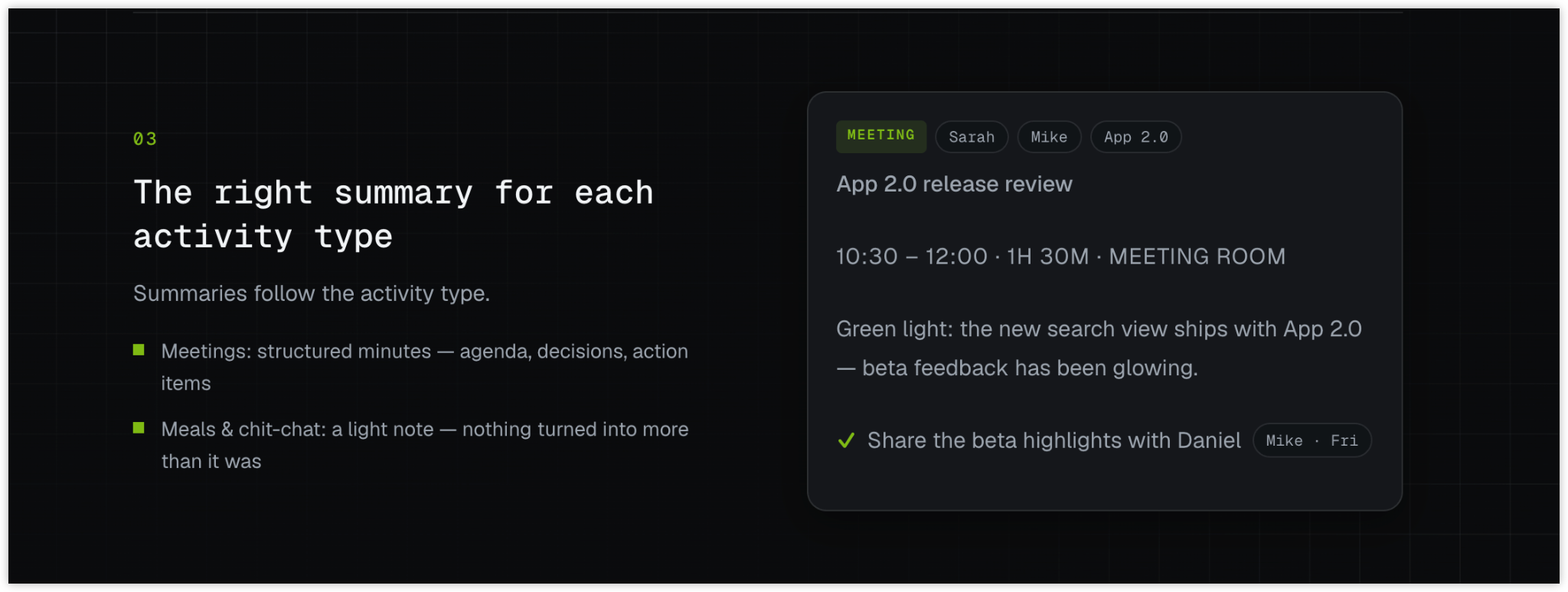
Hemory’s organized Memory and Q&A help you return to the relevant detail. Through a supported Model Context Protocol (MCP) connection, an AI agent can also use the interview when you ask, “Explain the label-scanning problem for a packaging brief, separating the customer’s observation from ideas we still need to validate.”
The preserved record supplies what was said. Retrieval selects the material relevant to the new question. The agent helps express it for the new task. You decide what design changes the observation justifies. These are connected functions; a summary alone does not have to anticipate every future use.
Which part do you need beyond your current notes?
Start with what your existing records already do well. Clear notes may be enough when you need only the agreed actions. A searchable transcript may be enough when you know the session and need to find a particular phrase.
Organization and retrieval become more useful when you remember a topic but not the meeting, or when a later question needs details omitted from the summary. In the warehouse example, the new question concerns label scanning, even though the interview notes focused on delivery scheduling.
If the discussion was never captured, the first improvement is to preserve similar conversations going forward. If it was saved but is difficult to use, the question is how to organize and retrieve what is already there.
For examples of applying saved discussions to research, decisions, and new drafts, see how searchable memory supports later work. This distinction between preserving the material and using it helps you choose the improvement your work actually needs.
FAQ
Is conversation memory the same as recording a meeting?
Recording captures the conversation. Conversation memory also involves making its content accessible for later use, through transcripts, organization, and retrieval. Keeping an audio file alone does not provide all of those functions.
Does it replace meeting notes?
It can reduce the need to manually capture and summarize every detail. Notes can still be useful for your own judgments, priorities, and shared decisions. The preserved conversation gives you somewhere to return when a later question goes beyond those selected points.
How is this different from an AI chat remembering my preferences?
The distinction is the source of the context. An AI chat may retain information you have supplied in that environment. Hemory captures real-world spoken discussions and makes their content available for later retrieval and use with supported agents. It addresses the work of getting those conversations into AI in the first place.
Do I need to summarize a conversation before using it with an agent?
Hemory already organizes captured discussions. With a supported connection, an agent can use that available context for your task. Give it the desired outcome and any current information it cannot access; you do not need to rewrite the whole conversation as background first.
Explore Hemory’s capture, memory, and AI features if useful context in your work often stays in the room after the discussion ends.