

 Hemory Team
On this page
Choosing between a watch and a phone for recording conversations depends on what is most likely to interrupt your day: a device running low on battery, needing to handle a call, or being inconvenient to start and carry. No single device is best for every situation. Compare the battery you can spare, how you want to start and stop listening, and where you need the transcript afterward.
TL;DR
- A watch is worth considering when hands-free access and keeping the device close matter most. Check its listening duration against your specific watch model and day.
- A phone may be the more practical primary device when it is already at hand or when you rely on familiar controls. Test what happens during calls on your particular phone and app.
- Don’t assume the transcript will appear on a paired device just because the recording was captured by a watch. Confirm where you can retrieve it before choosing a device for important conversations.
- Use one device as your default and switch when the setting calls for it. If you use Hemory, its supported platforms include iOS, Apple Watch, Android, and Wear OS, but behavior can differ by platform.
Compare the devices on the work you need to do
A device is useful for recording only if you can start listening when the conversation begins, keep it running for the time you need, and retrieve a usable record afterward. Compare the actual devices and app setup you use; general impressions such as “watches are convenient” or “phones have better batteries” don’t settle the decision for a particular day.
| Criterion | Watch may suit you when… | Phone may suit you when… | What to establish |
|---|---|---|---|
| Battery | You want a device you can wear through the conversation and have checked its listening capacity for that model. | You know how much of the phone’s battery you can spare alongside its other daily uses. | Test the listening period you actually need; don’t compare figures from different devices or conditions as if they were equivalent. |
| Convenience | Keeping the recorder close and using it hands-free makes it easier to take part in the conversation. | Your phone is already accessible and its controls are easy to use in the setting. | Practice starting and stopping before relying on either device. |
| Interruptions | You have checked what the watch does when a call or other interruption occurs. | You have checked how the recording app behaves when the phone receives a call or you switch tasks. | Confirm whether listening pauses, resumes, or needs your attention. Behavior can depend on the device and app. |
| Transcript access | You can retrieve the resulting record where you need it after using the watch. | The transcript is available on the device or in the workflow where you plan to review it. | Check the actual destination and access route, not just where recording started. |
Battery: compare your own listening window
Start with the longest stretch you expect to record and the battery you need to keep for the rest of the day. A watch may be convenient for a short conversation but a poor choice for an all-day schedule if its available battery cannot cover the listening time you need. The same practical question applies to a phone that must also remain available for other work.
Hemory’s product information lists 10 hours of listening for Apple Watch Ultra 3 and Series 11, among the models mentioned, with up to 30% additional battery consumption. Treat that as model-specific product information, not a universal watch figure or a direct comparison with a phone. It does not establish listening duration for every watch model, phone, or usage condition.
Before making a device your default, try a representative session and note the battery level before and after. Repeat under the conditions that matter to you, such as a longer meeting or a day when you use the phone heavily. If you cannot spare enough battery on either device, choose a different recording window or device rather than relying on an untested estimate.
Convenience: choose the device that lets you participate
A watch can keep recording controls close without requiring you to hold a phone. Hemory describes Apple Watch as easier to keep close than a phone and supports independent listening and upload from the watch. That can be useful when handling a phone would distract you from asking questions, brainstorming, or listening. It is a convenience consideration, not proof that every watch setup is more discreet or appropriate in every conversation.
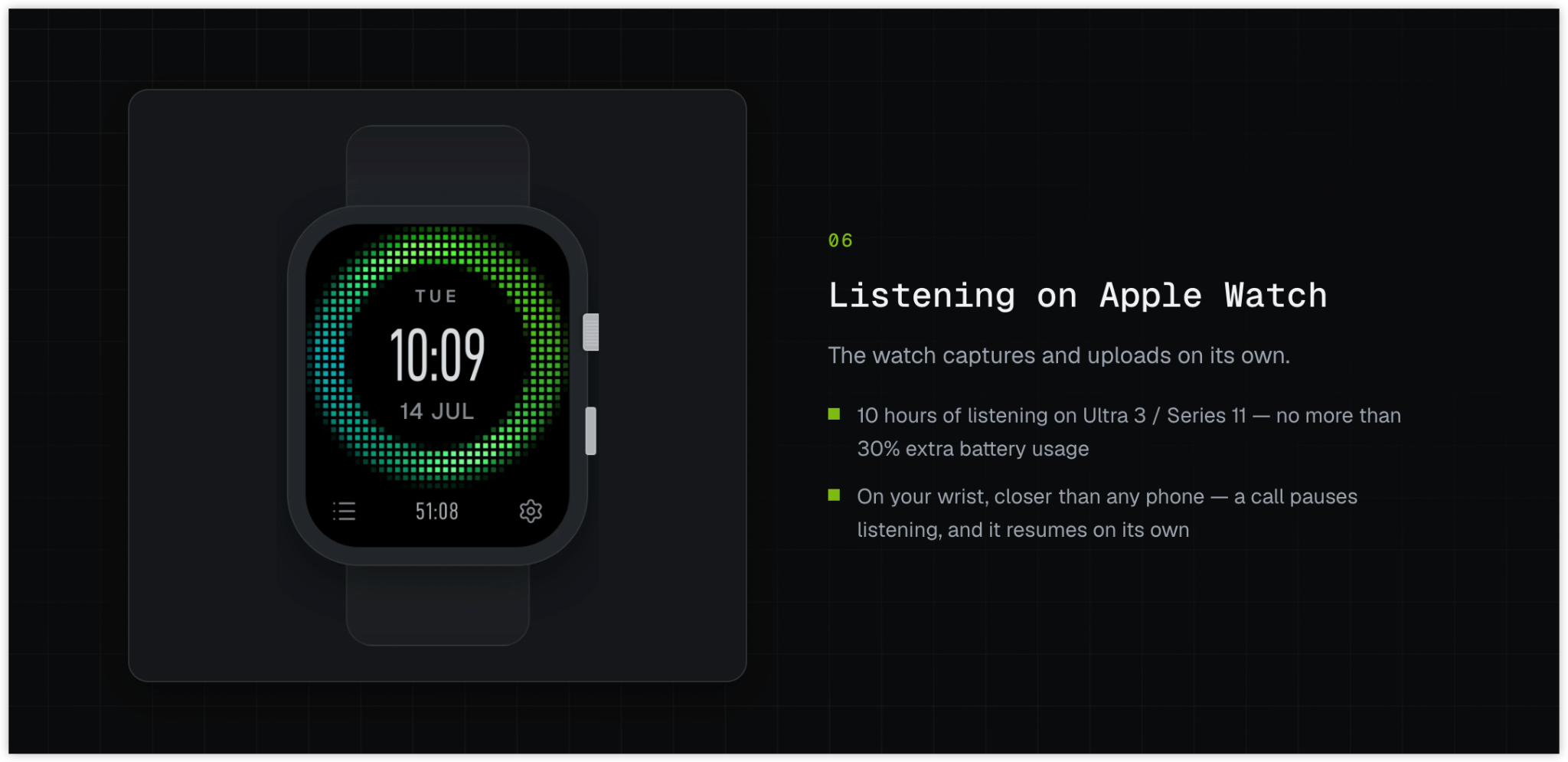
Hemory listening interface shown on Apple Watch.
A phone may be easier when it is already on the table, when you prefer its controls, or when the conversation is informal and easy to start manually. Try the start-and-stop flow in the setting where you plan to use it. If you must interrupt the conversation to find a control or confirm that listening has started, that device may not fit the task as well.
Recording should also fit the conversation’s consent and workplace requirements. A device that is easy to start is not, by itself, a reason to record a conversation without the necessary permission.
Interruptions: check what calls do on each device
A call can matter in two ways: it may interrupt listening, and you may need the device for the call itself. Hemory’s product description says that on Apple Watch, listening pauses when a call comes in and resumes after the call ends. If uninterrupted capture matters, decide whether that pause is acceptable and how you will handle any missed part.
Don’t assume a phone behaves the same way—or differently—without checking. Test your phone and recording app with an incoming call and any common interruption in your workflow. Confirm whether listening pauses, resumes automatically, or needs you to restart it. If you cannot test the exact setup, treat call behavior as an open question rather than building a critical recording plan around an assumption.
Transcript access: follow the record to the next task
Where the transcript ends up can matter more than which device captured the conversation. Check that you can find it later on the device or in the workflow you need, and that you can review the relevant lines before acting on them.
Hemory describes listening sessions as producing timestamped transcripts, with transcript-line playback on the listening device. Its built-in Q&A Agent also supports multi-turn questions based on transcript content across sessions. However, the available product information does not establish exactly where an Apple Watch session’s transcript appears on a paired phone. If phone access is important, confirm that route on your own setup before relying on it.

Review transcripts with speaker labels and timestamps.
This is also where a recording tool can reduce manual work. Instead of trying to choose and write down every useful detail while people are talking, you can focus on the discussion and return to the captured record later. A transcript can support recall, but it is not a guarantee of perfect capture or transcription; review details that affect a decision or next step.
Choose a primary device, then define when to switch
Use these questions to make a conditional choice:
- How long do you need to listen? Choose a device whose available battery covers that session with enough left for its other daily uses.
- Which device lets you stay engaged? Prefer the one you can start reliably without taking attention away from the conversation.
- What happens when a call interrupts? Use a setup whose pause or restart behavior you understand and can accept.
- Can you retrieve the transcript where you need it? Confirm the destination and access route, especially when recording on a watch and reviewing on a phone.
If both devices meet those needs, set one as your usual choice and switch for specific situations—for example, a watch when hands-free access matters and a phone when its controls or availability are more useful. Using both across different situations does not mean their records will be combined automatically; check how each session is stored and retrieved.
For Hemory users, the listed supported platforms include iOS, Apple Watch, Android, and Wear OS. That list does not mean every feature or behavior is identical across platforms. Make your decision using the actual device and route you will use. A good next step is to run one ordinary session, check battery use and interruption behavior, then confirm that you can find the transcript afterward.
FAQ
Is recording on a watch better than recording on a phone?
Not in every situation. A watch can be more convenient when hands-free access matters, while a phone may fit better when it is already accessible or its controls suit your workflow. Battery, call behavior, and transcript access should decide the choice for your setup.
Can an Apple Watch record without an iPhone?
Hemory’s product information says Apple Watch can listen and upload independently. That confirms independent capture and upload, but does not establish exactly where the transcript appears on a paired iPhone. Check transcript access on your setup if you need to review it there.
Will a recording continue when a call comes in?
It depends on the device and app. Hemory’s product information says listening pauses and resumes after a call on Apple Watch. For a phone or another setup, test the behavior rather than assuming it matches.
Should I record on both devices at once?
Only if you have a specific reason and have checked how each recording will be handled. The available product information does not establish automatic merging of sessions from different devices, so using two devices may leave you with separate records to review.