

 Hemory Team
On this page
When you need an answer from an old meeting, you can paste transcript excerpts into an assistant or connect it to a source of captured conversations. Pasting is direct and keeps the material in your hands, but you must choose and supply what the assistant sees. A connection can reduce that repeated preparation, provided the relevant conversations were captured and the specific assistant can access them.
TL;DR
- Paste text for a one-off question when you know which transcript contains the answer and can select the relevant material.
- Consider a connection when you expect to ask about multiple captured conversations or revisit a topic over time. Confirm what the specific client can retrieve before relying on it.
- Neither method guarantees complete recall. Pasted text cannot reveal material you did not include; connected retrieval is limited to captured, accessible records and the tools available to that client.
- If your old transcripts exist only as files elsewhere, do not assume a connection can import or search them. Use a source you can access, or check whether a supported import route exists.
What each approach gives the assistant
With pasting, you provide selected transcript text directly in the assistant’s conversation. The assistant can work from what you supplied, but it cannot consult the rest of a transcript or other meetings unless you provide them too. The amount and format you can paste depend on the assistant you use; check its current input limits if they affect your task.
With a connection, an assistant may retrieve relevant information from a connected source as part of its work. For Hemory, that route depends on the conversations having been captured there and being accessible through the particular supported client and its available tools. A connection is not a way to reach discussions that were never recorded or records the client cannot access.
Hemory describes a built-in Q&A Agent that supports multi-turn questions about a user’s Memory across conversations. It also lists MCP as a way to connect external agents. Those are distinct routes: do not assume an external client has the same tools or access scope as Hemory’s built-in Q&A. The Hemory Features page describes the product’s Q&A and MCP capabilities; check the setup and access details for the client you plan to use.
Compare the trade-offs
| What matters | Pasting transcript text | Connecting an assistant to captured conversations |
|---|---|---|
| What the assistant can use | The text you select and paste for that task. | Records available through the connection and tools exposed to that specific client. |
| Preparation | Find the source, choose relevant passages, and provide them again when needed. | Set up the connection and confirm its access; then give the assistant the task and any necessary current information. |
| Coverage | Limited to what you supplied. Other meetings and omitted passages are out of view. | Can draw on relevant accessible captured conversations, but coverage is not guaranteed to be complete. |
| Best fit | A narrow, one-off question when you already know where the answer is. | Recurring questions or work that benefits from retrieving context across captured conversations. |
| Main dependency | You need usable transcript text and an assistant that accepts it. | The conversations must be captured in the connected source, and the chosen client must support the connection and expose the needed retrieval. |
| Access considerations | You choose what text to share in the chat. | Access depends on the specific connection and client. Check its setup, tools, and permissions rather than assuming every client behaves alike. |
Neither choice is automatically better. The right one depends on where the source material lives, how often you will use it, and how much setup and access you are comfortable with.
When pasting is the better fit
Paste text when the question is specific and the relevant transcript is easy to find. For example, if you need to identify the rationale for one decision in a meeting, you can provide the relevant passage and ask the assistant to distinguish the decision from proposals or open questions.
This route makes the input visible and keeps the task bounded. It also puts the selection work on you: you must locate the right source, include enough surrounding context, and repeat that work when another meeting or a later question matters. If you paste only one excerpt, the assistant cannot know whether another conversation added a condition or changed the plan.
Use the assistant’s output as a draft interpretation, not proof that the transcript is complete or that a reported decision remains current. Check the source or a current project record when the distinction affects what you will do next.
When a connection is worth considering
A connection is more useful when you expect to ask about a subject that spans several conversations or comes up repeatedly. Instead of preparing a transcript bundle for each question, you can ask the connected assistant to find relevant captured context and use it for the current task. That can reduce selection, compilation, and retelling; it does not remove the need to review important conclusions.
For Hemory, this route starts with conversations captured in Hemory. Hemory organizes and makes Memory available through supported tools; the external assistant does its own retrieval and reasoning. You still provide the current goal, add information that is not in those conversations, and judge whether the response is suitable for use.
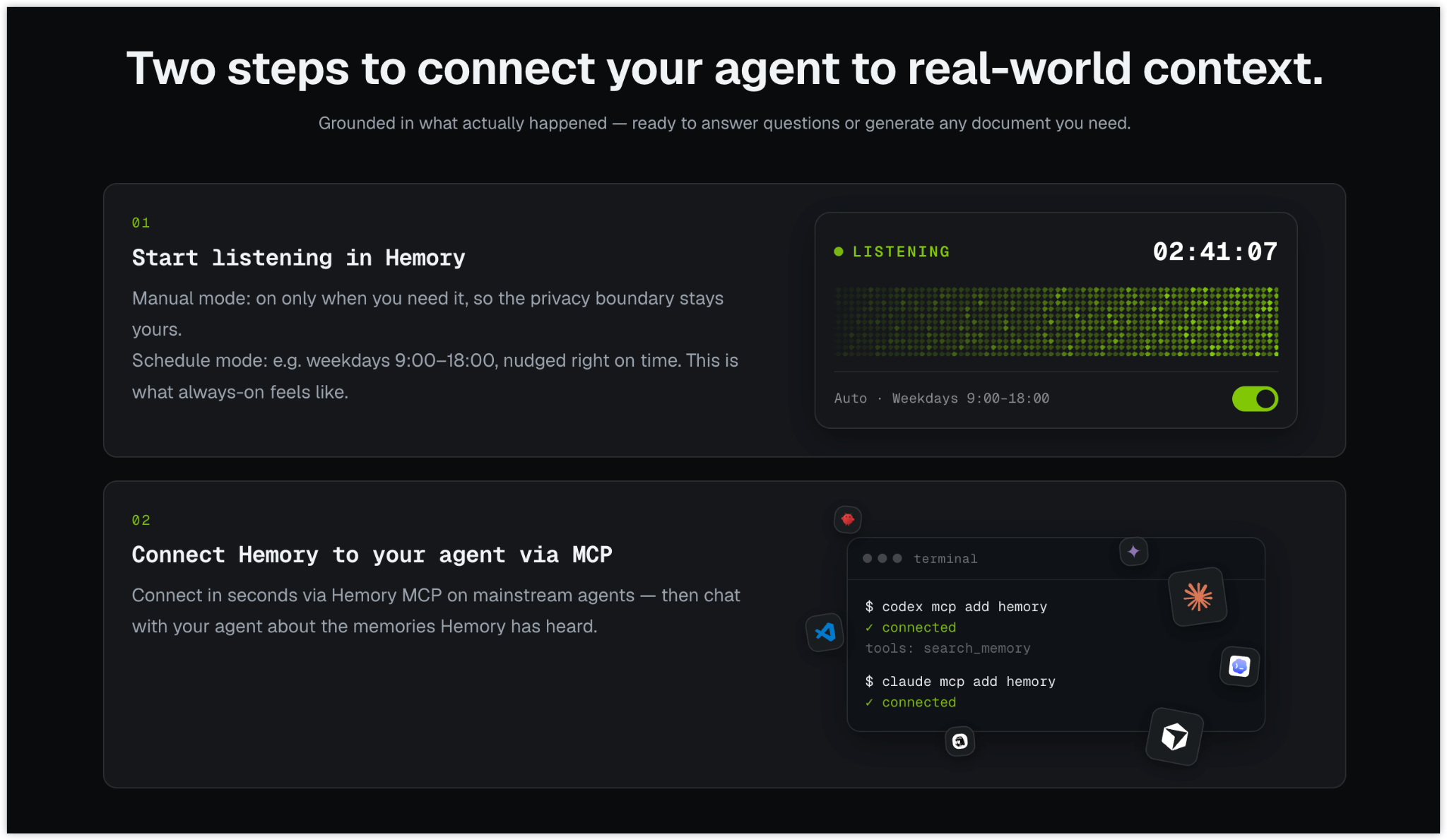
Connect an AI agent to Hemory through MCP.
Before relying on the connection, check the specific client:
- Confirm the route is supported. A product’s general MCP listing does not establish identical setup or behavior in every client.
- Check the available tools and access. Find out what the client can retrieve and what permissions the connection requires. Do not infer full archive access from the fact that a connection exists.
- Confirm the source records are there. A connection to Hemory can use only conversations captured and accessible through that route. Do not assume it can import old transcript files or reach material in another system.
- Try a question with a known answer. Use a detail you can check in a source record, then assess whether the result is relevant and sufficiently grounded for your task. A successful example does not prove the connection finds every related conversation.
If setup is not worthwhile for a one-time lookup, paste the relevant text instead. If the key records are elsewhere, use that source or confirm a supported way to make them available; do not choose a connection based on an unverified import assumption.
Make the choice
Choose pasting when you have a small, known set of transcript passages and want a quick answer without configuring a connection. Accept that the assistant’s view stops at the material you supplied.
Choose a connection when you have relevant conversations already captured in the connected source, expect to reuse them, and have confirmed that your chosen client can retrieve the records needed for the task. Accept that its reach depends on the client and accessible Memory, not on a promise of exhaustive recall.
If you are unsure, start with the source you can actually inspect. A focused pasted excerpt is a reasonable fallback, while a connection is worth setting up when repeated manual selection becomes a real burden. Hemory’s value in that workflow is preserving and organizing conversations so a supported assistant can retrieve relevant context later—not guaranteeing that every old or uncaptured discussion will be found.
FAQ
Can a connected assistant search every Hemory conversation?
Do not assume that. Retrieval depends on the specific client, tools, permissions, and accessible records. Confirm the scope for the connection you plan to use; a listed integration alone does not establish complete access.
Can I connect an assistant to transcripts I recorded before using Hemory?
The available information does not establish that arbitrary historical transcript files can be imported or reached through the connection. If those records are not already captured and accessible in Hemory, use their current source or confirm whether a supported import route is available.
Does pasting give me more control over what the assistant sees?
It gives you direct control over the text you choose to provide for that task. You still need to select enough context, and the assistant cannot account for related material you leave out. Check the receiving assistant’s handling and input requirements for your own use case.
Should I trust a connected answer without checking the transcript?
No. Use the answer as a starting point, especially when wording, conditions, or the current status of a decision matter. Check the relevant record or current project information before acting on a consequential conclusion.