

 Hemory Team
On this page
A monthly overview is harder to trust when it depends on what you happen to remember—or when it takes so long to combine meeting notes that important details get lost along the way. The right method depends on how many conversations you need to cover, what records you already have, and how much review the summary deserves.
TL;DR
- Use memory alone for a short, low-stakes recap—not as the only source for a consequential or comprehensive overview.
- Per-meeting notes are easier to trace when they are consistently maintained, but someone still has to gather and synthesize them.
- An AI agent can draft from captured, accessible conversations, which may reduce manual compilation. Check what it could access and review the result before sharing.
- Hemory can organize captured conversations as searchable Memory for later use. It cannot supply a discussion that was never captured or guarantee that a monthly summary covers every meeting.
Compare the three approaches
| Approach | Effort | Coverage and forgotten context | Review burden | Depends on |
|---|---|---|---|---|
| Write from memory | Low to start; grows as meeting volume increases | Often selective. Details may be missed or recalled unevenly. | High if claims, dates, or commitments matter | Your recall and any current records you consult |
| Combine per-meeting notes | Moderate to high: collect, sort, and synthesize the entries | Depends on how consistently meetings were recorded and what each note preserves | Usually manageable when notes are clear and traceable; gaps still need attention | A maintained set of notes or other meeting records |
| Ask an agent to draft from captured conversations | Lower manual assembly once relevant records are accessible; setup and review still take effort | Can surface useful details beyond personal recall, but only from conversations it can retrieve | You must review coverage, attribution, status, and any consequential conclusions | Prior capture, access through the connected client, and your review |
These are trade-offs, not guarantees. A carefully maintained set of notes may be more dependable for a defined set of meetings than an agent working from incomplete records. An agent may be a better starting point when there are many conversations and relevant captured context is accessible. Neither method removes the need to decide what belongs in the summary.
Start with the job the summary needs to do
Before choosing a method, write down who will read the overview and what they need from it. A personal reflection can be selective. A management update may need notable decisions, progress, risks, and unresolved questions. A handoff may depend on named owners, conditions, and next steps.
Set the period and scope too. “This month” might mean meetings held during a calendar month, a project’s recurring check-ins, or conversations with a particular team. List the meeting types or workstreams that matter. If the summary will inform a decision, define what evidence the reader needs and which claims must be checked against a current source.
A useful output is usually selective rather than a compressed account of every conversation. Common sections include:
- Major developments and decisions
- Work completed or still in progress
- Risks, dependencies, and unresolved questions
- Follow-up actions, with owners or dates only when they were established
Adapt the sections to the audience. Do not turn an unassigned task into a commitment or treat a proposal as an agreed decision.
When writing from memory is enough
A memory-based recap can work for a small number of familiar, low-stakes conversations when the goal is a brief personal overview. It is quick to begin and does not depend on a complete archive of notes.
Its weakness is selective recall. You may remember the most recent or vivid meeting more clearly than a less memorable discussion that changed a plan. Before relying on memory, ask whether an omission could change the reader’s understanding or next action. If it could, use a record to check the detail or choose a method with broader source coverage.
If you use memory as a starting point, label the recap accordingly and confirm important dates, decisions, conditions, and owners against records you can access. Do not present recollection as a complete account of the month.
When per-meeting notes are the better foundation
Use meeting notes when you already maintain them consistently, need a clear trail from summary points to individual discussions, or have to work within an established review process. Notes can make it easier to confirm where a detail came from, especially when they record the meeting date, topic, decisions, open questions, and follow-ups.

See how a meeting summary highlights decisions and follow-ups.
The trade-off is the work of producing and combining them. A stack of short notes may omit the reasoning behind a decision or the condition attached to a follow-up. A monthly summary still requires someone to collect the relevant entries, group related developments, and distinguish a current status from an older one.
For a practical synthesis, sort notes by workstream or outcome rather than simply concatenating them by date. Keep meaningful changes in status visible. If two entries refer to the same issue, establish that they share scope before treating one as an update to the other.
When an agent can help—and what Hemory contributes
An agent is worth considering when you need to synthesize many conversations and the relevant history has already been captured in a form the agent can access. It can help retrieve context and draft a starting overview, reducing the need to search through every note and manually retell the history. The agent performs the reasoning and drafting; you remain responsible for the goal, current information, and review.
Hemory’s Features page describes a built-in Q&A Agent that supports multi-turn questions about a user’s Memory across past sessions, and access to Memory through MCP for external agents. A connected agent can use accessible captured context for its own task-driven retrieval and drafting. This does not establish that every client has identical tools or permissions, or that any setup will retrieve a complete month in one request.

Retrieve past commitments and draft follow-up tasks.
If you use this route, first confirm that the relevant discussions were captured in Hemory and that the connected client can access what the task requires. Give the agent the reporting period, audience, scope, and requested sections. You do not need to manually assemble a full chronology first. If the agent cannot access an important current document or uncaptured detail, provide it separately or consult another source.
For example, you might ask a connected agent to draft an overview of captured project meetings from a specified month, grouped by workstream, with decisions, open questions, and follow-ups separated. Ask it to flag uncertain owners or dates rather than filling them in. Treat the result as a draft, not proof that every meeting was included.
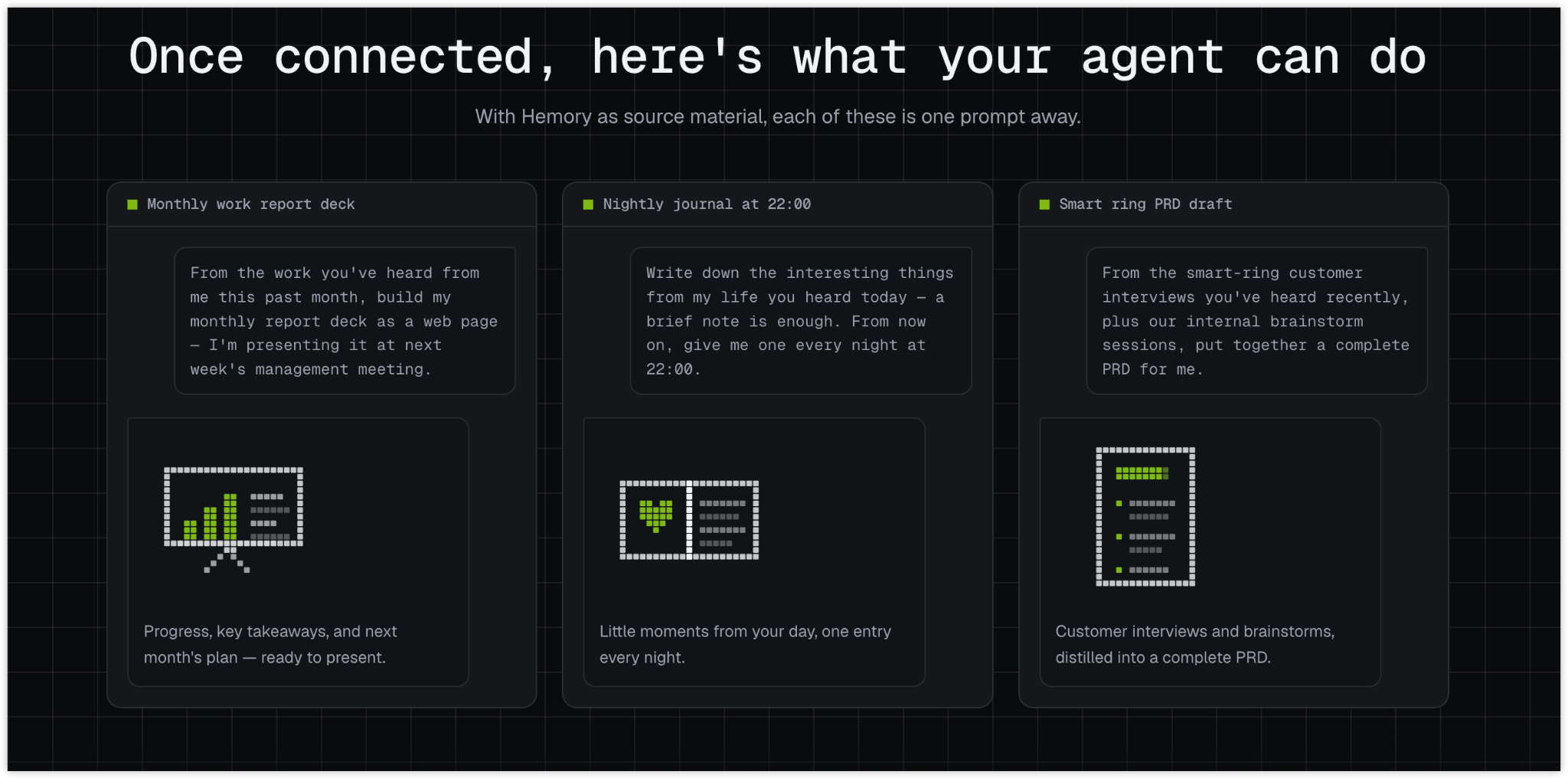
Turn saved context into reports, journals, and product requirements.
Hemory’s role is to preserve and organize conversations so they can be retrieved later; the external agent creates the requested synthesis. Capturing discussions can also let you stay engaged instead of trying to write down every potentially useful detail. That benefit depends on having the relevant conversations captured and accessible, and it does not guarantee perfect transcription or complete recall.
Choose by coverage, not just drafting speed
Use these questions to decide:
- How many meetings and workstreams are in scope? A few informal conversations may be manageable from memory. A busy month usually calls for records or retrieval.
- What happens if a detail is missing? For a consequential update, use a method that lets you check decisions, conditions, and current status against accessible evidence.
- What records already exist? Consistent notes may be the most direct route. If records are scattered or the volume makes manual compilation burdensome, captured conversation retrieval may be useful.
- Can the chosen method access the whole intended scope? A draft is only as broad as the meetings and documents available to it. Confirm the relevant time period and workstreams rather than assuming access is complete.
- Who will review the result? Allow time to check important claims and carry the approved summary into the team’s existing workflow. Do not assume an agent has sent, approved, or updated anything elsewhere.
A hybrid approach is often practical: use accessible meeting records or agent retrieval to assemble the broad draft, then check high-impact decisions and commitments against current notes or other reliable evidence. Add your current priorities separately, and clearly distinguish them from what was agreed in past meetings.
A review pass that keeps the summary trustworthy
Before sharing, check the parts that could change someone’s understanding or action:
- Scope: Does the draft cover the intended dates, teams, and workstreams? Note any known gaps.
- Attribution: Does the record support who said or accepted something? A person being mentioned is not the same as being assigned an action.
- Status: Separate proposals, accepted decisions, commitments, completed work, and unresolved questions.
- Conditions and timing: Preserve the terms attached to an agreement. A missing deadline does not mean there was no commitment, and an old commitment does not prove current progress.
- Current state: Check later changes against current records. A newer mention does not automatically replace an earlier decision.
- Audience: Remove detail that does not help the reader understand the month or take the next step.
A transcript or summary can help locate evidence, but no format is automatically complete or authoritative. Compare the content, scope, date, and current state of the records available to you. If an important detail was not captured, use another source or ask a focused clarification rather than guessing.
Which method should you choose?
Choose memory for a short, low-stakes recap where selectivity is acceptable. Choose per-meeting notes when you already keep them reliably and need a traceable record. Consider an agent when the month contains many relevant conversations, those conversations were captured and are accessible through the connection, and you can review the resulting draft.
If you use Hemory, start with a real monthly reporting task and the captured conversations relevant to it. Let retrieval reduce manual searching and retelling, then review the summary’s coverage and consequential claims before sharing it through your normal team process.
FAQ
Can an AI agent create a monthly meeting summary from conversations?
It can draft one if it can access relevant captured conversations and has clear instructions about the period, audience, and scope. Access and coverage depend on the records and connected client; review the draft before relying on it.
Is writing from memory ever a good option?
Yes. It can be suitable for a brief, low-stakes recap of a small number of meetings. Use records to check details when an omission could affect a decision or follow-up.
Should I keep per-meeting notes if I use an agent?
Keep notes that serve your workflow or provide important current information. An agent may reduce the need to manually combine every note, but it does not replace records the agent cannot access or your responsibility to review the summary.
Does Hemory automatically create a complete monthly report?
The supplied product information describes meeting notes and Memory Q&A, as well as MCP access for external agents. It does not establish that Hemory automatically produces a complete monthly report. A connected agent can draft from accessible context, but check the scope and review its output.