

 Hemory Team
On this page
If you do most of your work on a Mac or Windows PC, using Hemory on another device may feel like an awkward detour. The practical choice depends on whether capturing conversations on a phone or watch helps now—and whether the result can reach the desktop work you need to do.
TL;DR
- Hemory’s Features page lists iOS and Apple Watch as available; it marks macOS and Windows/Linux as coming soon and gives no release date.
- Phone or watch capture can be an interim option if it fits where your conversations happen. It is not a confirmed substitute for desktop use.
- Before changing your routine, confirm that your exact device is supported and test how you will use the resulting Memory in your desktop workflow.
- If your work depends on desktop access or cross-device syncing, keep your current process until that requirement is confirmed.
What is currently listed as available?
The Features page lists iOS and Apple Watch as available. It labels macOS and Windows/Linux as coming soon, but does not provide a release date. “Coming soon” is not a schedule, so do not plan around a particular launch date.
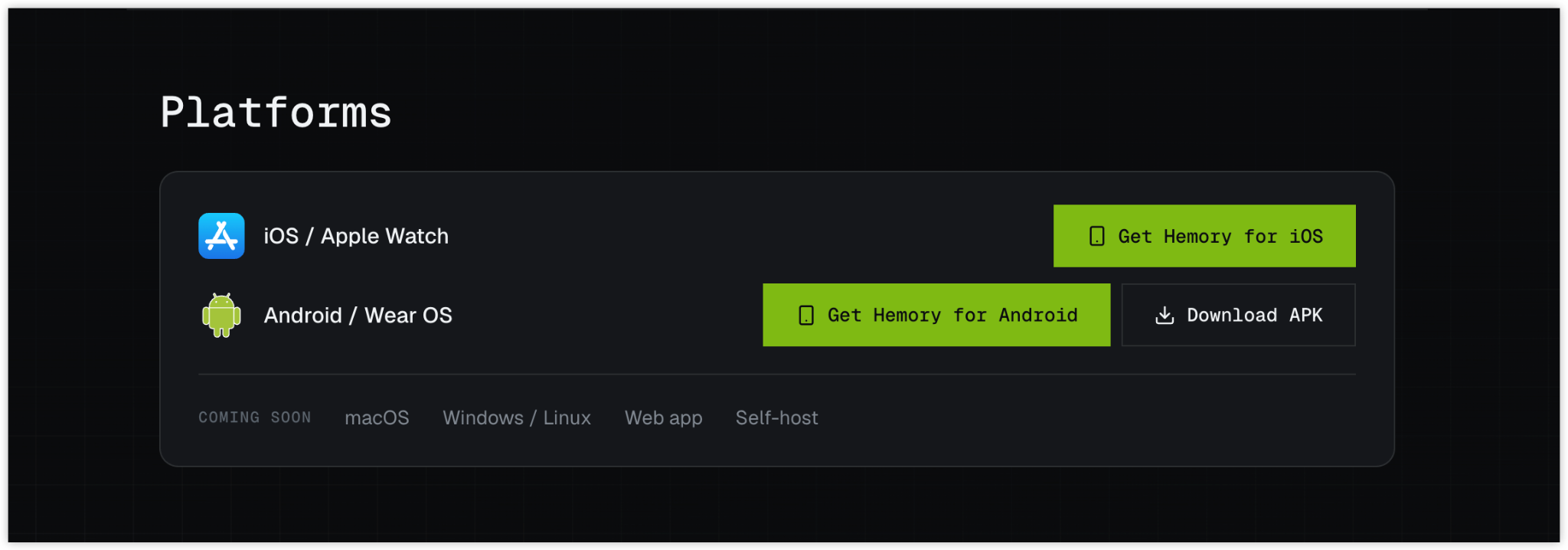
See the mobile and wearable platforms listed on the site.
There is a platform detail worth checking before you decide: Product Truth also names Android and Wear OS as supported, while the fetched Features page lists only iOS and Apple Watch. Confirm the current status for your exact phone or watch on Hemory’s Features page before treating it as an available option.
The page describes Apple Watch as able to listen and upload independently. That may make it worth considering when conversations happen away from your phone. It does not establish that watch and phone sessions appear in the same Memory, or that captured content syncs into desktop tools.
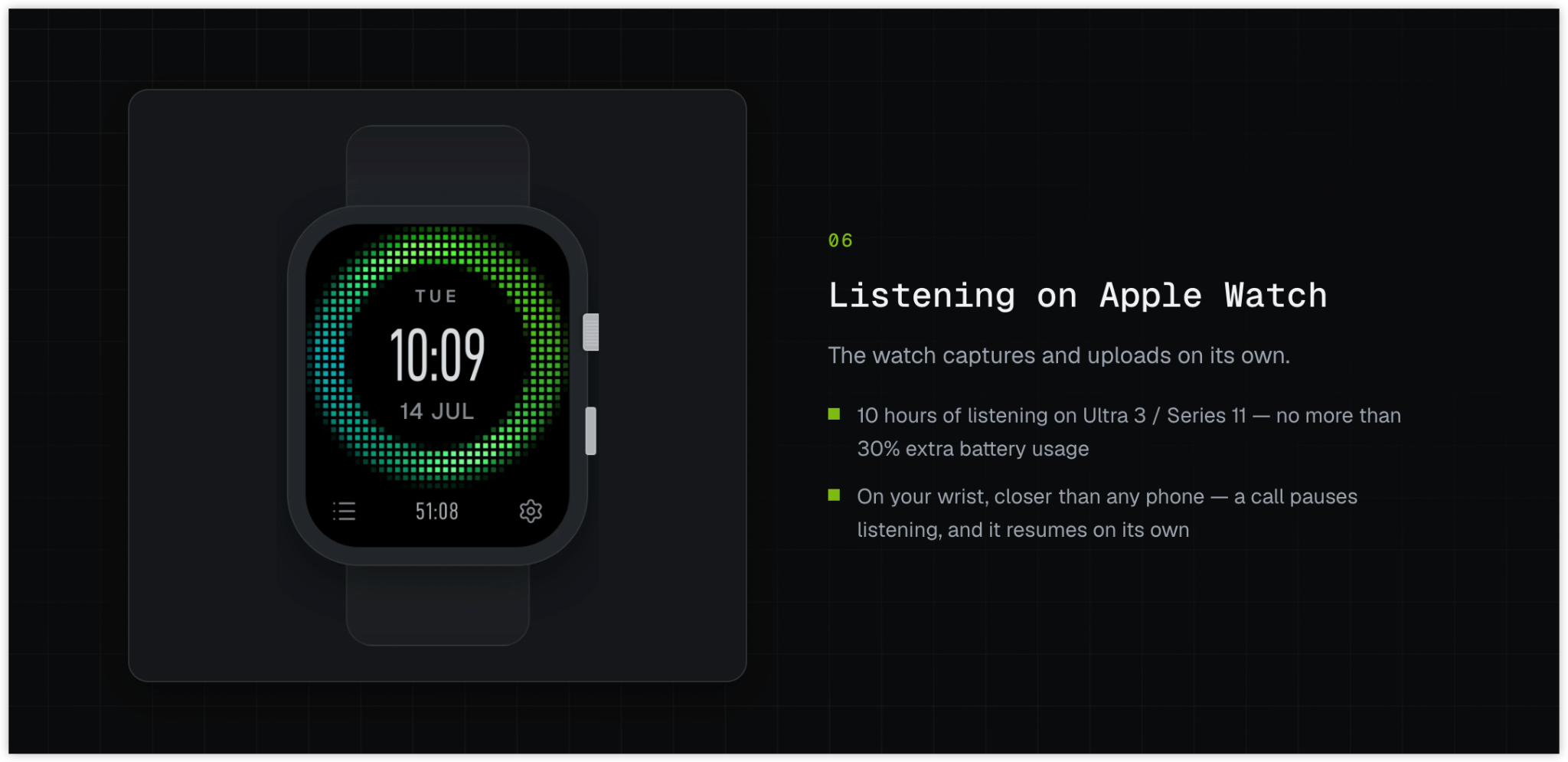
Hemory listening interface shown on Apple Watch.
Decide whether a phone or watch fits your work
Treat a supported device as a possible capture route, not as a smaller version of the desktop app. Ask what you need the device to do and what happens after a conversation.
| Your situation | What to consider |
|---|---|
| You mainly need to preserve discussions that happen while you are away from your desk. | A currently supported phone or Apple Watch may be a useful interim capture option, if the device and listening workflow suit the setting. |
| You need captured context available while drafting on your Mac or Windows PC. | Confirm how you can access and use that Memory from the desktop workflow. The listed platform information does not confirm desktop syncing or integration. |
| You need to start and stop listening at specific times. | Hemory describes Manual Mode and a Schedule Mode that provides reminders and one-tap start or stop actions. Check that the relevant behavior is available on your device. |
| You need a complete desktop-based process for your work. | Keep your current method until desktop availability and the necessary handoff are confirmed. |
The key question is not just “Can this device capture?” It is “Can I use what it captures in the next step of my work?” If the answer depends on desktop access, verify that access first.
Test the handoff before relying on it
If a supported phone or watch seems promising, try a small, low-stakes workflow before making it your default:
- Confirm the exact device. Check the current Features page rather than assuming that every phone or watch platform is available.
- Capture a conversation you are permitted to record. Use the listening controls that fit the situation. Schedule Mode provides reminders and one-tap start or stop actions; it should not be treated as silent automatic recording.
- Review the result on the available device. Hemory describes transcripts and organized Memory from listening sessions. A transcript is a record of speech, not a guarantee that every detail is captured perfectly.
- Try the next desktop task. Determine whether you can access the relevant Memory where you need to write, search, or make a decision. Do not assume that device capture also means desktop syncing.
- Keep a fallback. If the handoff is not available or does not suit your work, continue using your existing notes or another source you can access from the desktop.
This test answers a practical question: does the interim route preserve useful conversation context and let you use it at the point of work? You do not need to rebuild your whole process around an unconfirmed connection.
Choose an interim approach based on the dependency
Use phone or watch capture when the main need is to preserve conversations and you can work with the resulting Memory through a confirmed route. Capturing can reduce the need to select and write down every potentially useful detail while you participate. Later, retrieved context may help you recall what was discussed—but only for conversations that were captured and are accessible.
Wait for confirmed desktop support if your work requires a desktop interface, a specific computer-based process, or a verified connection between captured Memory and desktop tools. In the meantime, keep using an existing note or record that is available where you work. That is a more reliable bridge than assuming an undocumented sync or import path.
Should you wait for desktop support?
There is no release date in the supplied Features information, so waiting cannot be planned around a known launch. Choose based on the work you need to do now:
- Try a supported device if capture itself is useful and you have confirmed how you will reach the information for later work.
- Keep your existing process if desktop access is essential or the cross-device handoff remains unclear.
- Recheck the Features page before committing to a longer-term workflow, especially if you use Android or Wear OS, whose availability is not consistent across the supplied product information.
You can use Hemory on a supported phone or watch as a possible interim capture option. Whether it is a good fit depends on your device and the next step in your workflow—not on an assumed desktop release date. Confirm both before making the switch.