

 Hemory Team
On this page
Choosing a memory MCP server is not just a question of which agents can connect to it. A connection does not tell you how conversations enter the system, where records are stored, whether a team can share them, or what the full cost and license terms are. Those differences can make two similarly described tools poor substitutes.
This guide gives you a like-for-like selection process and a grounded first assessment of Hemory. The available source material is not enough to responsibly rank two or three vendors, so treat the comparison as a decision framework—not a verified market shortlist.
TL;DR
- Evaluate capture, storage, retrieval, sharing, agent support, license, and cost as separate questions. MCP compatibility alone answers only part of the selection problem.
- Confirm support for the exact client and setup you plan to use. A product listing is not proof that every client’s connection steps, permissions, and behavior have been tested.
- The available Hemory Features page lists Claude Code and Codex among its MCP-connected agents, but does not name Cursor. It also does not establish team sharing, storage terms, or the MCP server’s license.
- Do not choose from a ranking unless its sources, date, and test method support the claims. Verify decision-critical details with current documentation or the maintainer before committing.
Compare the whole memory path, not just the MCP connection
A memory tool can be part of several distinct stages:
| Stage | What to find out | Why it matters |
|---|---|---|
| Capture | How information gets recorded: manual entry, imports, listening sessions, or another supported route | An agent cannot retrieve a discussion that never entered an accessible record. Capture effort affects how much useful context accumulates. |
| Storage | Whether records are hosted, local, or self-managed; how sync, retention, and deletion work | Storage affects control, access, operational effort, and whether records remain available where you need them. |
| Retrieval | What the agent can search, which records it can access, and what permissions apply | A connection may expose some retrieval functions without giving an agent unlimited access to every record. Check the documented scope. |
| Team sharing | Whether sharing is supported, what is shared, and how access is managed | A personal memory store is not automatically a shared team knowledge base. |
| Agent and client use | Which clients are listed, how they connect, and whether their relevant tools and permissions are documented | Support for one client does not establish equivalent support or behavior in another. |
| License and cost | The applicable software license, subscription or usage charges, and any hosting or maintenance costs | A free tier or subscription price does not, by itself, tell you the MCP server’s license or total cost of operating it. |
Treat these as separate evidence questions. For example, “works with an MCP client” does not establish automatic capture, team-wide access, self-hosting, or permission to write to other systems.
Apply the same test to every candidate
Before comparing products, write down the workflow you actually need. A developer choosing a personal store for one coding assistant has different requirements from a team that needs shared, governed context across several clients.
For each candidate, record the evidence in the same format:
| Dimension | Evidence to record |
|---|---|
| Capture model | What sources can be captured, how capture starts, and what requires manual work |
| Storage and control | Hosting location, retention and deletion terms, sync behavior, and any self-hosting option that is currently available |
| Retrieval scope | What the connected agent can retrieve, which account or store it can access, and the documented permissions |
| Team sharing | Whether shared access exists, who can grant it, and what other users can see |
| Client fit | Current documentation for each client you will use, including setup requirements and relevant tool behavior |
| License | The license for the server or software component, separately from any paid product plan |
| Cost and upkeep | Subscription or usage charges plus any hosting, maintenance, or administration work |
Use three labels: documented, confirmed with the maintainer, and not established. A marketing page can help identify what to investigate, but do not convert an unstated detail into a positive or negative claim. If a detail would change your choice, ask the maintainer or consult current documentation before adopting the tool.
What the available evidence establishes about Hemory
Hemory is one candidate to assess if your workflow needs captured conversation context to be available to an AI agent. Its Features page describes listening sessions producing timestamped transcripts with speaker labels and AI cleanup, alongside automatic activity classification and summaries. It also describes a built-in Q&A Agent for questions about a user’s Memory and says the same capability is opened through MCP.

Review transcripts with speaker labels and timestamps.
The page lists Claude Code and Codex among the agents that can connect through Hemory’s standard MCP Server. It does not name Cursor in the supplied evidence. That is a reason to verify Cursor support—not proof that Cursor cannot connect. The page also says the MCP tools are being enhanced, so check the current documentation for the tools and permissions relevant to your workflow. A connection does not establish access to every record or permission to perform arbitrary actions in an external system.

Review MCP connection options and access settings.
The page lists a one-time $0 Free Trial with 10 listening hours, Starter at $10 per month with 20 hours, Pro at $20 per month with 60 hours, and Max at $50 per month with unlimited listening hours subject to a 24-hour daily cap. Treat these as listed plan prices, not a complete cost or license assessment. Verify current terms before purchase; the page does not establish the MCP server’s software license, team-sharing arrangements, or storage and retention terms.
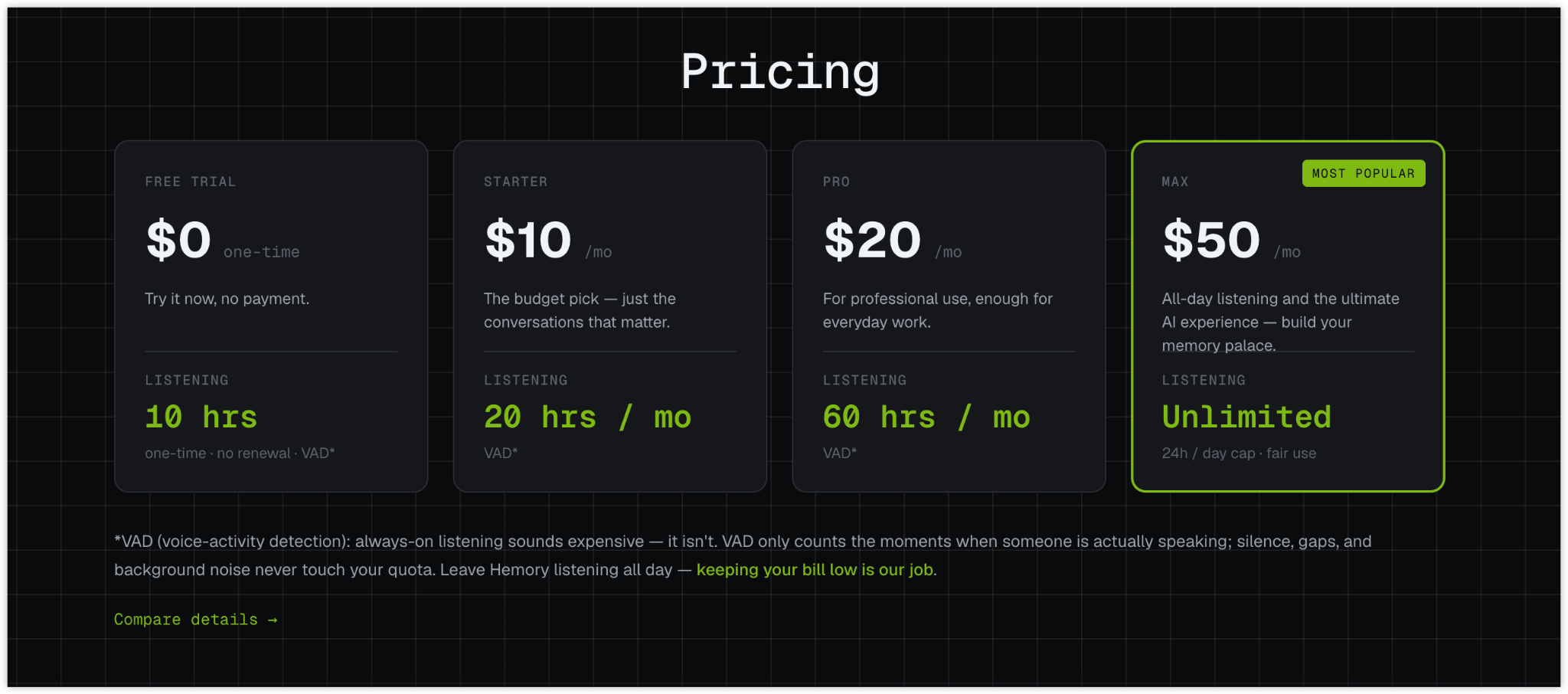
Compare listening plans and their advertised allowances.
| Question | What the supplied Hemory page supports | What still needs confirmation |
|---|---|---|
| Does it capture and organize conversations? | It describes listening sessions, transcripts, activity classification, and summaries. | Whether its capture workflow fits your devices, settings, and required sources. |
| Is MCP available? | Yes. The page describes a standard MCP Server and names Claude Code and Codex. | Current setup, tool scope, permissions, and compatibility with Cursor. |
| Can a team share the same Memory? | Not established by the supplied page. | Whether shared stores or team access are available, and under what terms. |
| Where is Memory stored, and how long is it retained? | Not established by the supplied page. | Storage location, retention, sync, and deletion behavior. |
| What does it cost, and what is the license? | The page lists subscription plans and listening allowances. | Current plan terms, the MCP server’s license, and any additional operating costs. |
The source is Hemory’s own Features page, so treat its product descriptions as maintainer-published information, not independent comparative testing. The page does not provide a basis for ranking Hemory against other servers.
Choose based on your use case
A personal setup may favor a capture flow you will actually use, retrieval that suits your tasks, and an acceptable storage arrangement. A team setup should make shared access, permissions, ownership, and retention explicit before anyone relies on the store for collaborative work. If self-hosting is essential, confirm that it is currently available rather than assuming a planned or unlisted option exists.
For Claude Code, Codex, and Cursor, check each client separately. Confirm the current connection instructions and the relevant tools and permissions for your intended work. If a client is merely mentioned in a comparison post but not in current maintainer documentation, mark support as unconfirmed until you resolve it.
Use a simple rule: choose a candidate only when its documented capture path, storage and access model, client support, license, and total cost fit your requirements. If team sharing or data location is a must-have and the vendor has not established it, pause the decision rather than filling the gap with assumptions.
FAQ
Does MCP compatibility mean a tool automatically captures conversations?
No. MCP describes a way for a client to access a server’s capabilities; it does not establish how information is captured. Check capture and retrieval separately, and confirm that the relevant conversations are already recorded and accessible.
If a product lists Claude Code, can I assume it supports Codex and Cursor too?
No. Check each client against current documentation. The supplied Hemory Features page lists Claude Code and Codex, but does not name Cursor; that source alone does not resolve Cursor compatibility.
Is a free plan enough to compare total cost?
Not necessarily. Check the plan’s limits and terms, the software license, and any hosting or maintenance costs. A listed subscription price does not answer all three questions.
Can I assume an MCP memory server supports team sharing?
No. Confirm whether shared access exists, what users can see, and how permissions are managed. A personal memory store or an agent connection does not establish a shared team archive.
Next step
Shortlist tools only after you have evidence for the requirements that matter most in your setup. For each one, save the current documentation and record unresolved points—especially client-specific support, team sharing, storage terms, license, and total cost. For Hemory, the available page provides a starting point on conversation capture, MCP access, named clients, and plan prices; verify the remaining details before relying on them in a personal or team workflow.