

 Hemory Team
On this page
Introduction
A tool can produce polished meeting minutes yet be a poor fit for finding a detail from an informal conversation later. A note app may keep your own observations but not capture the discussion itself. To compare options fairly, start with the work you need done, then test how each tool captures, organizes, retrieves, and exposes conversation information—and how you can review what it returns.
TL;DR
- Choose for the job you need done: a personal reminder, a shared meeting record, a searchable conversation history, or context for a later AI task.
- Compare tools using the same conversation types and follow-up questions. Check what they capture, what retrieval can reach, and what you can inspect or correct.
- Verify platform availability, connection scope, and permissions for the exact setup you would use. A listed integration does not prove every client has the same access.
- Treat summaries and transcripts as records to review, not guarantees of complete or error-free capture.
Start with the job, not the product label
“Note-taking,” “meeting minutes,” and “conversation memory” can overlap, but they usually emphasize different outcomes:
| Tool emphasis | Typical job to evaluate | A useful question |
|---|---|---|
| Personal notes | Keep selected thoughts, reminders, or observations | Can I record what matters to me and find it when I need it? |
| Meeting-minutes generator | Create a structured account of a meeting | Does the output make the agenda, decisions, and actions clear enough for the people who need it? |
| Conversation memory | Preserve and retrieve information from captured real-world discussions | Can I find relevant details later, including context I did not put in a short note? |
These are emphases, not fixed product boundaries. A tool may combine them, and a CRM, document system, or existing notes app may already hold the information you need. Begin by naming the outcome: for example, “find what was said about the launch constraint,” “send the team a record of decisions,” or “give an AI assistant relevant background for a draft.”
Compare the criteria that affect your work
1. What can the tool capture?
Check which conversations you can capture in the settings you actually use: a planned meeting, an informal discussion, a voice note, or another supported source. Ask how capture starts and stops, which devices are supported, and whether you need to take a separate action for each session.
Capture scope matters because a tool cannot retrieve a conversation that was never recorded or otherwise entered into it. Also consider whether the capture method is appropriate for the people and setting involved. Do not assume that support for one recording mode means the tool can capture every call, meeting platform, or historical file.
For a fair comparison, choose representative conversation types from your workflow and confirm that each candidate can capture them under the conditions you need. If a source is not supported, note the manual steps required to bring its useful information into your process.
2. What does it produce from a conversation?
Compare the output, not just whether a product advertises transcription or summaries. Depending on the job, you may need a transcript, a short recap, structured minutes, action items, or a personal note. Look at how the tool handles speaker labels, timestamps, editing, playback, and the distinction between what was said and what the system summarized.

Find individual statements in a searchable transcript.
A transcript preserves a record of speech as captured; it is not guaranteed to be complete or error-free. A summary is a selection of information, and its structure may vary by activity. For a shared record, check whether decisions and actions are clearly separated from discussion. For personal recall, check whether a concise summary still leaves a way to inspect relevant source wording.
Use the same sample conversation or comparable real task for each candidate. Review an output for missing conditions, unclear attribution, and any change in meaning. Do not treat a polished format as proof that the record is accurate or approved.
3. What can search or Q&A retrieve?
Ask what information each search or question-answering feature can reach: one note, one meeting, a selected folder, or conversations across sessions. Find out whether it searches transcripts, summaries, user-written notes, or some combination—and whether the scope depends on the app, account, connection, or permissions.
Test with questions that match your work. For example, ask for a decision and its condition, then ask a follow-up that narrows the result. Check whether the answer gives enough context to judge what it means. If you do not know the exact date or wording, try a topic or the practical clue you would realistically remember.
A failed search is not proof that the conversation was never captured or that no decision was made. The record may be outside the search scope, the wording may differ, or the information may not have been recorded. Confirm what each tool searched before drawing a conclusion.
4. Can an AI tool use the conversation context you need?
If you want an AI assistant to draft or analyze work using past discussions, check whether the tool can provide accessible conversation context to the specific assistant or client you plan to use. Verify the setup, retrieval scope, and permissions for that combination. A product listing an integration does not establish that every supported client exposes identical tools or access.
The practical test is whether the assistant can retrieve relevant captured background and use it for the task without requiring you to manually reconstruct every discussion first. You still need to provide the current goal and any new information that changes the output. Review the draft for missing conditions, inaccurate attribution, and unsupported assumptions; the assistant’s output is not team approval or an action taken in another system.
Hemory is one example of this approach: its product information describes searchable Memory from captured conversations, built-in transcript-based Q&A across sessions, and an MCP connection path for supported external agents. The external agent does its own reasoning and drafting, and the user reviews the result. Check the current scope and permissions of the particular connection you intend to use rather than assuming all clients behave alike.

Review MCP connection options and access settings.
5. Does it work on the platforms and in the workflow you need?
Check availability on the exact devices and operating systems your routine depends on. Consider how listening or note capture begins, whether you can control it, and what happens when your device or connection is unavailable. Confirm whether a feature is available now or only planned.
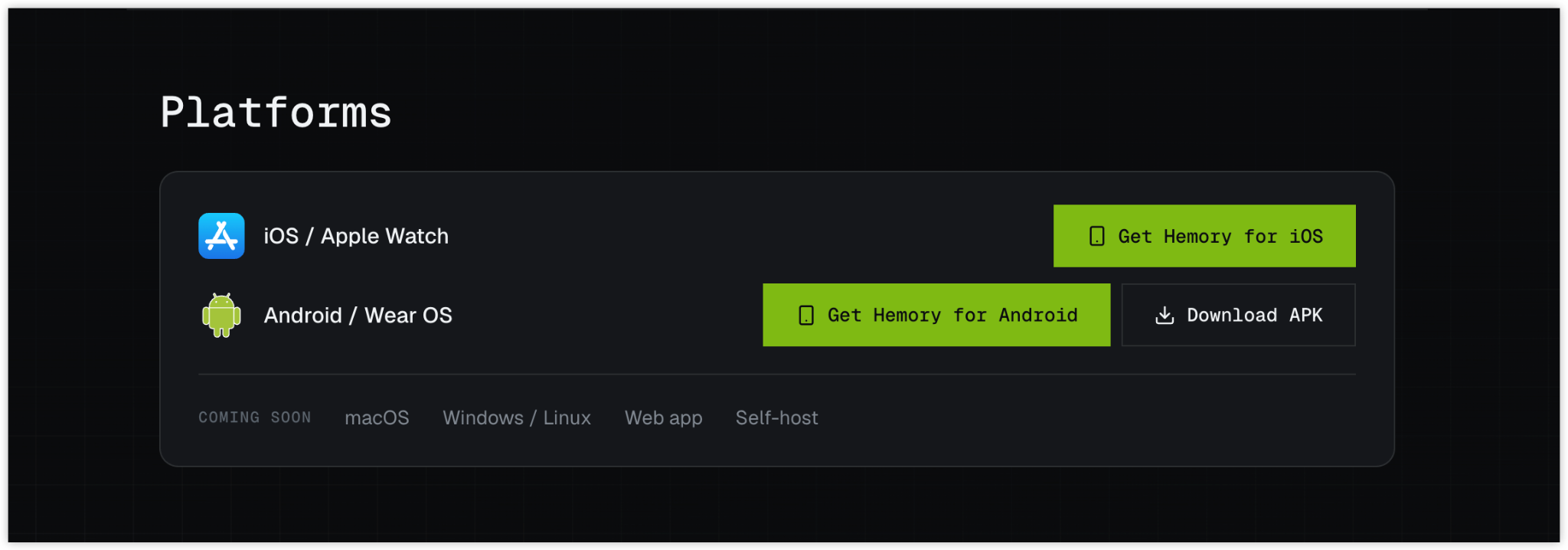
See the mobile and wearable platforms listed on the site.
Then follow the whole path from capture to use: where the record appears, how you find it later, and how you share or carry the result into your existing work. If you need colleagues to review a record, verify that they can access it through your intended workflow. Do not assume that a personal memory store automatically gives a team access or writes updates into a CRM or project tool.
6. Can you review and correct the result?
Before choosing, establish how you can inspect a transcript, summary, or AI-generated answer and what options exist when something is unclear. Depending on the task, useful review may include checking timestamps, speaker attribution, a transcript line, or the current record in another system.
Review proportionately. A routine recap may need a quick read; a decision that changes scope or a customer commitment deserves closer attention to wording, conditions, and who accepted it. Distinguish a proposal from an accepted decision, and a prepared update from one that has actually been shared or approved.
7. What are the practical limits and ongoing costs?
Check any limits that affect your use: capture availability, usage allowances, retention, export, data handling, and the cost of the plan or connected tools. Confirm these details from current product information and for the plan you would actually choose. Do not infer portability, deletion behavior, or universal access from the presence of transcripts or an integration.
Run a small, like-for-like evaluation
Use a few tasks that represent your actual work rather than trying to test every feature. For each candidate:
- Choose the same kinds of conversations or notes you need to handle.
- Capture or enter them using the intended device and workflow.
- Review the transcript, note, or summary for useful detail, clear attribution, and missing conditions.
- Search for a detail you might remember only approximately, then ask a follow-up if retrieval supports it.
- If AI access matters, try the specific connected assistant and verify what context it can reach.
- Record setup friction, review effort, platform gaps, and any unresolved permissions or data questions.
Compare what you observed against your priorities. A tool that creates excellent minutes may be the better choice when shared meeting records are the main deliverable. A note app may fit when you mainly need personal reminders. Conversation memory may matter more when later retrieval across captured discussions is central. If several jobs matter, weigh the trade-offs instead of expecting one feature label to answer the question.
Make the choice conditional on your priorities
Write down the two or three requirements that would make a tool useful in your workflow, then separate must-haves from preferences. For example, if your main need is approved meeting records, prioritize structure, review, and sharing. If you need to recover details from several captured conversations, prioritize retrieval scope and source context. If AI-assisted drafting matters, verify the precise connection and access path.
Before committing, resolve any gap that could change your decision: unsupported capture sources, unclear retrieval scope, unavailable platforms, or uncertain permissions. Keep a manual fallback for information that cannot be captured or retrieved. The right choice is the tool—or combination of tools—that supports the job you named with acceptable capture, review, and access requirements.
FAQ
Is a meeting-minutes generator the same as a conversation memory app?
No. A minutes tool typically emphasizes a structured meeting record, while conversation memory emphasizes preserving and retrieving information later. A product may offer both, so compare the outputs and retrieval scope you actually need.
Do I need transcripts if a tool provides summaries?
Not always. Summaries may be enough for a quick recap, but source wording or conditions can matter when reviewing a decision or interpreting an answer. Check whether you can inspect an underlying transcript or another useful source record when needed.
How can I compare tools if I cannot test every feature?
Choose a small set of representative tasks tied to your decision. Compare the same capture types, follow-up questions, platform conditions, and review steps across candidates. Verify any capability that would change your choice instead of treating a marketing label as proof.
Can an AI assistant use every conversation stored in a connected app?
Do not assume so. Access can depend on the product, connection, client, and permissions. Confirm the scope for the exact setup you intend to use, and review what the assistant returns before relying on it.
Next step
Take one real task you want a tool to support and turn it into a short evaluation checklist: the conversation source, the information you need to find later, the device or assistant involved, and the level of review required. Testing candidates against that same task will reveal more than comparing feature names alone.