

 Hemory Team
On this page
If you expect calls throughout the day, choosing a device for a conversation can mean balancing where it will sit, whether your phone will be nearby, and how long you need listening to run. For Hemory, the practical choice is between an iPhone and an Apple Watch—not a claim that one device is always better.
TL;DR
- Choose the device you can place appropriately, keep powered, and use for the expected session length.
- Apple Watch can independently capture and upload listening content. Hemory’s Features page lists 10 hours of listening and up to 30% battery consumption for Apple Watch Ultra 3 and Series 11; those figures are model-specific.
- Hemory documents listening pausing when an incoming call arrives and resuming after the call. Don’t assume the call itself is captured.
- The available product information does not establish a measured visibility advantage or a phone-side battery figure. Compare your actual setting and device rather than assuming a winner.
Start with the situation, not the device
Both options may make sense for a call-heavy day. Decide based on where you will be, how long the conversation will run, and what you need to do if a call interrupts listening. Hemory lists iOS and Apple Watch among its supported platforms. Its Features page describes Apple Watch capture as independent, but it does not establish a universal visibility or battery advantage over an iPhone.
| What matters | Apple Watch may fit when… | iPhone may fit when… |
|---|---|---|
| Phone access | You expect to be away from your phone and want independent capture. | The phone is already with you and you can place it where it suits the conversation. |
| Device placement | Wearing the watch works for the setting and the session. | You have a suitable place for the phone and can keep it there. |
| Session length and battery | Your watch model and remaining charge suit the planned session. | Your iPhone’s remaining charge suits the planned session; the supplied product information gives no phone-side listening battery figure to compare. |
| Incoming calls | You have accounted for listening to pause and resume around a call. | You have accounted for the possibility of interruptions and won’t assume listening continues through a call. |
| Visibility | The watch’s actual position fits the setting; don’t assume it will go unnoticed. | The phone’s actual position fits the setting and is workable for the conversation. |
These are decision prompts, not product test results. Pick the device that works in your circumstances, then use another source or ask a focused follow-up if a needed detail was not captured.
If your phone may be out of reach, consider Apple Watch
Hemory’s Features page describes Apple Watch as able to capture and upload listening content independently. That makes the watch a practical option to consider when you expect your phone to be elsewhere. The page does not specify every connection condition or a particular distance, so don’t assume a specific range or setup beyond the documented independent capture.
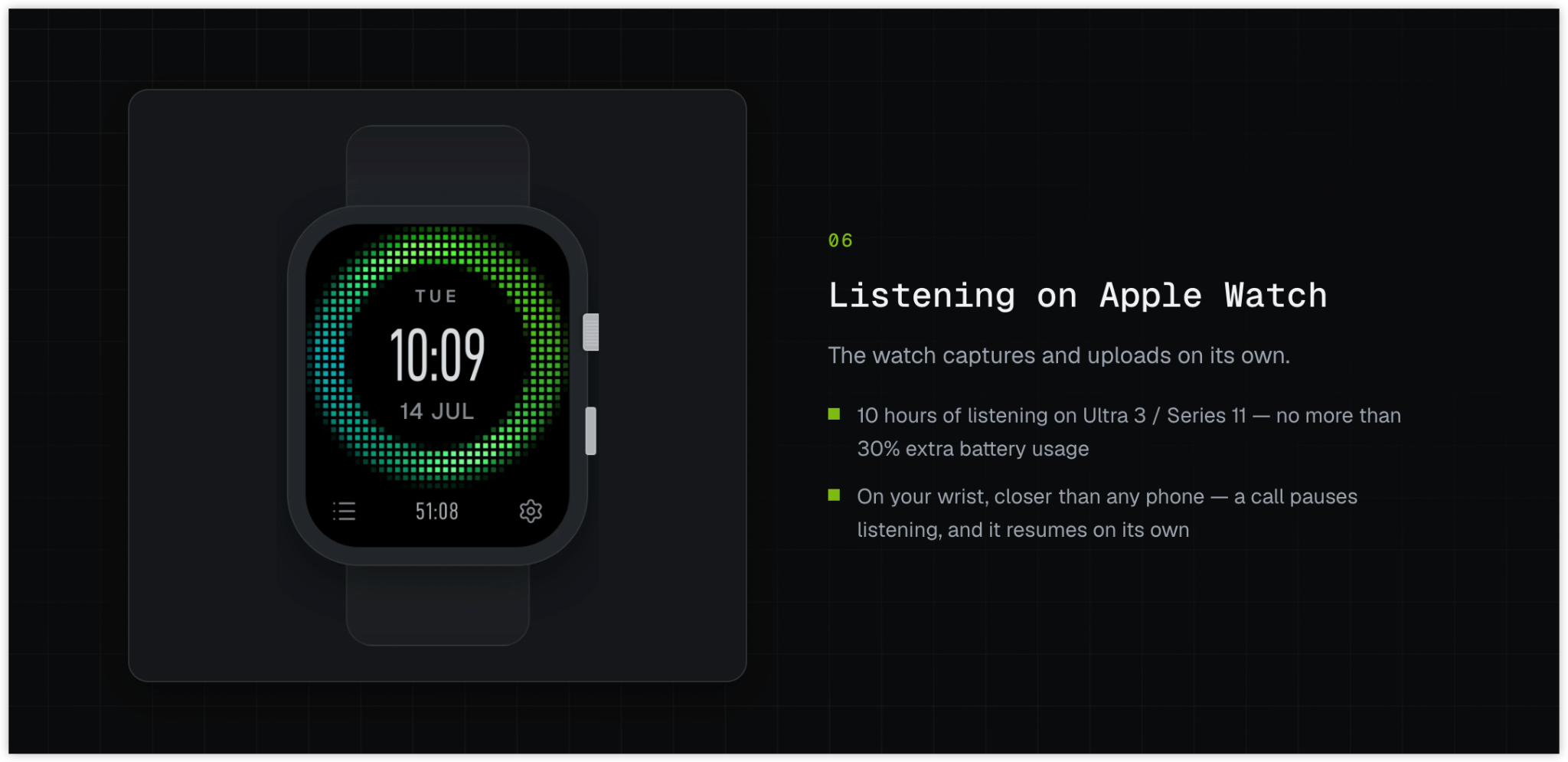
Hemory listening interface shown on Apple Watch.
Battery figures depend on the model. The Features page lists 10 hours of listening and up to 30% battery consumption for Ultra 3 and Series 11. Treat those as figures for those named models, not a general estimate for every Apple Watch. If your watch is a different model, the session will be longer, or the battery is already low, plan around your actual device rather than relying on those figures.
If you expect calls, plan for interruptions
Hemory’s Features page says listening pauses when an incoming call arrives and resumes after the call ends. That behavior is useful to factor into a call-heavy day, but it does not show that either device is better at capturing a call or recording conversation that happens during one. If an important exchange overlaps with a call, don’t assume it was captured; use another available source or ask a focused clarification if you need the missing detail.
Treat visibility as a setting-specific check
The available product information describes the watch as body-worn but does not provide a measured comparison of how visible it is versus a phone. Consider where each device would actually be placed and whether that placement suits the setting. A watch should not be assumed to go unnoticed, and a phone’s visibility depends on where you put it. Choose based on the real arrangement rather than a general claim about either device.
Make a conditional choice
Use this quick rule:
- Choose Apple Watch when independent capture is useful, wearing it fits the setting, and your specific watch model has enough battery for the planned session.
- Choose iPhone when it is already with you, you can place it appropriately, and its remaining battery suits the session.
- Reconsider the setup when the session may exceed the device’s available battery, a call is likely to interrupt an important exchange, or neither placement fits the setting. Use another available source for any detail that matters but may not be captured.
This is a choice between workable setups, not a universal ranking. The supplied information includes model-specific Watch figures but no corresponding iPhone battery figure, so it cannot establish which device lasts longer for a given person.
FAQ
Can Apple Watch capture listening content independently?
Hemory’s Features page describes Apple Watch as independently capturing and uploading listening content. It does not specify every connection condition or a particular operating range.
Does Hemory keep listening through an incoming call?
The Features page says listening pauses when an incoming call arrives and resumes after the call. It does not establish that the call itself is captured.
Which device has better battery life for a long session?
The available information does not provide a phone-side listening figure for comparison. It lists 10 hours of listening and up to 30% battery consumption for Apple Watch Ultra 3 and Series 11 only. Use the figures only for those models and account for your device’s actual charge.
Choose the device that fits the setting, session length, and likely interruptions. Preserving a conversation can let you stay focused on the discussion; afterward, review what was captured and use another source for any important gap.