

 Hemory Team
On this page
A watch that captures conversations throughout a day of meetings needs to last longer than a single session. But a published listening-hour figure does not tell you how much battery your particular watch will have left at the end of the day.
TL;DR
- Hemory’s published figures list 10 hours of listening and up to 30% additional battery use for Apple Watch Ultra 3 and Series 11. Don’t apply those figures to another model without confirmation.
- Listening time is not a full-day battery estimate. The published page does not specify the test conditions or define the baseline for the additional battery figure.
- Before relying on your watch for a long day, check its exact model and try a representative day of capture. Keep another way to record important conversations if an interruption would matter.
What do Hemory’s Apple Watch figures tell you?
Hemory’s Features page lists 10 hours of listening and up to 30% additional battery use for Apple Watch Ultra 3 and Series 11. Treat these as figures associated with those named models, not as a guarantee for every Apple Watch.
The page does not state the battery’s starting level, the watch’s condition, the settings used, or what baseline the “up to 30%” figure refers to. It also does not give a full-day battery total. So the figures can help set expectations for the listed models, but they cannot predict how much charge your own watch will have after a day of meetings.
The page’s mention of other models does not identify them clearly enough to establish whether the same figures apply. If you have a different watch, don’t assume it gets the same listening time or battery result; look for model-specific information or test it yourself.
Why listening time and battery life are different
Listening time describes the period Hemory is listening, not the watch’s total battery life for the day. A watch also has its normal power use, and results can vary with its condition, settings, and how you use it. A listening-hours figure alone does not account for those differences.
Hemory says an Apple Watch can listen and upload independently of a phone. That can make the watch a useful capture device when you are away from your phone, but independence does not mean the battery will last through every schedule. Hemory also says incoming calls pause listening and listening resumes after the call ends, so a call can interrupt capture even if the watch still has charge.
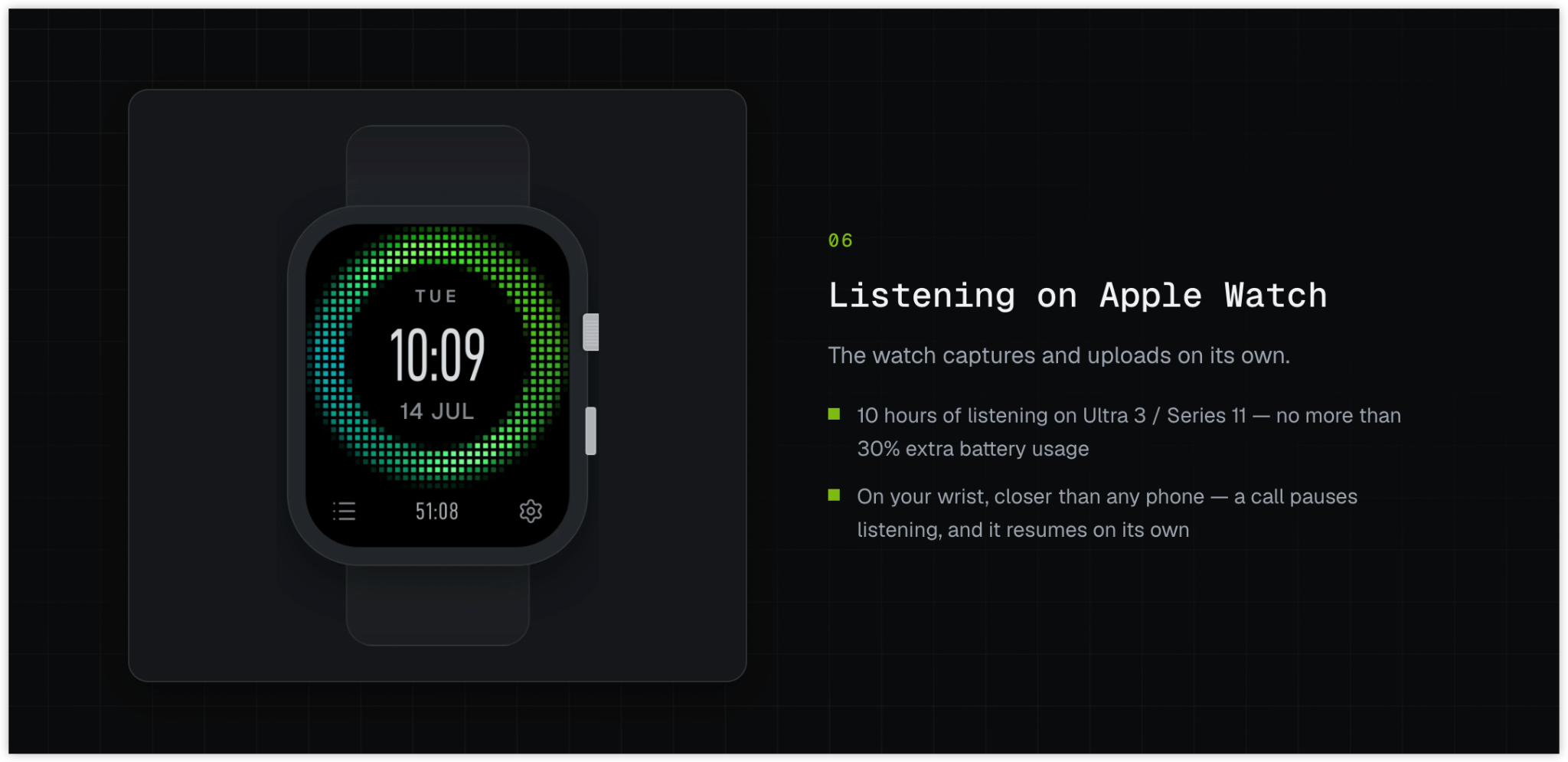
Hemory listening interface shown on Apple Watch.
How to decide whether to rely on your watch
Start with the exact watch model, then test the use case you actually have. A short test may not answer whether the watch can handle a day packed with conversations.
- Confirm the model. Find the exact model name in your watch settings or device information. Use Hemory’s published figures only for the models they name; treat other models as unknown until you have model-specific information.
- Set up a representative day. Start with the charge level you expect to have on the real day. Use Hemory and your watch as you normally would, including the schedule and other watch use you expect. You don’t need to reproduce every meeting, but the test should be long enough to reveal whether your usual routine leaves a comfortable margin.
- Check at natural breaks. Note the remaining charge at a few points during the day. If the battery is already low before the final important conversations, the watch is not a dependable sole capture option for that schedule.
- Choose a fallback. If the result is uncertain, plan a charging break or another supported way to capture the conversation. Keep the fallback ready before the day starts rather than assuming the battery will hold.
A test is useful only for the setup you tried. A different watch, battery condition, schedule, or pattern of use may produce a different result. If your test does not resemble the real day, treat it as a rough signal rather than a guarantee.
Make the decision based on the cost of a gap
If missing a conversation would have little consequence, a watch that may need a charge could still be convenient. If the day includes important discussions that are difficult to recreate, avoid making an untested watch your only capture method.
Hemory’s role is to capture and organize conversations for later use; it cannot recover a discussion that was never captured. The practical choice is therefore about both battery and the consequence of interruption: test the watch, then decide whether a charging plan or backup capture method is enough for your day.
FAQ
Does 10 hours of Hemory listening mean the watch battery lasts 10 hours?
No. The published 10-hour figure describes listening time, not a guaranteed battery runtime or the remaining charge after a full day.
Does the up-to-30% figure apply to every Apple Watch?
The published figures name Ultra 3 and Series 11. The page does not provide enough model detail to apply the same figure to other watches, so check your model rather than extrapolating.
Can I rely on the watch without testing it first?
That depends on how costly a capture gap would be. If the conversations are important, test your own watch under a similar schedule or arrange a backup before relying on it alone.
Will Hemory capture a call on the watch?
Hemory’s Features page says listening pauses when a call comes in and resumes after the call ends. Don’t assume the call itself is captured by that listening session.
The practical takeaway
Hemory’s published figures are useful starting points for Ultra 3 and Series 11, not a full-day battery promise for every watch. Check your model and try a realistic schedule. If you can’t accept a gap, plan a charging break or backup capture method before the day begins.