

 Hemory Team
On this page
A useful idea can come up over lunch, during a hallway conversation, or on a walk—and be hard to recall when you need it later. You do not have to treat every exchange like a formal meeting. Set up a simple way to capture the conversations you want to revisit, then search your saved records when a detail matters.
TL;DR
- Choose Manual Mode to start and stop listening yourself, or Schedule Mode to set listening times and receive reminders with one-tap start and stop actions. Schedule Mode does not silently record.
- Start listening when a conversation you want to keep begins, and stop when it is over. You remain in control of capture.
- Later, ask Hemory questions about your captured conversations. Everyday activities such as meals and casual chats may have lighter records than formal meeting summaries.
Choose a listening mode that fits your day
Use Manual Mode when your conversations happen unpredictably or you want to decide each time whether to capture one. Start listening when a useful exchange begins and stop when it ends.
Schedule Mode is useful when you have a predictable period in which you often want to capture conversations. Set the listening times, then use the reminders and one-tap actions to start and stop. A schedule is not background monitoring: you take the action to begin listening.

Set listening times for weekdays and weekends.
Hemory supports listening on iOS, Apple Watch, Android, and Wear OS. Choose a device and mode that suit the situation, and follow the controls on that device. If you do not want to record a conversation, do not start listening. Be considerate of the people with you and follow any relevant workplace policies and local requirements.
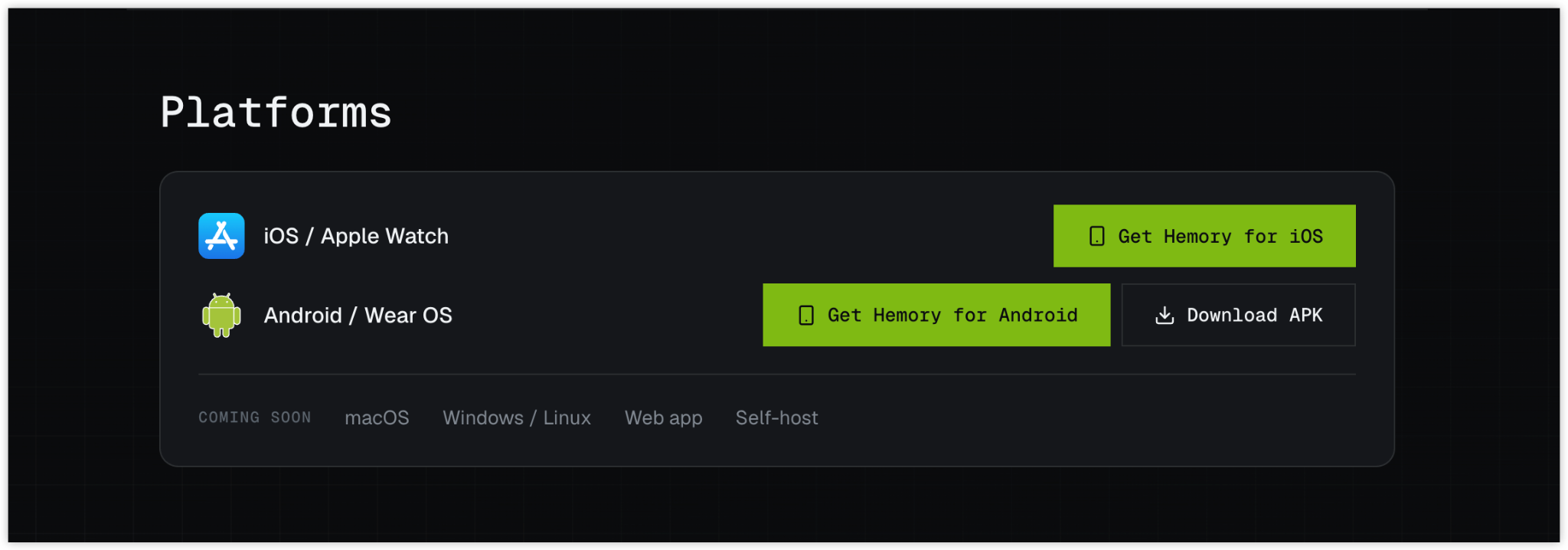
See the mobile and wearable platforms listed on the site.
Start when a useful conversation begins
You do not need to decide in advance which sentence will matter later. When you notice a conversation you want to keep, start listening and take part normally. Stop listening when the conversation is finished or you no longer want to capture it.
For example, a casual lunch conversation might include an idea for a project, a recommendation, or a question to follow up on. Capture the exchange if you expect to want that context later; you do not need to turn it into a meeting or write a full summary while listening.
Hemory creates a timestamped transcript for a listening session and organizes daily content into activity types, including Meal and Chit-chat. Summaries vary by activity: lighter conversations receive lighter records, rather than formal meeting notes with an agenda, decisions, and action items. A useful conversation is not guaranteed to become a structured meeting summary, and a transcript may not preserve every detail perfectly.

Revisit daily conversations in an activity timeline.
Find the conversation when you need it
Once the conversation has been captured, ask Hemory’s built-in Q&A about your Memory. Start with the question you want answered and add a real clue if it helps, such as the topic or a person you remember. Hemory’s Q&A supports follow-up questions and can retrieve across different captured conversation sessions over time.
For example, you might ask, “What was the book someone recommended over lunch?” If the answer is unclear, add a clue you genuinely recall, such as who was there or what you were discussing. Treat a result as a lead: review the relevant transcript context before relying on an important detail. If you do not find it, try another clue or use another source. A search that comes up empty does not prove the conversation was never captured.
If you did not start listening during the conversation, Hemory cannot recreate that exchange from memory. Use another available record or ask someone a focused follow-up instead. A voice recap you record afterward can preserve your recollection, but it is your retelling—not the other person’s exact words.
Make the habit easy to repeat
Keep the routine tied to a real need. Use Manual Mode when you want to make a decision in the moment; use Schedule Mode when reminders during a predictable period would help. Start listening only when you choose to capture a conversation, stop when you are done, and return to the saved record when a later question makes it useful.
This gives you a way to stay engaged in an informal conversation instead of trying to write down every potentially useful detail. The record can help you revisit what was said later, while your judgment—and the conversation itself—remain central.
FAQ
Does Hemory automatically record every casual conversation?
No. You start and stop listening in Manual Mode. Schedule Mode provides listening times, reminders, and one-tap start and stop actions; it does not silently capture conversations.
Will a lunch conversation get formal meeting notes?
Not necessarily. Hemory organizes activities by type, and lighter activities such as meals or casual chats receive lighter records rather than formal meeting summaries.
Can I find something if I forgot when or where it was said?
You can ask Hemory’s Q&A about captured conversations and refine your question with clues you remember. The records only cover conversations that were captured and are accessible; a search result is not a guarantee that every relevant detail will be found.
Start with one conversation you want to remember
Choose the listening mode that fits your day, then start and stop capture yourself when a useful informal conversation happens. When you need the detail later, ask about the saved discussion instead of relying only on memory or reconstructing the exchange from scratch.