

 Hemory Team
On this page
If you want to capture an in-person meeting without adding a meeting bot, start listening on a supported phone or watch before the conversation begins. Hemory’s Manual Mode lets you start and stop listening yourself; Schedule Mode sends reminders with one-tap controls. Afterward, you can review a timestamped transcript with Speaker labels and, when the activity is classified as a meeting, structured meeting notes.
TL;DR
- Hemory supports iOS, Apple Watch, Android, and Wear OS. Choose a device you can use comfortably during the conversation.
- Use Manual Mode when you want to control the start and stop yourself. Schedule Mode sends reminders and requires a tap to start or stop; it does not silently record.
- Expect a timestamped transcript with Speaker labels and AI cleanup. Meeting-type activities may also receive structured notes covering the discussion, decisions, and action items.
- Treat transcription and speaker attribution as aids, not guarantees. Review important wording and labels before relying on them.
Choose a supported phone or watch
Hemory currently supports iOS, Apple Watch, Android, and Wear OS. Choose a device that can stay with you and that you can operate without disrupting the meeting. If you plan to use a watch, confirm that the relevant Hemory app and listening option are available on your device.
macOS, Windows/Linux, the Web app, and self-hosting are listed as coming soon, so do not rely on them for a capture you need now.
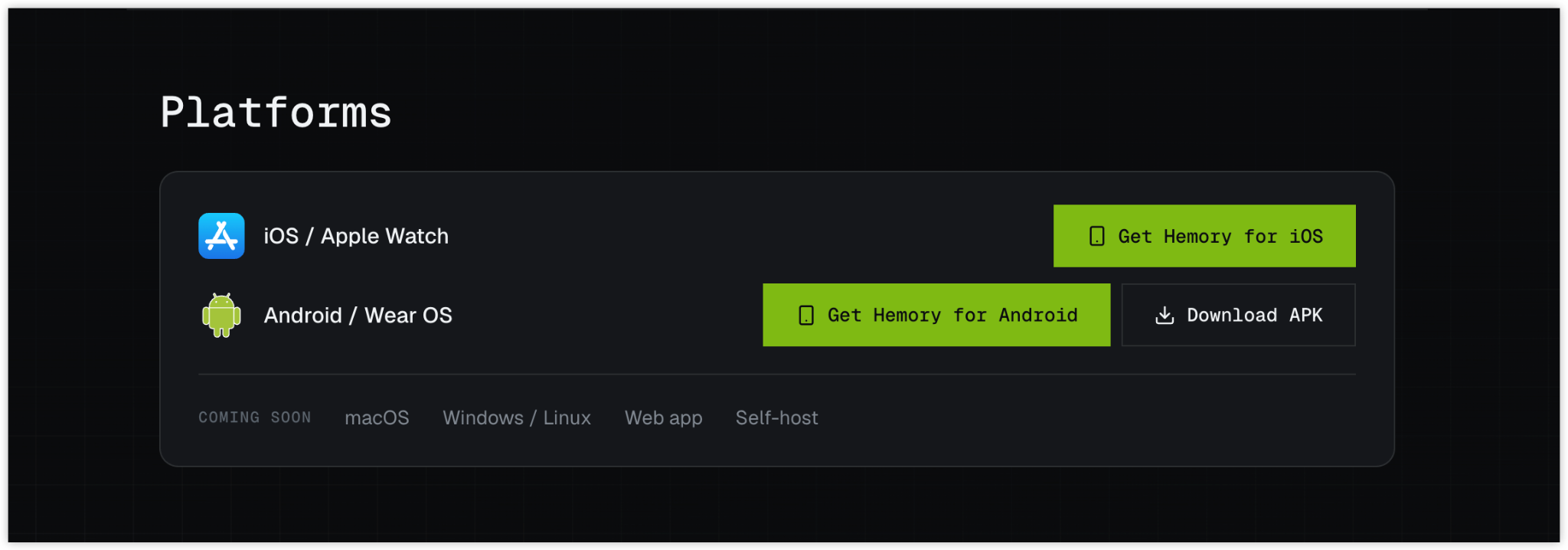
See the mobile and wearable platforms listed on the site.
Before recording other people, check the rules and workplace policies that apply to your situation. A recording feature does not determine whether you need to notify participants or obtain consent.
Start listening in Manual Mode
Use Manual Mode for a meeting you want to capture on demand:
- Open Hemory on your supported phone or watch before the discussion starts.
- Start listening in Manual Mode using the available start control.
- Participate in the meeting rather than trying to write down every potentially useful detail.
- When the discussion is over, stop listening using the available stop control.
The confirmed workflow describes Manual Mode as letting you start and stop listening. The exact controls may differ by platform, so follow the controls shown in the version you are using. Starting capture before the first relevant discussion helps avoid missing the opening context; stopping afterward keeps the captured session bounded to the conversation you intended to record.
Use Schedule Mode for recurring reminders
If you often want to capture discussions at predictable times, set listening times in Schedule Mode. Hemory sends reminders and offers one-tap start and stop actions. The reminder is a prompt to act; Schedule Mode does not silently open the microphone or record without your action.

Set listening times for weekdays and weekends.
Choose this mode when reminders fit your routine. If a meeting is outside the schedule or you want control over a one-off conversation, start and stop listening manually instead.
What you can expect after capture
A listening session produces a timestamped transcript with Speaker labels and AI cleanup. Timestamps help you locate a moment in the conversation. Speaker labels help distinguish voices, but they are not a guarantee of correct identity or perfect attribution. If a name or exact wording will affect a decision, review the relevant transcript lines rather than assuming every label is right.

Find individual statements in a searchable transcript.
Hemory also classifies activities based on conversation content. When an activity is classified as a meeting, it may receive structured notes covering topics, decisions, and action items. Other activity types receive summaries suited to those activities, so do not assume every capture will produce formal meeting minutes.

See how a meeting summary highlights decisions and follow-ups.
Transcript-line playback is available on the listening device. Use it when you need to revisit the surrounding audio for an important passage and playback is available. The product information does not specify an exact processing time, so do not rely on the transcript appearing by a particular deadline.
Review the result before using it
For routine reference, the transcript and meeting notes can help you revisit what was discussed without reconstructing the whole conversation from memory. Before acting on a consequential detail, check the wording, attribution, and status in context. A suggestion is not automatically a decision, and a mentioned person is not automatically the owner of an action.
If an important point is missing or unclear, use another available record or ask someone who was part of the discussion. A transcript can preserve captured speech, but it cannot recover a conversation that was not recorded or guarantee that every spoken word was transcribed correctly.
FAQ
Does Schedule Mode record automatically?
No. It sends reminders and provides one-tap start and stop actions. You still choose when listening begins and ends.
Will every speaker be identified by name?
No. Speaker labels may help distinguish voices, but attribution is not guaranteed. Unconfirmed speakers can remain anonymous, so review a label when identity matters.
Does every listening session produce meeting minutes?
No. Hemory classifies activities based on conversation content. Activities classified as meetings may receive structured notes; other activity types receive different summaries.
Capture the discussion, then review what matters
Choose a supported device and the listening mode that fits the meeting. Starting and stopping capture yourself—or responding to a Schedule Mode reminder—lets you stay focused on the discussion instead of trying to record every detail by hand. Afterward, use the transcript and any meeting notes as a starting point, and review consequential wording or attribution before you act.