

A customer’s explanation, a project constraint, or an idea shared over lunch may become useful weeks later. Hemory turns the conversations you choose to record into searchable transcripts and summaries, so you can revisit what was said and use it to answer new questions. A discussion that helps you understand a customer’s workflow today may inform a proposal or a follow-up interview tomorrow.
TL;DR
- Hemory turns captured conversations into searchable transcripts and summaries you can revisit.
- Search by topic or ask a specific question to recover details, understand reasoning, and connect separate discussions.
- Reuse the same memories for research, planning, and new drafts, including work with compatible AI agents.
Why conversations are worth returning to
Conversations contain more than their immediate outcomes. Alongside a decision or request, people explain what they are trying to achieve, describe a workaround, question an assumption, or mention a limitation. These details help you understand how a conclusion was reached and when it applies.
Some of that context makes it into a brief or meeting summary. Other details may seem peripheral at the time. A concern raised during a customer visit can become relevant to a later proposal; an informal discussion can explain why an earlier approach was set aside.
With Hemory, you can save these informal exchanges alongside formal meetings and personal voice notes, then revisit them when a new question arises.
How Hemory makes spoken context searchable
Spoken information arrives in fragments. A customer describes a process, mentions an exception later, and explains the reason only after a follow-up question. Making that exchange useful afterward means preserving enough of the discussion to find both the detail and its background.
When you start listening in Hemory, it captures and transcribes the conversation. Hemory organizes saved conversations into activities and summaries, with speaker information to help you revisit the discussion. Meeting summaries can include decisions and action items. Choose conversations that are appropriate to record, with the people involved aware and comfortable with the recording.
The organization provides several ways back into the material. A timeline helps when you remember roughly when something happened. Activity summaries and speaker information help you identify the relevant discussion. Search and follow-up questions let you explore the content in relation to a specific need.
A summary offers an overview; the saved conversation provides context to revisit when your question becomes more precise. You can begin with a broad topic, locate the relevant discussion, and ask about a requirement, explanation, or condition within it.
This is the practical meaning of searchable memory in Hemory: captured conversations remain available for retrieval and further use. A discussion that first helped you understand a client’s situation can later inform a proposal, a follow-up interview, or a review of an earlier decision.
For turning a meeting’s immediate commitments into tasks, see how to create a to-do list from meeting conversations with Hemory.
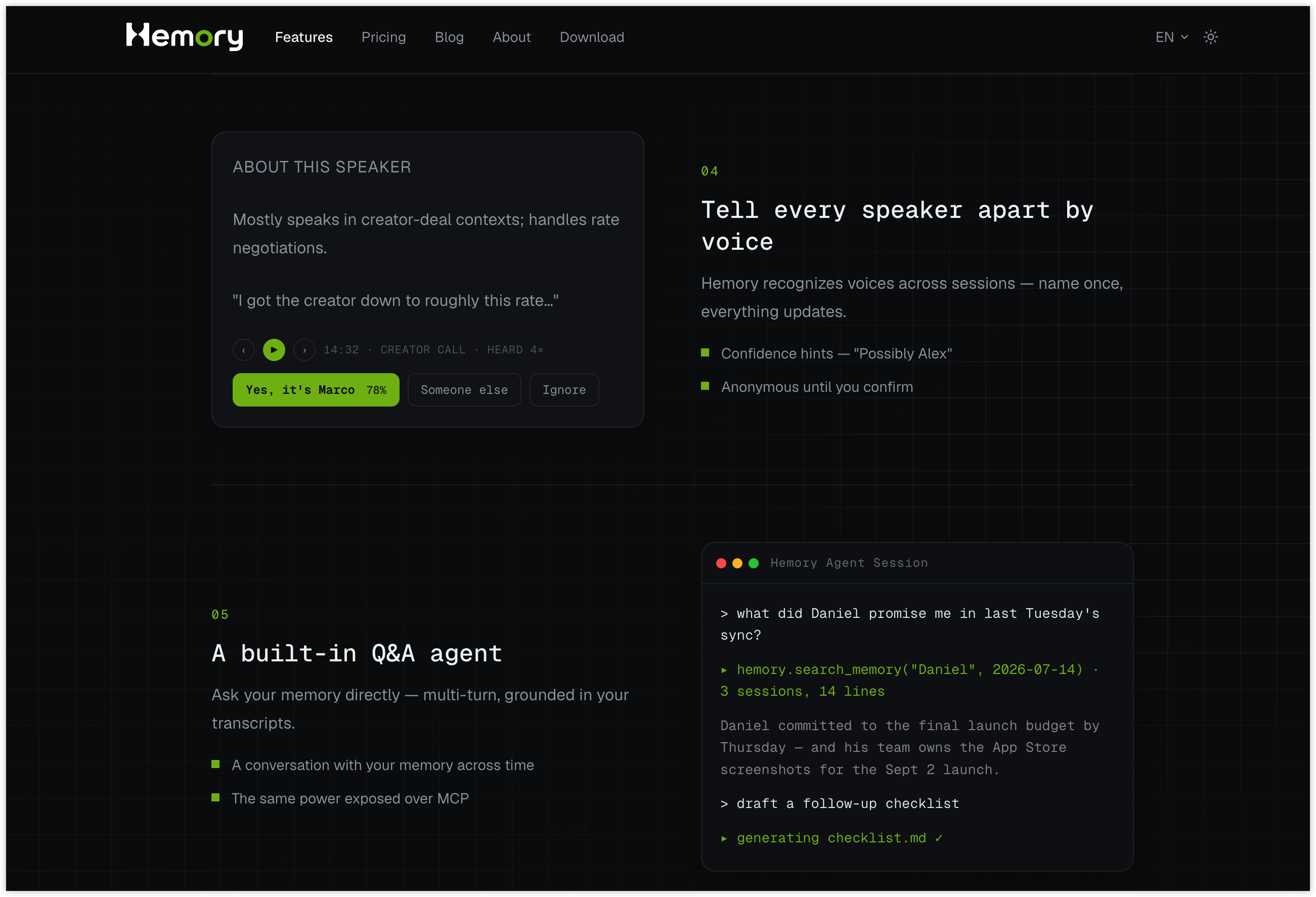
Hemory’s conversation memory Q&A demo
Four ways to put conversation memory to work
Recover the details behind a request
Remembering only the main point can leave out important details. “The client wants a report” may omit who uses it, which systems are involved, or what the client does manually today.
Hemory helps you return to the saved discussion and retrieve the details of the customer’s workflow. A workaround mentioned in passing may become relevant when you investigate a problem that was not on the agenda at the time. Retrieving the customer’s description gives you specific material to examine as your understanding develops.
This is particularly useful when you remember that something was discussed but cannot recall the exact exchange. A topic, person, or approximate time gives you a starting point for finding it again.
Understand the reasoning behind a decision
A decision is easier to reassess when you can recover the considerations behind it. A solution may have been deferred because of timing, a dependency, or an unresolved question. Those reasons matter when circumstances change.
By revisiting the relevant conversation in Hemory, you can recover the constraints and alternatives that were actually discussed. That helps you distinguish a temporary compromise from a longer-term preference and decide which assumptions need another look.
This also makes it easier to explain the decision to others. You can refer to the discussion rather than reconstructing the reasoning from memory.
Connect information across separate discussions
A topic can develop through a customer interview, a spontaneous conversation with a colleague, and a voice note recorded afterward. Each contributes a different part of the picture.
Hemory’s searchable memory helps you find the relevant conversations and voice notes and review them together. You can compare what different people meant by the same request, trace how an idea developed, or identify a question that remained unresolved across several exchanges.
Keeping track of each contribution’s source and timing matters here. It lets you distinguish a recurring observation from one person’s suggestion, and an earlier position from a later update. Those distinctions make the collected context more useful for analysis and preparation.
Carry real-world context into new work
New work often requires background gathered for a different purpose. Customer conversations can inform a research brief; an earlier discussion of constraints can help frame a proposal; personal voice notes can supply ideas for an article. In Hemory, you can return to the relevant memories and assemble the observations, reasoning, and open questions that matter to the work now.
Hemory also connects to compatible AI agents through the Model Context Protocol (MCP), allowing them to retrieve relevant saved conversations for use in new work. That gives a connected agent access to relevant conversation context when helping you develop a brief or explore an idea. You can review how it interprets the material, checking which points come from the recorded discussions and which are suggestions that need further investigation.
Understanding the work behind a feature request
Consider a product manager reviewing requests for a data export feature. Over several weeks, they capture customer visits and an informal internal discussion in Hemory.
The following is an illustrative example.
| Conversation | What was said |
|---|---|
| Customer visit | “Every Friday, I download individual transactions and match them against our finance system.” |
| Separate client discussion | “I export the summary so my director can review it without logging in.” |
| Informal discussion with a colleague | “A scheduled report might solve the sharing request. Reconciliation would still need transaction-level data.” |
Later, the product manager needs to understand the work behind the requests. They use Hemory to find the relevant discussions around exports, reporting, and reconciliation, with a question in mind:
“What are customers trying to accomplish when they ask for exports, and what did they say about their current process?”
The retrieved material gives the manager two different needs to investigate: reconciling detailed records across systems, and sharing a summary with someone outside the product. A scheduled report is an option suggested by a colleague; whether it meets the customer’s needs still requires validation.
The first customer conversation can also serve several purposes over time. On the day of the visit, it helps document the current reconciliation process. Before a later interview, the manager revisits it to identify unanswered questions about fields, exceptions, and manual steps. When evaluating a proposed reporting feature, they return again to ask whether the design supports the transaction-level work the customer described.
The source conversation stays the same; the question changes. Hemory makes the relevant discussions available to revisit, while the product manager evaluates what they support and what still needs validation.
FAQs
What is searchable conversation memory?
Searchable conversation memory is saved conversation content that you can find and revisit when you need it. Hemory records and organizes the conversations you choose to capture, helping you retrieve details and context for later questions and work.
Does Hemory only work with scheduled meetings?
No. You can use Hemory to capture customer discussions, informal exchanges with colleagues, brainstorming sessions, and personal voice notes, as well as formal meetings. Choose conversations that are appropriate to record, with the people involved aware and comfortable with the recording.
Can I use the same conversation for different tasks?
Yes. A customer conversation might first help you understand an existing process, later inform research questions, and eventually help you assess a proposed solution. Hemory keeps the captured context available to revisit as those needs develop.
Can AI agents use my saved Hemory memories?
Hemory provides an MCP connection through which compatible AI agents can use saved memories as context. For example, a connected agent can help organize observations and constraints from relevant conversations into a research brief. You can review its interpretation against the source material.
Build memory for questions you have not asked yet
You do not need to predict every future use of a conversation. Start with exchanges you expect to build on: customer discussions, project conversations, idea development, and spoken reflections you want to revisit.
As you capture and organize them in Hemory, you build a body of context that can support new questions over time. The same material can help you recall a requirement today, understand its background next week, and draft a proposal later.
That memory depends on what you have recorded and kept. When an interpretation informs a decision, review the relevant transcript to check what was said and in what context.
Choose a conversation worth returning to, capture it with Hemory, and come back when you have something new to ask.