

 Hemory Team
On this page
Four ideas for one feature surfaced in a single week: a remark in the hallway after standup, a customer’s complaint on a call, a thought on a walk, and a side comment in a design review. None of them got typed. A week later you owe a PRD, and the work begins with reconstructing what those ideas actually were — which one the customer raised, what the walk thought was really about, and whether the hallway remark was a request or just an observation.
That reconstruction is the part an AI agent can now take on, but only under a condition that is easy to skip: the ideas have to have been recorded somewhere the agent can reach. What follows is how a spoken idea travels from a conversation into a draft, which part of that path belongs to Hemory, which belongs to the agent, and which stays with you.
Key takeaways
- A spoken idea is only reusable later if something captured it. An idea that never reached a record cannot be retrieved by any agent, however you prompt it.
- The job splits three ways. Hemory records and organizes the conversation; a supported connected agent retrieves the relevant parts and drafts; you set the goal and decide what the draft is allowed to say.
- Retrieval does not do the writing. The agent brings its own reasoning and generation, and Memory supplies the material it would otherwise have to be told.
- A PRD drafted from captured ideas is material for review, not approved scope. Check what is current, what was only floated, and what still has no owner.
- Nothing wakes your agent on your behalf. You start the task, and the ideas have to be reachable from that connection for it to work.
What a captured idea actually is
Two things get confused here. One is a recording — an audio file sitting on a phone. The other is a record that can be read, searched and reasoned over. Only the second can feed a draft.
In Hemory, a listening session is transcribed with timestamps and speaker labels, cleaned up by AI, and classified into one of six activity types: Meeting, Work, Meal, Social, Learning or Chit-chat. Summaries follow that classification, so a meeting may come back with agenda, decisions and action items, while a lighter session gets a short summary rather than a formal record.
The useful consequence is that an idea arrives with its surroundings. A bare line such as “we should cache field notes offline” is thin on its own; the exchange around it usually carries the reason, the constraint, or the objection that decides whether it is worth building. That context is what makes a captured remark usable a week later, when the sentence alone would not be.
It is also worth separating capture from recollection. If you record a voice note afterwards summarizing what you discussed, that is your retelling of the conversation — helpful, but not the same as the record of what the other person said.
An idea you never recorded is not context
The usual complaint about AI and memory — that it forgets what you told it — does not describe this situation. The agent did not forget your ideas. It was never given them.
The manual work that follows is not just re-explaining one item. You have to decide in advance which of twenty remarks will matter to a document you have not written yet, write those down, and hope you guessed right. Anything you leave out is gone, because there is no record to return to.
That is the burden capture removes: not typing, but predicting. When the discussion is preserved as it happens, you can take part in it and still have the material available later.
Who does what
| Stage | What happens | Who does it |
|---|---|---|
| Capture | A conversation or spoken note becomes a timestamped transcript with speaker labels and a summary | Hemory, in a session you start manually or schedule |
| Retrieval | The parts relevant to the drafting task are found across sessions | A supported connected agent working through Hemory Memory, or Hemory’s built-in Q&A |
| Drafting | Problem statement, requirements, open questions and structure are written | The external agent |
| Judgment | Scope, priorities, what is still current, what gets approved | You and your team |
The Features page describes the built-in Q&A Agent as answering from transcripts with multi-turn follow-up and retrieving across different conversation sessions, and notes that the same capability is exposed over MCP. That is the basis for treating retrieval as part of the agent’s job rather than a step you perform first.
What a connection does not do is hand over everything. An agent reaches the material its connection and tool list allow, and different clients do not necessarily expose identical scope or permissions. A published list of supported clients says a connection is offered; it is not independent proof that every client behaves the same way.
What the draft looks like
Consider a product manager with three captured sessions from the week: a customer call about technicians losing field notes where there is no signal, a design review where two engineers argued about sync, and a walk during which they talked through a lighter capture screen. They connect a supported agent and give it the goal in a sentence, plus a few clues:
Draft a PRD outline for offline capture of field notes in the mobile app. Use what I discussed this week about the technician's offline problem, the sync debate, and the lighter capture screen.
A draft might come back like this:
Problem. Field technicians lose notes in areas without connectivity, and re-enter them at the end of the day.
Requirement 1, proposed. Notes are saved locally and queued for upload when a connection returns.
Open question. How sync conflicts are resolved was raised and left unsettled.
Floated, not agreed. A lighter capture screen was discussed this week; no decision was recorded.
The interesting part is what the draft leaves you to do. Priorities stay marked as proposed until the team confirms them. The customer’s complaint is a fact from the call; your explanation of why it happens may not be, and the two belong in different paragraphs. The capture-screen idea may have been raised and dropped inside the same conversation — keeping it as an open question is honest, promoting it to a requirement is not.
That division is the point. The agent did the compiling and the writing. You did the deciding.
Where the sequence breaks
Most failures here are ordinary, and each has a different fix.
The idea was never captured. Nothing to retrieve. Use another source, or ask the person who raised it. Capture only helps going forward if you start it.
The capture exists but the connection cannot reach it. Access depends on the connection and its tools. If a session sits outside what the agent can read, the answer will look thin rather than obviously wrong.
The record is too thin. A single sentence without its surrounding exchange returns little. Point the agent at the session, or add the constraint you remember.
Recollection outruns the record. “We agreed to do X” and “we could do X” sound similar a week later. Check the transcript before the draft hardens around a promise nobody made.
The draft goes nowhere on its own. Hemory does not write into your project tracker, and an MCP connection does not authorize arbitrary external actions. Moving the PRD into the team’s system is a handoff you still make.
What stays with you
- The goal: what this document is for, who reads it, and how detailed it should be.
- Current facts the capture cannot know — what shipped since, capacity, a decision reversed two days ago. The draft’s inputs are as current as the sessions behind them.
- The judgment on priority, and the difference between proposed and approved.
- A read of the draft against the records it came from: who said what, and whether the attribution holds.
None of this is a reason to do the extraction by hand first. It is a reason to review the draft’s consequential claims rather than accept the whole document.
Next step
If the discussions are already in Hemory and you owe a PRD this week, the next move is small. Connect a supported agent, state the goal in one sentence, name two or three clues from the week, and read the draft against the sessions it came from. What you skip is the hour usually spent retyping ideas and trying to remember which conversation each one came from.
If the discussions are not captured yet, start there. The next conversation you record is material you will not have to reconstruct.
FAQ
Do I need to write up my spoken ideas before an agent can draft from them? No. Captured sessions are already transcribed, labeled and summarized by activity type, so the material exists as text. What you supply is the task — what you want drafted and enough clues to locate the relevant sessions. Writing your own summary of each conversation first is optional, not a prerequisite.
Can an agent draft a PRD from ideas I only remember? Only from what you type into the conversation. That is you retelling, and anything you leave out is unavailable to the agent. Hemory cannot retrieve a discussion that was never recorded.
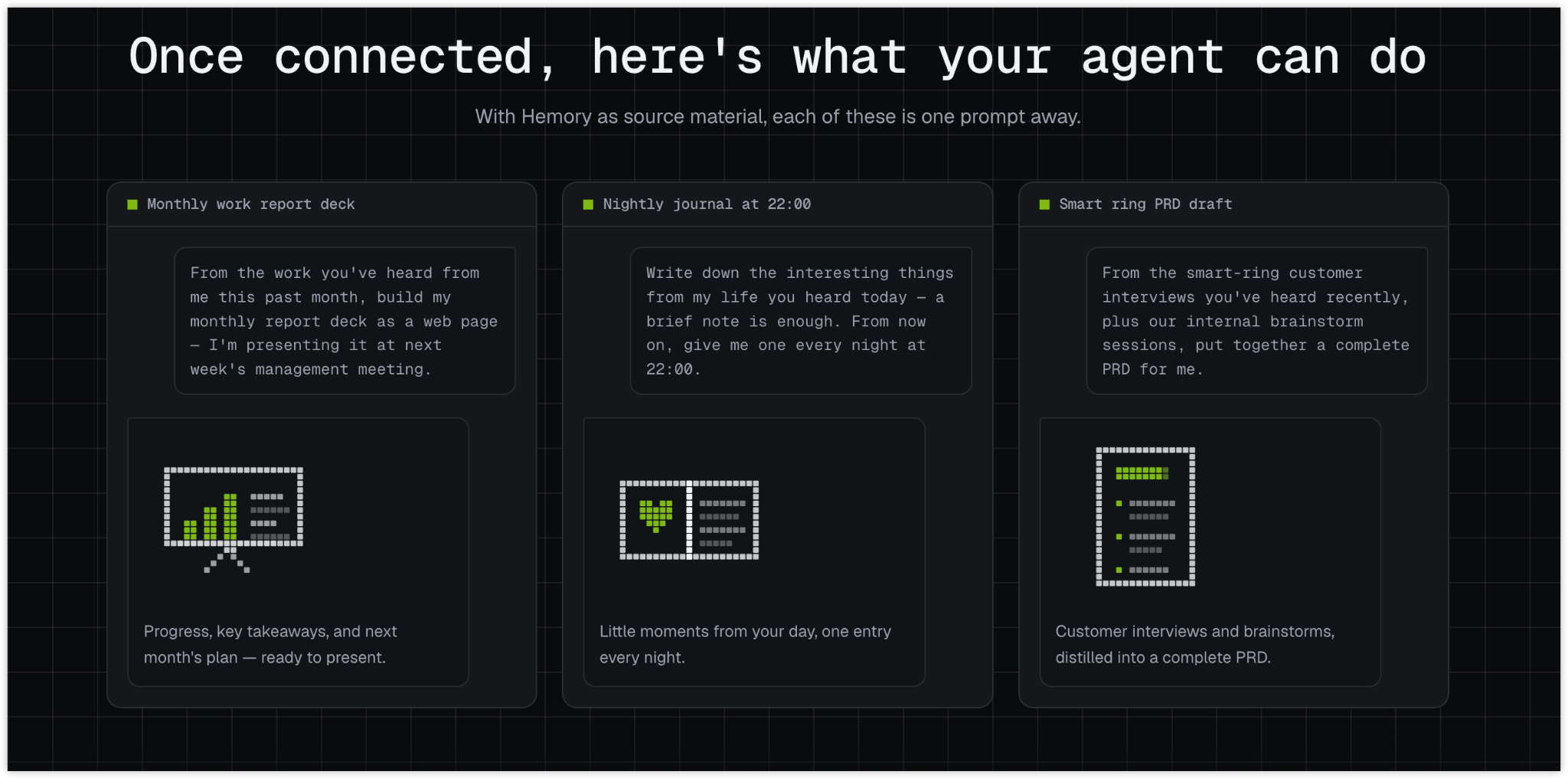
Does Hemory write the PRD itself? No. Hemory records, organizes and makes conversation context retrievable; the drafting happens in the agent you connected. Hemory’s published examples include a PRD built from customer interviews plus brainstorming, but that is an outcome produced by an external agent, not a native Hemory document feature.
How do I check that the draft used my ideas rather than guesswork? Read each claim against the sessions behind it. Anything that changes scope, priority or a rejection should be traceable to something recorded. Statements without a trace are the agent’s inference and should be labeled as such. A failed search does not prove the idea was never captured — it may be phrased differently, or sit outside the connection’s reach.
