 Hemory Team
On this page
Product discussions often describe a feature in pieces: a goal in one meeting, a constraint in another, and an unanswered question in a refinement session. Turning that history into acceptance criteria can mean reconstructing the discussion before you can draft anything. A connected, supported AI agent can retrieve relevant conversations already captured in Hemory and help shape a first draft. You still decide whether the evidence supports each criterion and whether the wording is ready for the team.
TL;DR
- Give the agent the feature and goal, then let it retrieve relevant captured discussions through a supported connection.
- Request testable criteria with the source statement behind each one; keep missing decisions and assumptions separate.
- Check the source, status, conditions, and current product context before editing and approving the draft.
1. State the feature and the outcome you want
Start with the feature or user need, not a detailed summary of every past meeting. Include any current information that changes the task, such as a newly agreed scope or a target platform. Be clear about what the feature should help someone do.
For example, you might say: “Draft acceptance criteria for saved filters. The goal is to let users return to a filter they have already created. Use relevant captured product discussions, and flag any decisions that are still unclear.”
That gives the agent a search direction while leaving it room to retrieve relevant background you may not recall. It does not mean the agent will find every relevant exchange. The conversation must already have been captured in Hemory, and the connected agent must have access to Hemory retrieval through a supported connection. Available tools and access can vary by agent and connection.
2. Let the agent retrieve relevant captured discussions
Ask the connected agent to find conversations relevant to the feature and goal. You do not need to prepare a complete chronology or manually summarize every meeting before it can start. Hemory preserves and organizes captured discussions; the connected agent uses the context available to it to retrieve material and draft.
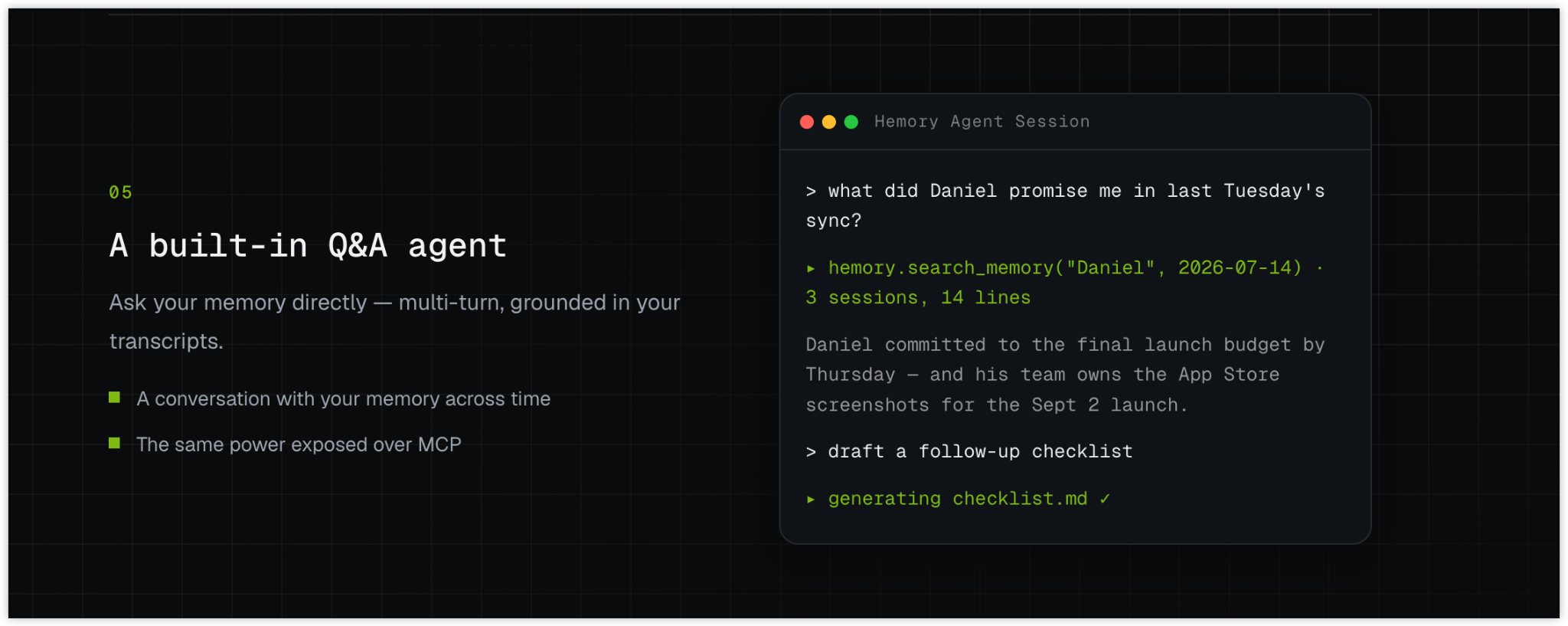
A useful request is:
Find captured discussions relevant to saved filters and the goal of letting users return to a filter they created. Draft acceptance criteria from the retrieved material. For each criterion, include the supporting statement and its meeting or transcript reference when available. Separate confirmed decisions, proposals, and unresolved questions. Do not invent owners, deadlines, behavior, or approval.
Treat retrieved material as evidence to examine, not proof that the search was complete. If the agent cannot retrieve relevant conversations or show enough source detail to assess a claim, use another available record, ask a focused question, or provide the relevant passage yourself. Hemory cannot supply a discussion that was never captured.
3. Ask for criteria that can be tested
Acceptance criteria should describe observable behavior under stated conditions. A common format is Given / When / Then:
| Part | What it describes |
|---|---|
| Given | The relevant starting state or condition |
| When | The user’s action or triggering event |
| Then | The observable result that defines acceptable behavior |
Use this format when it makes the behavior clearer. A concise bullet can work just as well if it is specific and testable. Ask the agent to keep each criterion focused on one behavior and to avoid turning suggestions or unanswered questions into settled requirements.
4. Keep evidence and open questions visible
A draft should distinguish what the discussion supports from what still needs a decision. For every criterion, look for a source statement or reference that you can check. Ask for exact wording when available, but do not assume the agent can provide a verified link or a precise transcript citation. Confirm its reference in the captured discussion before relying on it.
Consider a discussion that says, “Users should be able to save a filter and return to it later.” A cautious draft might be:
Draft interpretation: Given a user has saved a filter, when they open their saved filters, then they can select that filter and view the criteria they saved.
Needs clarification: Does “return to it” mean restoring the filter on the same device only, or should it also be available on other devices?
The criterion is a proposed interpretation of the statement, not evidence that the team agreed on cross-device behavior. Keep the unresolved question visible rather than filling in an answer the discussion did not provide.
5. Verify and edit the draft before using it
Review each criterion against its supporting discussion and current product information. Focus on details that could change implementation or testing:
- Source and attribution: Does the cited discussion actually support the behavior? Is the speaker correctly identified where that matters?
- Status: Was the behavior agreed, or was it only suggested or left open?
- Conditions: Are prerequisites, exceptions, and constraints included where they affect the outcome?
- Testability: Could someone determine whether the criterion passes without guessing what it means?
- Current state: Has newer information changed or narrowed an earlier requirement? A later mention alone does not prove an earlier agreement was superseded.
A transcript is a record of speech, not a guarantee that the speech was complete or that every statement became a decision. If wording, identity, or status affects the criterion, check the relevant transcript or current team record. Add new facts only when you have a current source for them.
When the draft is ready, edit it for clarity and carry it into your team’s normal product workflow. The agent generates a draft; you and your team decide what to accept, change, or leave unresolved.
FAQ
Can an AI agent draft acceptance criteria from meeting notes?
Yes, if it can access the relevant notes or captured discussions. A connected agent can also retrieve context from Hemory when the conversations were captured there and the supported connection provides access. Review the evidence and decisions before using the draft.
Do I need to summarize every meeting first?
No. You can start with the feature and goal and let a connected agent retrieve relevant captured context. If it cannot access a needed source, provide the relevant material or use another record rather than assuming it found everything.
What if a discussion mentions an idea but no one approved it?
Keep it labeled as a proposal or open question. Do not turn it into a confirmed acceptance criterion unless the team’s decision process supports that conclusion.
Should every criterion include a transcript quote?
Include enough source detail to check important claims, such as a supporting statement and a meeting or transcript reference when available. A quote is useful, but it does not by itself establish that the statement was approved or remains current.
Turn captured discussion into a reviewable draft
Start with one feature goal and let a supported connected agent retrieve the relevant discussions already captured in Hemory. That can reduce the work of searching across sessions and retelling the background. Keep source evidence and unresolved questions beside the criteria, then use your judgment and team process to approve the final wording.