

 Hemory Team
On this page
Hemory lets supported AI agents retrieve context from the same real-world conversations, so you can move from research to coding or writing without repeatedly preparing and explaining the background. Each agent connects separately; its chats, drafts, files, and task state are not automatically shared with other agents through Hemory.
TL;DR
- Reuse the conversations you have already captured. Each connected agent can retrieve the background relevant to its task, reducing repeated file preparation, uploads, and explanations.
- Give each agent a task, not a retelling of every meeting. Hemory makes the conversation record available; the agent searches it and uses the results in its own work.
- Pass along conclusions that should guide the next step. An approved brief or specification can carry a decision from one agent to another, while either can retrieve the original discussion when needed.
- Keep the sharing boundary clear. A Hemory connection does not automatically synchronize agent chats or work in progress. Retrieved excerpts enter the receiving client’s context and are subject to its data handling.
Why the same conversations matter to several agents
Suppose you spent Tuesday afternoon on a customer call and an internal product discussion about a new export feature. On Wednesday, you use one agent to analyze the request, a coding agent to implement it, and another assistant to draft release notes.
Each task needs part of the same background. The research agent needs the customer’s problem and constraints. The coding agent needs the reasoning behind the requirements. The writing assistant needs to understand what the change will mean for the customer.
Without an accessible conversation record, you may have to assemble that background separately for each tool. Every retelling takes time and creates another opportunity to leave out a condition or blur the difference between an idea and an agreed decision.
Hemory reduces that preparation at the source. You record the discussions on a supported phone or watch, and Hemory transcribes and organizes them into searchable memory. Later, connected agents can retrieve what they need from that record.
You do not have to prepare a new version of the conversation every time you change tools. A detail omitted from the first agent’s brief can still be found by the next agent. Conversations captured before you knew exactly how you would use them can support several tasks over time.
How agents use the same Hemory memory
Each agent establishes its own connection to Hemory. When a task needs background, it searches the conversation memory available through that connection and brings the relevant results into its current session.
For example, two agents connected to the same Hemory memory can ask different questions about the export discussions:
| Agent’s task | Context it needs |
|---|---|
| Analyze the customer request | The problem the customer described, requested behavior, and constraints |
| Plan the implementation | The team’s decisions, technical dependencies, and unresolved details |
| Draft customer communication | The customer’s wording and the reasons the feature matters |
The agents can use a common source while selecting different passages for different purposes. They do not need to load the entire conversation history to begin.
Hemory provides access through MCP, the Model Context Protocol, which connects compatible AI clients to external tools and data. Its official site lists clients including Claude Code, Codex, and Cursor. Hemory also has a separate ChatGPT connection. Set up the supported connection for each tool you want to use; one tool’s connection does not configure the others.
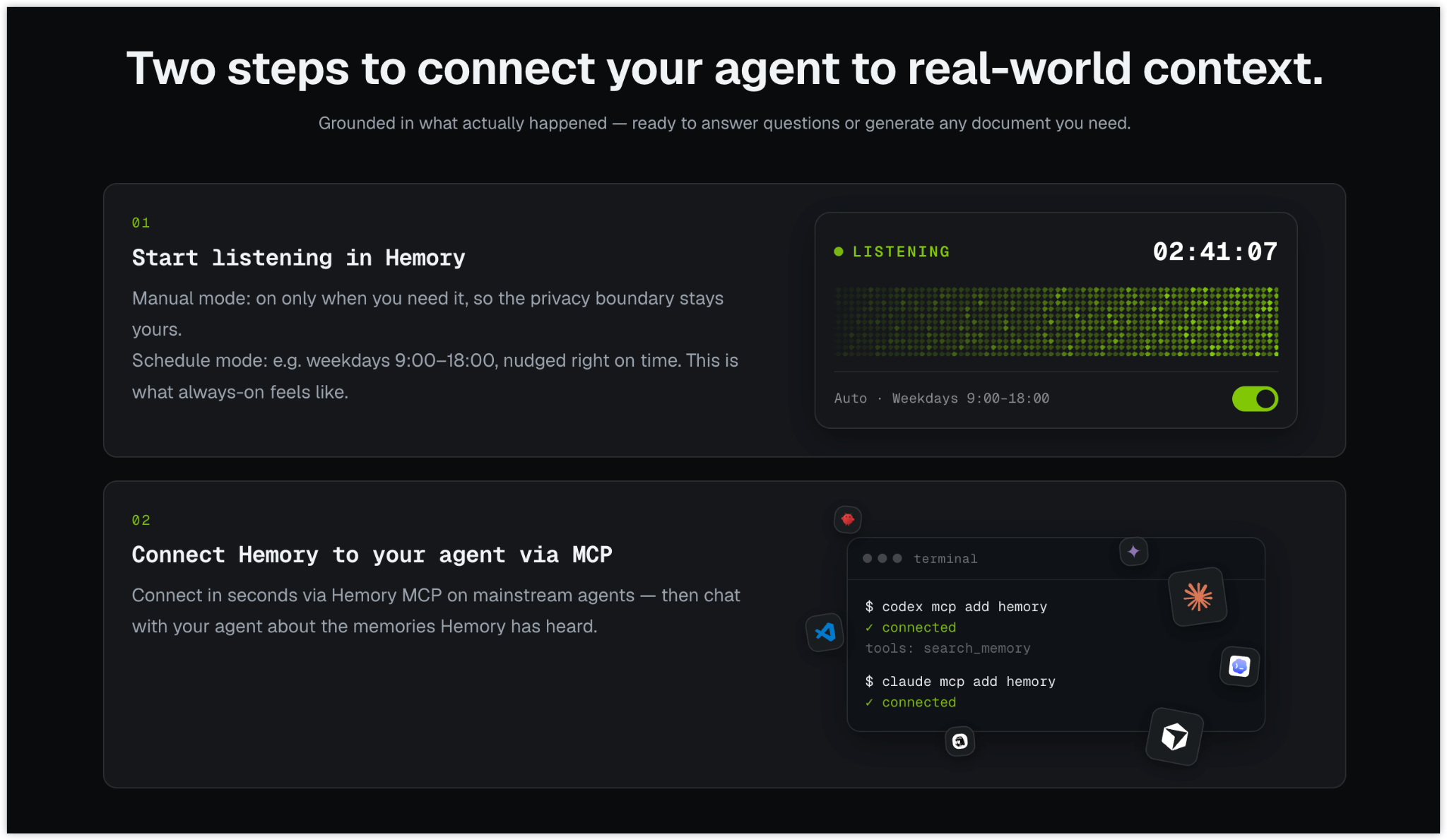
The shared resource is the conversation memory. Connecting two tools to it does not create a channel for reading each other’s chats or controlling each other’s tasks. If those tools also have access to the same repository or documents, that access comes from their other connections.
A workflow from customer discussion to implementation
The export feature example shows how to reuse the original discussions while carrying new work forward. Begin with the relevant conversations captured in Hemory and a working connection in each agent you plan to use.
1. Let the research agent retrieve and organize the request
Give the first agent the task and a few clues about the discussion. You do not need to locate every passage yourself.
Search my Hemory memory for the customer call and internal product
discussion about CSV export from earlier this week. Draft a requirements
brief covering the customer's problem, requested behavior, constraints,
team decisions, and open questions. Separate what we agreed from what
was only suggested.
The agent retrieves the discussions and prepares the brief. You review the conclusions, resolve any decisions that need your input, and add current information from outside those conversations.
Hemory has already handled the capture and initial organization. The agent now handles retrieval and drafting, so your effort goes into deciding what to build.

2. Make the reviewed brief available to the coding agent
Save the approved requirements somewhere the coding agent can read, such as requirements/csv-export.md in the repository. If the first agent can write to that location, ask it to save the reviewed draft there.
This handoff carries the decisions and interpretation you have just settled. It does not require you to summarize the original conversations again.
For example, the customer may have suggested a weekly export, while your team chose to build an on-demand export first. The approved brief communicates that choice. The original discussion remains available if the next agent needs to understand why it was made.
3. Let the coding agent retrieve details as it works
The coding agent uses the approved brief to guide implementation. Its own Hemory connection lets it recover relevant background without asking you to reconstruct the discussion.
Use requirements/csv-export.md as the approved specification and plan
the export endpoint. If file size limits or column order are unclear,
search my Hemory memory for the related export discussions.
Flag any unresolved question or conflict with the specification before
making an implementation choice that depends on it.
This gives the coding agent both an agreed specification and access to the reasoning behind it. A short brief can stay readable without having to contain every detail that might become relevant during development.
4. Give the writing agent context and the actual delivery status
An assistant drafting release notes can retrieve the customer’s description of the problem from Hemory. It also needs evidence of what was delivered, such as a release checklist or implementation summary that you provide or make accessible to it.
Using the release checklist provided, draft a customer update about
CSV export. Search my Hemory memory for the customer's original problem
and use that context to explain the benefit. Describe only the
capabilities confirmed in the release checklist.
The conversation explains why the work matters. The release checklist establishes what is ready to announce.
Across these steps, each agent can retrieve the original discussion for its own purpose. The information you pass between agents is the new work that should guide the next task: reviewed requirements, implementation results, and release status.
What is shared, what stays separate, and what privacy means
A shared conversation source gives agents access to relevant background. It does not automatically combine their histories or working environments.
| Information | What a Hemory connection makes available |
|---|---|
| Conversations captured and organized in Hemory | Each connected agent can retrieve relevant records within its connection’s available scope |
| Your chat with another agent | Not automatically shared through Hemory |
| An assistant’s saved preferences or built-in memory | Not automatically synchronized through Hemory |
| Files, code, tools, and other connected data | Available only through that client’s own access and configuration |
| Drafts, plans, and conclusions produced by an agent | Available to another agent when you share them or place them somewhere it can access |
| A running task, terminal session, or execution state | Not transferred through the Hemory connection |
Retrieved content enters the receiving client’s context
When an agent retrieves an excerpt from Hemory, that content becomes available in the receiving client’s session. Its storage, retention, and other handling depend on that service and your settings.
“Separate chats” therefore describes what the Hemory connection does not automatically synchronize. It is not a guarantee that retrieved content stays only inside Hemory. Choose connected tools and retrieval tasks with the sensitivity of the conversation in mind.
Tools and permissions depend on the connection
Each client has its own setup, available tools, and permission handling. Use its supported Hemory connection and check the access it provides.
Hemory’s changelog also documents speaker labeling and management through MCP. That is a change to information in Hemory, distinct from sharing an agent’s draft or chat. It does not establish general permission to write generated documents or edit all memory content through MCP.
A common source can still produce different answers
Two agents may retrieve different passages or interpret the same discussion differently. For background research, that may be useful. For implementation, both agents should work from the same reviewed requirements and current decisions.
If their answers conflict, compare the relevant passages and dates. An early proposal and a later decision can both be accurately retrieved while calling for different actions.
A reviewed brief keeps the chosen direction clear. Access to the original conversation keeps the supporting detail available.
FAQ
Can one agent see what I discussed with another agent?
Not through the Hemory connection alone. Connecting both agents gives them access to conversation memory, not automatic access to each other’s chats. To reuse a conclusion or draft, share it with the next agent or save it somewhere that agent can access.
Do all connected agents get the same tools and permissions?
Not necessarily. Each client connects separately, and its setup, available tools, and permission handling depend on its configuration. A shared source does not mean identical access or behavior across clients.
Do I need to summarize a conversation before an agent can use it?
No. Hemory transcribes and organizes captured conversations, and connected agents can retrieve relevant context directly. A reviewed brief becomes useful when you want to carry decisions or new conclusions from one task to the next.
Will agents give identical answers if they use the same memory?
No. Their questions, retrieved passages, instructions, and models can differ. Use the same reviewed brief when they need to follow an agreed direction, and refer back to the conversation when an interpretation or important detail needs resolving.
Start with a task that spans two AI tools
Choose a piece of work that moves from research to drafting or from planning to implementation. Capture the discussions it depends on in Hemory and connect the two tools you use.
Let the first agent retrieve the background and draft its output. Review the result and make the agreed conclusions available to the second agent, which can retrieve further context as needed.
Explore Hemory to give your AI tools a reusable source of real-world conversation context.
