

 Hemory Team
On this page
Introduction
An AI agent may mention a detail from an earlier discussion that you did not put in your latest request. That does not necessarily mean it has searched everything you have ever said. It may mean your task led it to search conversation Memory available through its tools and use a relevant result. Understanding that distinction helps you see what the agent can add—and what you still need to check.
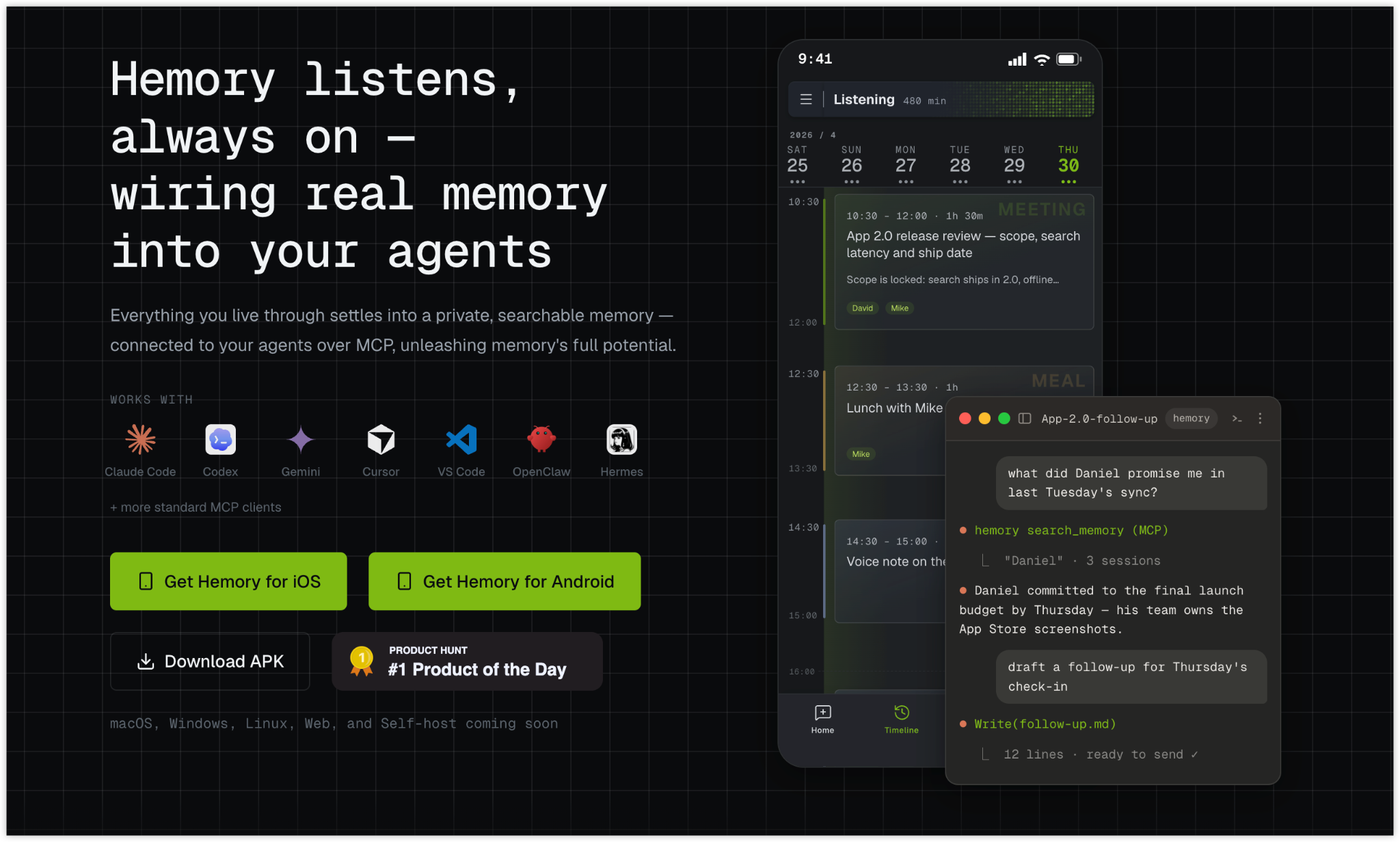
Bring past conversations into AI workflows with searchable memory.
TL;DR
- A task gives an agent a reason to retrieve context; the agent uses the Memory tools and scope available to it.
- Hemory can preserve and organize captured conversations so supported Q&A or connected agents can retrieve relevant details later.
- Retrieval is limited by what was captured, transcript quality, and the search performed. A surfaced detail is not proof that all relevant context was found; a missing detail is not proof it was never discussed.
The basic mechanism: task, retrieval, use
A useful mental model is task → search accessible Memory → use retrieved context. The agent is responding to a request, not necessarily scanning conversations in the background or monitoring for details to surface later.
1. The task gives the search direction
A request such as “Draft a follow-up for the launch discussion” tells an agent what work to do and gives it a subject to investigate. You do not need to remember every earlier comment or provide a complete history before the search can begin. The task may give enough direction for the agent to look for related captured conversations and bring relevant material into its response.
The request still matters. A clear goal, topic, person, or approximate time frame can help orient the work when you know it. You do not need to invent clues you do not remember, and there is no single required set of search terms.
2. The agent searches what its tools can access
For this to work, the relevant conversation must have been captured and be accessible through the selected route. Hemory’s built-in Q&A supports multi-turn questions grounded in transcripts and can retrieve across conversation sessions. A supported external AI agent can also retrieve Hemory Memory through the tools available in its connection.
These routes are related but not identical. A built-in Q&A surface and an external agent client may differ in their available tools, scope, or permissions. Do not assume that one route can access every record available through another.

Review MCP connection options and access settings.
If a conversation was never captured, the agent cannot retrieve it from Hemory. If the detail is only in a document or another system, provide that material or use a route that can access it.
3. Retrieved context informs the response
The agent uses what its search returns to answer the question or help with the task. That may include a point you did not think to mention because it was in an earlier captured discussion rather than the current chat.

Retrieve past commitments and draft follow-up tasks.
For example, suppose you ask for a draft rollout update. An accessible earlier conversation includes a concern about which customers can access the new feature. The agent may bring that concern into the draft even though your request did not mention it. That is a useful lead from retrieved context—not proof that the concern is still current, that every rollout discussion was found, or that the team made a final decision.
Hemory’s role is to capture and organize conversation Memory and make it retrievable through supported routes. The agent performs its own reasoning and drafting; you provide the current goal and review whether the result fits the work.
Why retrieval can surface a detail you forgot
When a person asks an agent to complete a task, they do not have to manually recall and re-enter every potentially relevant point. If the agent has access to previously captured conversations and its tools retrieve a relevant detail, that detail can become part of the working context even though it was missing from the request.
This depends on the source already existing. Hemory cannot reconstruct an uncaptured exchange. Capturing and organizing discussions as they happen can make later retrieval possible while leaving you free to focus on the conversation instead of selecting and writing down every detail that might matter someday.
Where retrieval stops being reliable
A retrieved answer is only as useful as the available records and the work done to find and interpret them.
| What affects the result | What it means for you |
|---|---|
| Capture | An uncaptured conversation is not available in Hemory Memory. A captured record may also omit a detail that was not heard or retained. |
| Transcript quality | Transcripts can contain errors or omissions. Treat wording and speaker attribution with care when they affect a decision or next step. |
| Search and access | The agent can use only the tools and Memory scope available through its route. The particular search may retrieve some relevant records and miss others. |
| Interpretation and currency | A retrieved statement may be a suggestion, an earlier position, or a conditional comment—not a current decision. Confirm status when it changes what you will do. |
A result means the agent surfaced something it considered relevant from accessible material. It does not establish that the search was exhaustive, that every related discussion was captured, or that an earlier statement remains current.
Likewise, if the agent does not mention a detail, that tells you only that it did not surface in this result. It does not prove the detail was never discussed, never captured, or absent from every source. If it matters, search another available source, try a more focused follow-up, or ask a person who can clarify.
How to use a retrieved detail
Use the agent’s response as a starting point, then review the parts that could change the outcome:
- Source: Does the detail come from a captured conversation or another material the agent could access?
- Meaning: Is it a proposal, a question, an accepted decision, or a commitment? A mention alone does not establish agreement.
- Status: Is it still current, or did a later discussion change it?
- Attribution: Is the speaker identified clearly enough for the action you plan to take?
- Gaps: What important information is missing, and can another source or a focused clarification provide it?
For a low-stakes task, a concise answer may be enough. For an external commitment or consequential decision, check the relevant record and confirm the current status with the appropriate people. Do not treat a transcript as guaranteed truth or a missing search result as proof of absence.
Frequently asked questions
Does an AI agent search every past conversation?
Not necessarily. It can retrieve from conversations available through the tools and scope of its current route, but retrieval is not a guarantee that every relevant record will be found. The built-in Q&A and external clients can also differ in scope and permissions.
Does a detail appearing in the response mean it is confirmed?
No. It means the agent surfaced that detail as relevant. Check its source, attribution, meaning, and current status before treating it as an approved decision or commitment.
What does it mean if the agent cannot find a detail?
Only that the detail was not surfaced in that result. It may not have been captured, may be outside the route’s access, or may not have been retrieved by that search. Check another available source or ask a focused question if the detail matters.
Use retrieved context as a lead, not a guarantee
Task-driven retrieval can reduce the need to remember and re-enter every earlier point yourself. With Hemory, that benefit depends on the discussion having been captured and being available through the route you use. Let a surfaced detail inform the work, then confirm the parts that affect decisions, commitments, or next steps. If something important is missing, treat that as a prompt to investigate—not as proof it never happened.