

 Hemory Team
On this page
An AI agent cannot use a meeting or call conversation just because it happened. The conversation must first be captured, made accessible through a supported connection, and relevant to the task the agent is given. Even then, retrieval may miss details, and transcripts can contain errors or omissions.
Here are the prerequisites to check—and the limits to keep in mind—before relying on conversation memory as agent context.
TL;DR
- The conversation must have been captured in Hemory and be accessible to the connected agent. An uncaptured event cannot be retrieved later.
- Capture requires user action. Manual Mode lets you start and stop listening; Schedule Mode provides reminders and one-tap start/stop, not silent recording.
- The agent needs a supported connection and a task with enough clues to search for relevant conversations. You do not need to reconstruct the whole discussion first.
- Treat results as useful context, not a complete or infallible record. Review consequential details and fill gaps from another source or with a focused follow-up.
1. The conversation has to be captured first
An agent cannot retrieve a discussion that Hemory never recorded. If a meeting or call was not captured, the agent cannot recover what was said from memory of the event alone. Use another available record, such as a document or notes, or ask someone who was there to clarify.
Hemory’s current supported platforms include iOS, Apple Watch, Android, and Wear OS. Capture can be started and stopped manually. Schedule Mode can remind you when it is time to listen and offers one-tap start and stop; it should not be treated as background monitoring or silent recording. A call is not automatically available merely because it took place: confirm that your setup captured the conversation.
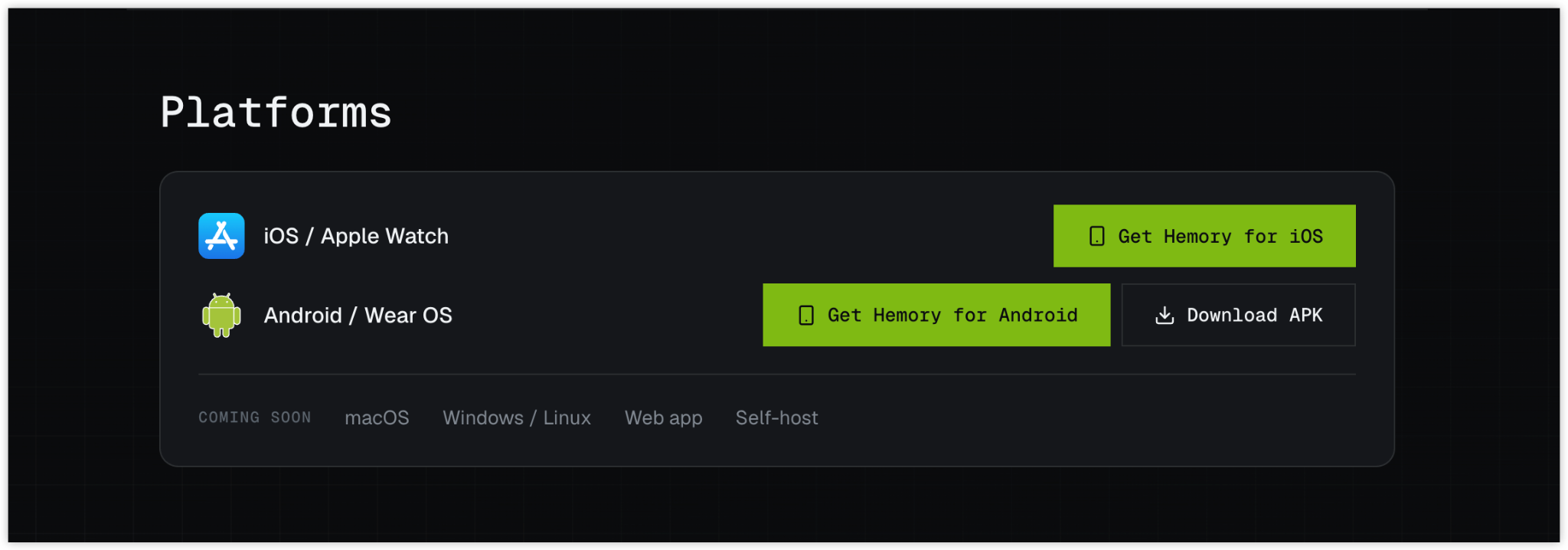
See the mobile and wearable platforms listed on the site.
Once captured, Hemory organizes conversation information for later retrieval. A listening session produces a timestamped transcript with speaker labels and AI cleanup, but that does not guarantee a perfect transcript or that every relevant detail was recorded. Review important wording, names, conditions, or commitments before acting on them.

Find individual statements in a searchable transcript.
2. A supported connection must make relevant Memory accessible
The agent needs a connection that supports access to Hemory Memory. Hemory’s public MCP listing describes supported external-agent options, but a listing does not establish that every client has identical setup steps, tools, permissions, or behavior. Use a connection route supported for your chosen client, and do not assume it exposes every record or allows arbitrary actions in other systems.

Review MCP connection options and access settings.
The division of work matters: Hemory captures, organizes, and provides access to conversation context; the connected agent retrieves and reasons over the context its connection makes available. The agent does not gain access to conversations outside that scope simply because it is connected. You remain responsible for reviewing its answer and carrying any useful result into your work.
3. Give the agent a task it can search for
A prompt should state what you are trying to find or produce and include identifying clues you know, such as a project, topic, person, or approximate time period. You do not need to supply every detail from the conversation or write a complete chronology first. The point of accessible conversation memory is to let the agent retrieve relevant background you may not remember to include.

Retrieve past commitments and draft follow-up tasks.
For example, a request might say:
Find the captured discussions about [project or topic]. Summarize the relevant points for [current task], distinguish what was explicitly said from your interpretation, and flag anything you cannot determine.
Add current instructions or documents when they affect the answer. A prompt can guide the search, but it cannot make an uncaptured conversation available or guarantee that retrieval will find every relevant detail.
4. Review the result in proportion to its consequences
Use an agent’s response as a starting point for work, not proof that the source material is complete or that an interpretation is correct. Check important claims against the available transcript, current documents, or another suitable source. Pay particular attention to who said what, whether a suggestion was accepted, any conditions, and whether a past decision still applies.
If a result is incomplete, that does not by itself prove the conversation was never captured or that no decision was made. The connection may not expose the relevant record, the prompt may lack useful clues, or the discussion may not have included the information. Try a more specific search, use another record, or ask a focused question. Do not treat repeated mentions as proof of separate events or a later mention as proof that an earlier agreement changed.
What this setup does not provide
- Access to uncaptured events: If the conversation was never recorded or otherwise supplied, Hemory cannot reconstruct it.
- Background monitoring: Schedule Mode uses reminders and one-tap controls; it does not mean the agent is silently listening or monitoring your work.
- Guaranteed completeness: Capture, transcription, connection scope, and retrieval can all leave gaps. A returned answer is not proof that every relevant conversation was found.
- Automatic action: An agent’s access to Memory does not itself authorize it to send messages, update another system, or make decisions on your behalf.
- Availability on every platform: Platforms marked as coming soon, including macOS, Windows/Linux, the web app, and self-hosting, should not be treated as generally available.
FAQ
Can an agent use a conversation that was not recorded?
No. It needs a captured conversation that is accessible through its supported connection, or information supplied through another source.
Does Schedule Mode record automatically in the background?
No. It provides reminders and one-tap start and stop. You still take the action to begin and end listening.
Does a connected agent find every relevant conversation?
No. The accessible records, connection scope, prompt clues, capture, and transcription all affect what it can retrieve. Review important results and use another source when a needed detail is missing.
Do I need to summarize every meeting before asking the agent?
No. You can give the agent the task and useful search clues rather than preparing a full manual chronology. Add current information the conversation could not contain, then review the result.
Start with one captured conversation and a real task
Choose a task where earlier discussion could help, confirm that the relevant conversation was captured and is accessible to your connected agent, then ask for the specific context you need. Hemory can reduce the work of selecting and retelling that background; the agent’s result still needs your judgment before you rely on it.