

 Hemory Team
On this page
An AI agent cannot use a meeting it has no access to. For conversation memory to help with a task, the discussion must first be captured, the agent must be able to reach that stored context through a supported connection, and the task must give it a useful reason to search. Even then, retrieval and transcripts can be incomplete.
TL;DR
- Capture the conversation while listening is active. Hemory cannot recover an uncaptured discussion after the fact.
- Connect through an agent and route that Hemory supports; a connection does not mean every client has the same tools or access.
- State the task and give useful clues, such as a project or topic. Dates and names can help when known, but should not be prerequisites.
- Review important findings. A transcript is not guaranteed to be perfect, and a search may not surface every relevant conversation.
1. The conversation must have been captured
Conversation memory starts with a recording session. Hemory’s Manual Mode lets you start and stop listening. Schedule Mode provides reminders for set listening times, with one-tap start and stop actions; it does not silently record in the background.

Set listening times for weekdays and weekends.
Hemory lists iOS, Apple Watch, Android, and Wear OS as supported platforms. macOS, Windows/Linux, the web app, and self-hosting are marked as coming soon, not generally available. The available capture experience depends on the platform and how listening is started. Don’t assume that every meeting or call is captured automatically. On Apple Watch, listening pauses during calls and resumes afterward, so do not assume the call itself was recorded.
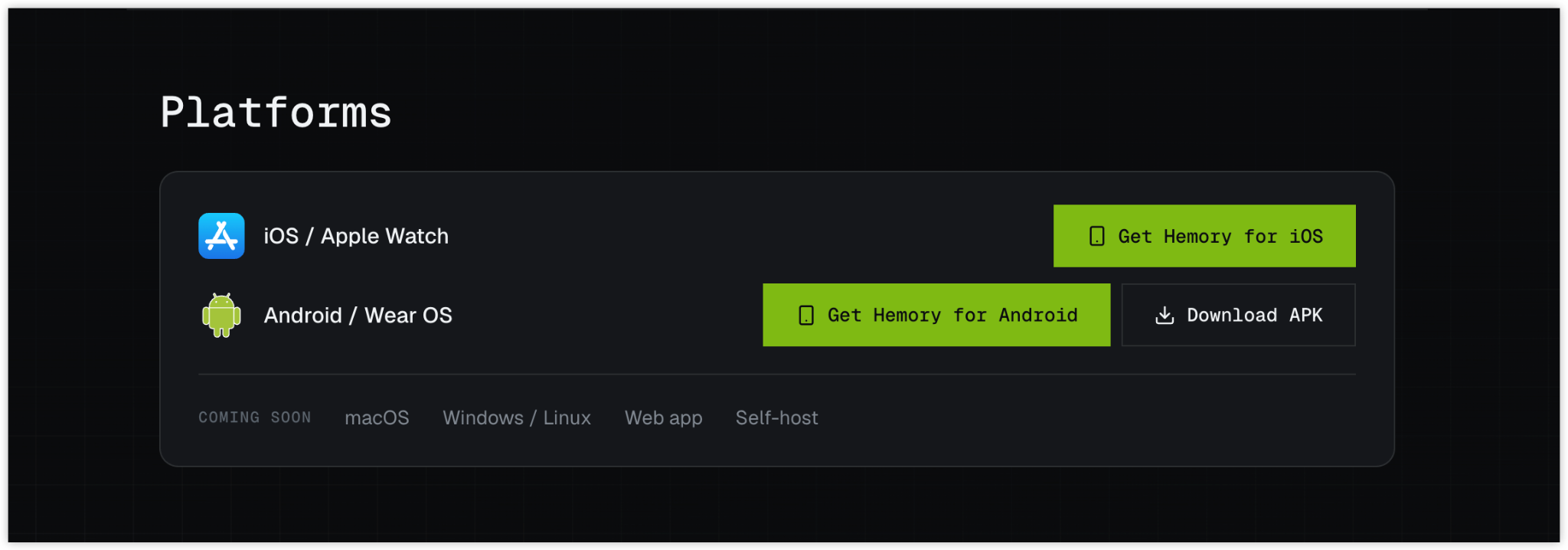
See the mobile and wearable platforms listed on the site.
A listening session produces a timestamped transcript with speaker labels and AI cleanup. Hemory also organizes captured conversations into Memory for later use. Transcription can still contain errors or omissions. If a discussion was never captured, or a detail is missing from its record, an agent cannot retrieve that detail from Hemory; use another source or ask someone for clarification.

Find individual statements in a searchable transcript.
2. The agent needs a supported route to the stored context
Having conversation records in Hemory is not the same as making them available to every AI agent. The agent must use a supported connection that can access the relevant Memory. Hemory publicly lists MCP clients, but a listing alone does not establish that every client has identical setup steps, tools, permissions, or behavior.

Review MCP connection options and access settings.
This guide covers the prerequisite, not connection instructions: confirm the specific agent and route you plan to use are supported, then check what context and tools that route exposes. A connection does not imply unrestricted access to every record or permission to take actions in other systems. The external agent performs its own reasoning and drafting; you remain responsible for reviewing its work and carrying it into your workflow.
3. Give the agent a task it can search against
A useful request tells the agent what work to do and gives it clues for finding relevant discussions. You do not need to prepare a complete chronology or manually summarize every meeting first. Start with the outcome, add a project or topic and a time range if you know one, and include current facts the conversations cannot supply.

Retrieve past commitments and draft follow-up tasks.
For example:
Prepare a short briefing on open decisions about [project]. Search captured conversations related to [topic or workstream]. Separate decisions from proposals, note any conditions or unresolved points, and tell me what you could not establish. Current information: [add relevant updates].
The project or topic helps narrow the task. A date range or speaker name may help when you remember it, but do not invent clues you do not know. If the answer depends on a current status, provide that information or ask the agent to flag it as unknown rather than infer it from an older discussion.
4. Review the result in proportion to its impact
Treat the agent’s response as a working result, not proof that it found everything or interpreted every statement correctly. For details that affect a decision, check the relevant record when you can access it. Pay particular attention to who said something, whether it was a proposal or an accepted decision, any conditions, and whether later information changed the status.
If the result omits an important point, try a more specific search clue or consult another source. A failed search does not prove that no conversation was captured or that no decision was made. Likewise, an answer that sounds familiar is not evidence that the agent retrieved the right record.
What this makes possible—and what it does not
When capture, access, and a clear task are in place, an agent can use relevant real-world conversation context without requiring you to recall and re-enter every detail yourself. You can give it a current goal and useful clues, then review the work it produces.
That does not provide access to conversations that were never captured, guarantee complete retrieval, or make the agent monitor meetings or wake up automatically in the background. To try the workflow, start with one task tied to a conversation you know was captured, use a supported connection, and review the result before relying on it.
FAQ
Can an agent retrieve a meeting that was never recorded?
No. Hemory can provide captured conversation context, but it cannot reconstruct a discussion that was never recorded there. Use another source or ask for the missing information.
Do I need to summarize every meeting before asking an agent?
No. You can give a connected agent the task and useful search clues without preparing a full manual summary or timeline first. Add current information that is not in the captured conversations.
Does a supported connection give an agent access to every conversation?
Not necessarily. Access depends on the supported route and the tools and permissions available in the specific client. Do not assume every agent connection has the same scope.
Can I rely on the transcript or search result as complete?
No. Transcripts may contain errors or omissions, and retrieval may miss relevant context. Review consequential details and use another source when information is missing.