 Hemory Team
On this page
An action item is a specific task agreed or assigned for follow-up after a discussion. A useful entry makes the work clear and identifies its owner, with a deadline or dependency when one has been agreed.
The distinction matters when a conversation mixes choices, suggestions, questions, and commitments. “We should update the onboarding guide” might be a proposal or agreed work with no owner yet. The surrounding discussion tells you which.
TL;DR
- Identify the work people agreed to carry out, rather than classifying statements by tense or wording alone.
- Separate decisions, ideas, open questions, and action items, even when they appear in the same sentence.
- A task can be agreed while its owner or deadline still needs confirmation.
- Hemory organizes recorded discussions into meeting notes and action items, so you can focus your review on the points that need clarification.
Action item, decision, idea, or open question?
Each type of meeting outcome answers a different question. Keep them distinct so readers can see what is settled and what needs to happen next.
| Type | Question it answers | Example | How to record it |
|---|---|---|---|
| Decision | What choice has been made? | “We’ll use a live workshop for the new support hires.” | The agreed choice and any important reason |
| Idea | What could we consider? | “We could make a self-paced course later.” | A possibility to explore, without treating it as approved work |
| Open question | What do we still need to find out or decide? | “Can the night-shift team attend the workshop?” | The unresolved question |
| Action item | What work has been agreed or assigned? | “I’ll check the night-shift team’s availability and report back tomorrow.” | The task, its owner, and the stated timing |
The examples assume the first choice was agreed and the final commitment came from an identified speaker. A transcript’s speaker label can tell you who “I” refers to.
An open question and an action item can coexist. Whether the night-shift team can attend remains unknown while someone checks availability. Record the question and the task to resolve it, rather than pretending the question has already been answered.
Three checks for identifying an action item
1. Has the conversation established that the work should happen?
Look for agreement or a clear assignment in context. Someone may volunteer, accept a request, or receive an assignment through the team’s usual decision-making process.
“I’ll revise the guide” is a direct commitment. “Can you revise the guide?” is a request. If the reply is “Yes, I’ll send it tomorrow,” the exchange establishes both ownership and timing. Without that reply or a clear assignment context, record the request as awaiting confirmation.
A phrase such as “we should” is not enough on its own. The group may adopt the suggestion, leave it for later, or reject it. Read the response and any later conclusion.
2. Is there a specific task with a recognizable result?
“Improve onboarding” describes a goal. “Draft a checklist for a new hire’s first support shift” identifies a task and an output.
A task does not need to solve the whole problem. Research, clarification, and preparation can all be action items: check a requirement, compare two options, or arrange a discussion with the person who can decide.
Look for a result that lets the owner explain what has been completed. If the wording only names a broad topic, ask what the next piece of work should be.
3. Is responsibility clear enough to follow up?
Once the work is agreed, identify who will move it forward. A speaker may name themselves, the discussion may identify an owner, or an established role may make the assignment clear.
Separate agreement to do the work from agreement about who owns it. “Yes, we need to update the guide; let’s assign it at tomorrow’s check-in” establishes the task while leaving ownership open. Record it as agreed work — owner unassigned.
By contrast, “Maybe support could update the guide” may still be a suggestion. Do not turn the usual team or most likely person into a confirmed owner without support from the discussion.
A missing owner makes follow-up harder, but it does not erase an agreement that the work should happen.
Read the exchange, not just the sentence
Grammar provides clues, but it does not determine what the group agreed. A decision can use future wording, and a question can function as a request.
| Exchange | What it establishes |
|---|---|
| “We’ll run the workshop on Tuesday.” The group confirms the date. | A decision about timing; setup tasks still need to be identified |
| “Could you send the attendee list?” — “Yes, this afternoon.” | An accepted task with an owner and timing |
| “Could you send the attendee list?” — “I don’t have access to it.” | A request with an unresolved access or ownership issue |
| “We should shorten the workshop.” — “Let’s keep that as an option.” | An idea, not an instruction to revise the agenda |
| The workshop lead assigns Nia to draft a shorter agenda for the next review. | A task assigned by the person responsible for allocating the preparation work |
| “We need a shorter agenda.” — “Agreed; we still need to choose an owner.” | Agreed work with ownership outstanding |
Later statements can change the record. If a person offers to send a file and then the group agrees it is no longer needed, do not leave the earlier offer as an active task.
The practical question is: What did the discussion leave people expected to do?
Split a decision from the work it creates
One statement can contain more than one outcome:
“We’ll use a live workshop, and I’ll draft the facilitator guide.”
If Nia says this and the group agrees to the format, record:
- Decision: Use a live workshop.
- Action item: Nia drafts the facilitator guide.
- Timing: Not agreed, unless another part of the discussion establishes it.
Writing “Use a live workshop” as the task would hide the work Nia accepted. Writing only the task would omit the choice that explains why a facilitator guide is needed.
The two records also finish differently. Nia can complete the guide while the format decision remains in effect. A later decision to use a self-paced course may change the task, but completing the task does not itself change the decision.
Use a decision log when the choice and its reasoning need to be revisited. Keep the resulting work in the place where tasks are followed up.
Review the outcomes without taking notes on every sentence
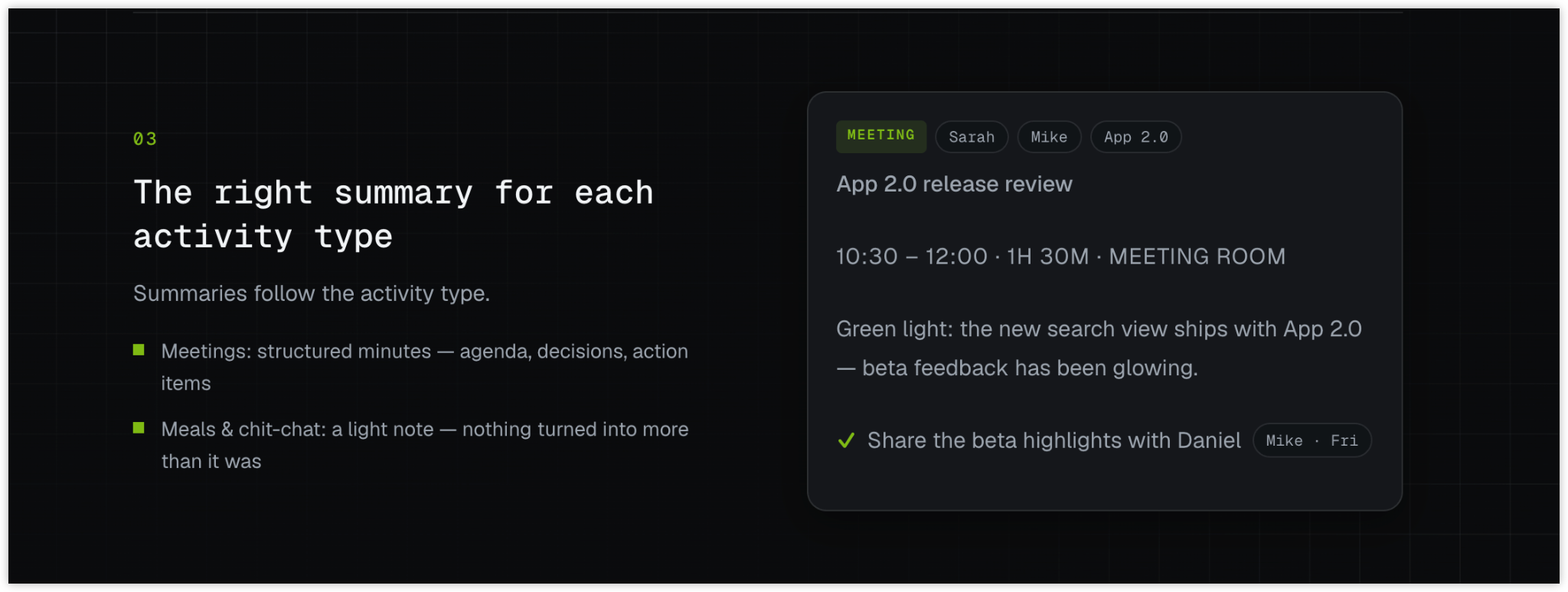
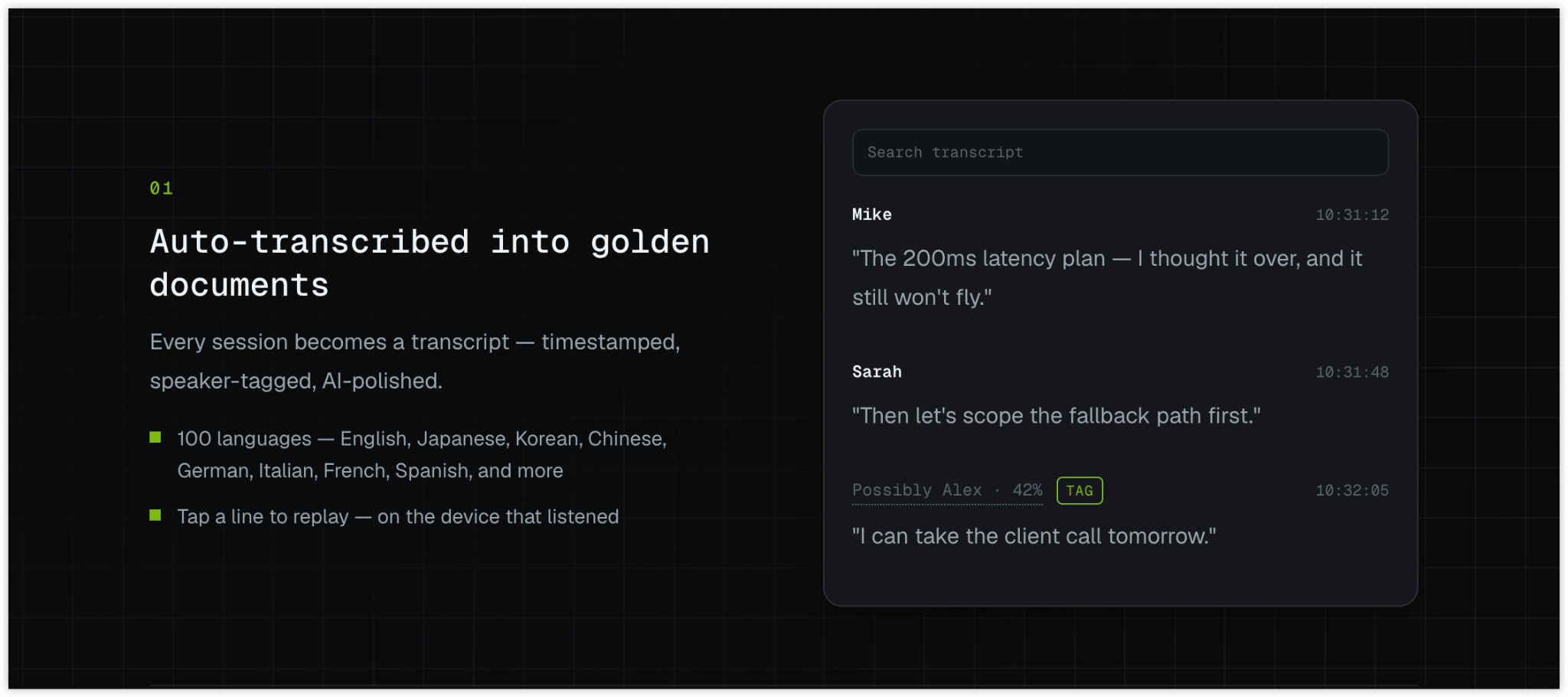
During a busy discussion, trying to label every statement can distract you from the question or idea being developed. Hemory can record the conversation with participants’ agreement and organize it into structured meeting notes, including decisions and action items.
Begin with those organized outcomes. Review the assignments and questions that affect what happens next, rather than rebuilding a task list from the whole conversation.
Suppose the workshop summary includes “Check night-shift availability,” but you cannot tell whether anyone took responsibility. Ask Hemory about the exchange:
Who agreed to check whether the night-shift team could attend the workshop, and what timing did we discuss?
The recorded conversation may contain a commitment that the short entry leaves out. If it does, use that context to complete the assignment. If the group agreed the check was needed but never chose an owner, ask who will take it on. If the check was merely suggested, first establish whether the group wants it done.
This leaves you with a focused follow-up instead of a general request for everyone to review the meeting again.
For the next step, see how Hemory turns meeting conversations into a to-do list. That guide covers organizing and using the tasks after you have identified them.
Ask the question that resolves the actual gap
“Is this an action item?” can bundle several uncertainties together. Name the part that is unclear.
| What is unclear? | Ask |
|---|---|
| Whether the suggestion was adopted | “Are we doing this, or keeping it as an option?” |
| What the task includes | “What should the first version cover?” |
| Who is responsible | “Who will take this on?” |
| When the result is needed | “When do we need the attendee list?” |
| Whether a condition applies | “Can this start now, or does it depend on the agenda being agreed?” |
You do not need every possible detail before recording a task. Preserve what was agreed and raise the missing detail that matters to execution.
Before sending a meeting follow-up, make sure its task list does not quietly promote ideas into assignments. A short “To confirm” section keeps the remaining questions visible.
Frequently asked questions
Is a deadline required for an action item?
No. Work can be agreed before a deadline is set. Record the task and any clear owner, then confirm timing when it matters to planning or another person’s work. Do not borrow a project milestone and present it as the task’s agreed deadline.
Is an action item different from a task?
An action item is a task identified for follow-up, often during a meeting or discussion. Once it enters your working list, it can be managed like other tasks. The term mainly explains where the work came from and why it needs follow-up.
Can investigating an open question be an action item?
Yes. The question may remain open while someone works on it. “Which billing errors are customers reporting?” is the question; “Review this week’s support tickets and summarize the billing errors” is a task that can help answer it.
Does “we should” always mean the statement is only an idea?
No. The phrase may introduce a suggestion that the group then adopts. Use the surrounding exchange to establish whether the work was agreed, assigned, deferred, or left undecided.
Start with the outcomes of your next discussion
Use Hemory to preserve and organize the conversation while you participate. When you return to the summary, focus on the work people agreed to do and ask specific questions about any gaps. The useful result is a clear set of next steps, with decisions and possibilities still recognizable as their own kinds of information.