Hemory Team
On this page
A product manager presents a PRD after six user interviews. One requirement reads, “Users find the approval step confusing.” An engineer asks which users said that and what they were trying to do at the time. The PM remembers the gist, but the exact wording and context are buried in notes and a short summary.
This guide shows how to build a PRD in which every requirement can be traced back to what participants said, and in which unanswered questions stay visible. The method works with any interview records. It also covers how Hemory can reduce the retrieval and drafting work when the interviews were captured there.
TL;DR
- Log user statements as numbered evidence entries before you write requirements. Each entry needs the interview, the participant, the context and the wording.
- Keep three layers apart: what the participant did or said, what you infer from it, and what you propose to build.
- Give every requirement evidence IDs, acceptance criteria and a status. A requirement with no evidence is a hypothesis, and the PRD should say so.
- Count participants, not mentions. One person raising a problem three times is still one person.
- Keep open questions next to the requirements they affect, and review quotes against the source before anyone approves.
- If the interviews were captured in Hemory, you can ask its Q&A or a connected AI agent to retrieve the relevant statements and draft the evidence log. You supply the goal and current facts, and you review the result.
Step 1: Fix the PRD question and gather the sources
Start with the decision the PRD must support, such as “What should we change in the approval flow for the next release?” Interviews are wide-ranging, and without a question you will collect statements that are interesting but irrelevant to the document.
Then list where the interview material lives. It may be transcripts, your own notes, recordings, a research repository, a CRM, or conversations captured in Hemory. Material outside Hemory does not need Hemory, and the method below works the same way with any of these sources.
Note what is missing at this stage. If one interview has only a two-line summary, you cannot quote it reliably. Record that gap as an open question instead of filling it from memory.
Step 2: Log user statements as evidence entries
An evidence entry is the smallest unit the PRD will point to. Use one entry per statement or observed behavior:
Evidence ID: E-014
Interview: Interview 3, finance coordinator, mid-size company
Context: Asked how she submits expense reports at month end
Wording: “I take photos of receipts all month and then lose the afternoon matching them.”
Type: Reported behavior
Source location: Transcript, around the 12-minute mark
Notes: Paraphrase of earlier remark in E-009
A few rules keep the log trustworthy:
- Copy wording exactly. If you paraphrase, mark it as a paraphrase.
- Attribute to a specific participant, not “users.” Roles and segments often explain why people disagree.
- Record the question that prompted the answer. A statement given in response to a leading question carries less weight than one volunteered.
- Keep a pointer to the place in the source where you can find the passage again.
If the interviews are captured in Hemory
This route applies only to interviews that Hemory captured earlier. Hemory cannot retrieve a conversation that was never recorded, and if a needed detail has no usable record, fall back to your notes or ask the participant a focused follow-up.
Captured sessions are written up as transcripts with timestamps and speaker labels, and Hemory distinguishes speakers by voice across sessions. A speaker stays anonymous until you name them, and a name you give once is applied across your library. Uncertain matches show a confidence such as “maybe X,” so confirm who is speaking before you attribute a quote to a participant.

There are two ways to retrieve material, and they suit different jobs:
- Hemory’s built-in Q&A answers questions about your own Memory with multi-turn follow-ups grounded in transcripts. It suits checking one interview or asking a follow-up about a statement.
- A supported connected agent can use Hemory over MCP (Model Context Protocol) to retrieve captured conversations and draft in the same task. It suits pulling statements across several interviews. Hemory provides capture and retrieval, and the agent does the drafting. Hemory itself does not write the PRD or update your project tools. Which tools and permissions a given client has depends on that client’s connection, so check what yours exposes.
A request to a connected agent can be as direct as this:
My goal: a PRD section on the expense report approval flow for the next release.
Retrieve what participants said in my user interviews about submitting and approving expense reports.
For each statement, give the exact wording, which interview and participant it came from,
and what question or topic prompted it. Draft an evidence log, then propose requirements
that each cite evidence IDs. Mark anything you inferred rather than found,
and list questions the interviews did not answer.
You do not need to build a complete quote log by hand first. The retrieval and first draft are the agent’s job. Your job is to supply the goal, add current information the interviews could not contain (for example, a technical constraint decided last week), and review. If you only need one fact, such as what Participant 4 said about approvals, ask Hemory’s Q&A directly and skip the agent.
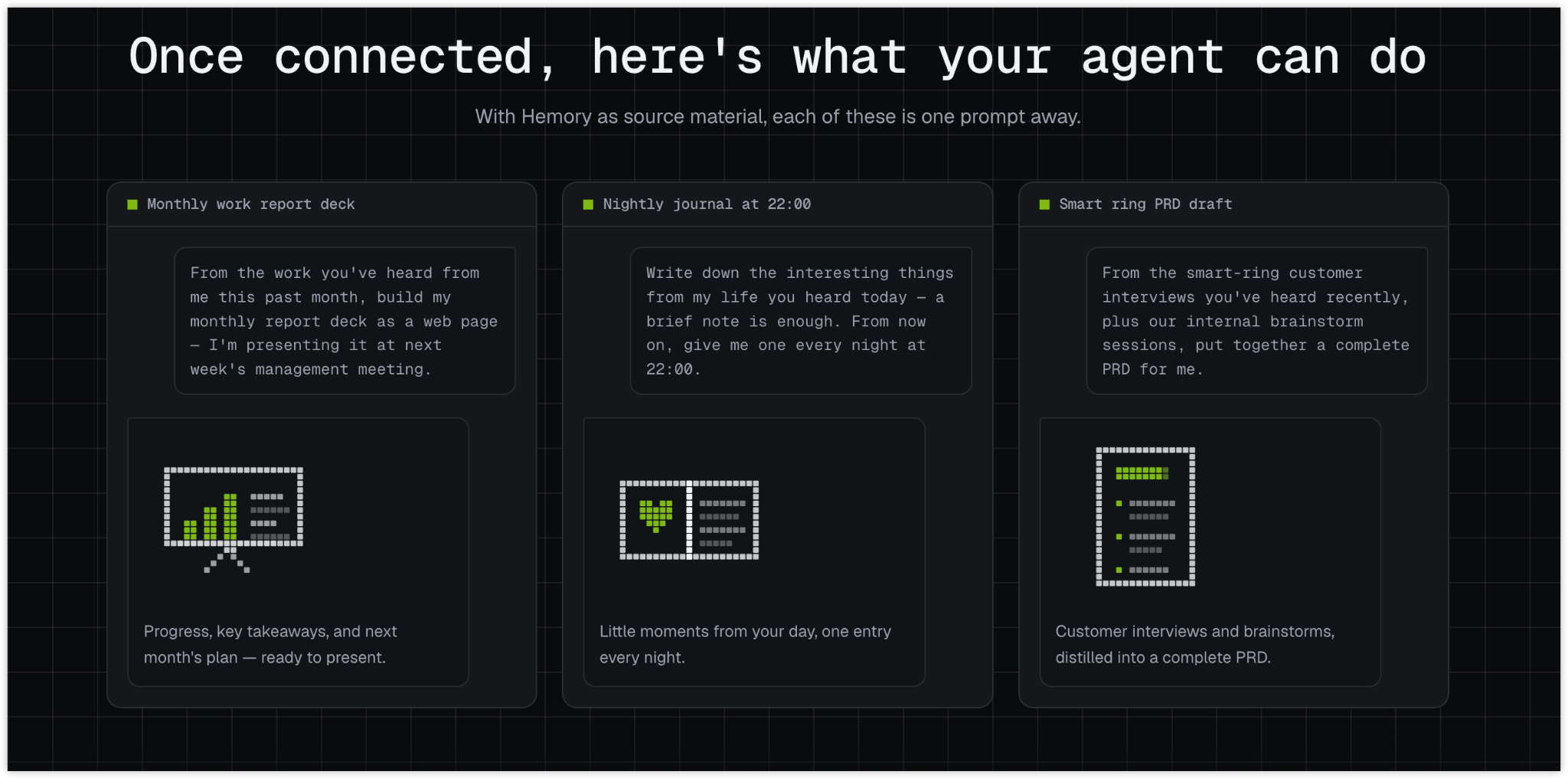
If an agent produced the ledger and a first set of requirements, Steps 3 to 7 become review checks on its output instead of writing from scratch. Transcript lines can also be replayed on the listening device, which helps when a quote matters and the transcript wording looks off.
The documented limits matter here. Transcripts are not guaranteed to be perfect, and a retrieval can miss relevant passages. A search that returns nothing does not prove nobody said it.
Step 3: Separate what was observed from what you infer
The most common reason a PRD becomes hard to defend is that participant words and the PM’s reading of them are blended into one sentence. Keep three layers distinct:
| Layer | Example | How to record it |
|---|---|---|
| Observation | “I photograph receipts all month and then match them at the end.” | Evidence entry with exact wording |
| Interpretation | Receipt matching is the most time-consuming part of month-end reporting. | Mark as your interpretation and cite the entries it rests on |
| Proposal | Let users attach a receipt to an expense as soon as it occurs. | Becomes a requirement, with the interpretation behind it |
Participants also propose solutions, such as “just add a button.” Treat a suggested solution as evidence of a problem, and record the problem it implies. The solution may still be worth building, but it is a proposal, not a user need.
Step 4: Group into problems and weigh the evidence
Group evidence entries by the problem they describe. Then check how well each group is supported:
- Count participants, not mentions. Four entries from one person are one person’s experience.
- Check who is speaking. Three coordinators and one executive may describe the same process from different positions.
- Do not merge on keywords. Two people saying “approval” may mean different steps.
- Keep contradictions. If one participant wants fewer approval steps and another wants a second approver, record both and note the likely reason, such as company size.
- Do not treat sequence as cause. A complaint that follows another complaint in the same interview is not proof they are linked.
Describe strength in plain terms, such as “raised by 3 of 6 participants, all in finance roles.” This is more honest than a confidence score you cannot defend.
Step 5: Write requirements with evidence references and acceptance criteria
Each requirement gets a short, consistent entry:
Requirement R-04: Attach a receipt to an expense at the time it is created
Problem: Month-end reporting requires matching saved receipts to expenses by hand.
Evidence: E-009, E-014, E-022 (3 of 6 participants, all finance coordinators)
Evidence type: Reported behavior; solution not suggested by participants
Acceptance criteria:
  - A user can attach an image to a new expense before saving it.
  - An expense with an attached receipt shows the image in the report view.
  - Existing expenses without receipts remain editable.
Proposed priority: Medium (for review)
Status: Draft
Open questions: Q-02, Q-05
Two details are easy to get wrong. First, write acceptance criteria that someone could test, such as observable behavior, not “easy to use.” Second, label priority as “Proposed priority” until stakeholders have agreed it. A requirement awaiting review is not a commitment.
If a requirement comes from somewhere other than interviews, such as a legal obligation or an engineering constraint, say so in the evidence field. A PRD can contain unsupported requirements, but it should not imply that users asked for them.
Step 6: Keep open questions beside the requirements
Open questions are part of the PRD, not an apology for it. List them in a table and link each one to the requirements it affects:
| ID | Question | Why it matters | Affects | Who could answer |
|---|---|---|---|---|
| Q-02 | Do participants outside finance also need to attach receipts? | Only finance coordinators raised it | R-04 | Follow-up interviews |
| Q-05 | Does the receipt image need to meet an audit standard? | Changes the acceptance criteria | R-04 | Compliance contact |
| Q-07 | Interview 5 has no usable record of the approval discussion | One participant’s view is missing | R-02 | Re-ask or recover from notes |
Typical open questions fall into four groups: evidence you could not find, statements that conflict, constraints nobody has confirmed, and decisions that belong to a stakeholder. “Who could answer” is a suggestion for the review meeting, not an assignment.
Step 7: Review before approval
Review in two passes.
Check the evidence. Open the source for any quote that supports a major requirement and confirm the wording, the speaker and the context. You do not need to re-read every transcript. Prioritize quotes that carry a requirement on their own, quotes that sound surprising, and anything an agent drafted. Replay audio only when it is available and the transcript is unclear.
Check the document with stakeholders. Ask them to challenge the layers: Is this really what participants said? Is the interpretation reasonable? Is the proposal the right response? Record changes with the reason, and update statuses honestly. “Reviewed” is not “approved,” and a PRD generated or drafted with AI is a draft until the people responsible for the product have accepted it.
Keep the key conditions in the PRD itself, not only behind a link. A reader who cannot open the transcript should still understand what the requirement rests on.
FAQ
Can AI draft a PRD from user interviews?
Yes, as a first draft. An assistant can turn interview material into an evidence log and proposed requirements, and a connected agent can retrieve captured conversations in Hemory to do so. The draft still needs your goal, current constraints and a review of quotes, attribution and interpretation. Hemory supplies the captured conversations, and the agent does the drafting.
How many interviews do I need before writing a PRD?
There is no fixed number. What matters is whether the evidence covers the decision you are making and the user groups affected by it. If only one group has been interviewed, say so in the PRD and list the others as an open question.
Does every requirement need a user quote?
No. Requirements from compliance, technical constraints or business strategy can be valid. Label their source honestly so readers can tell evidence from other reasons.
What if I did not record the interviews?
Then your notes are the source, and the method still applies. Mark paraphrases as paraphrases and list the missing wording as an open question. For future interviews, capture them with the participant’s consent so you can listen instead of writing down every possibly useful detail.
Next step
Take your next set of interviews and build only the evidence log first. Once every statement has an ID, a participant and a context, the requirements, acceptance criteria and open questions follow far more easily. If you capture interviews with Hemory, retrieval and first-draft work can move to Hemory’s Q&A or a connected agent, which leaves you free to listen during the interview and to spend your time on judgment and review afterward.