

 Hemory Team
On this page
A meeting ends with a follow-up to write, a decision to revisit, or a document to draft. Reconstructing every earlier discussion before you can begin takes time—and can leave out the detail that matters. If those conversations were captured in Hemory and a supported connected agent can access them, you can start with the task and ask it to retrieve relevant context. Then review what it found before using it in your work.
TL;DR
- State the outcome you need and any current information that may change the answer.
- Ask the connected agent to look for relevant discussions already captured in Hemory; a complete manual brief is not a prerequisite.
- Review the conversation details it identifies, distinguish evidence from inference, and clarify important gaps before drafting.
- Treat retrieval as a starting point, not proof that every relevant conversation or detail has been found.
Start with the task, not a history of the task
Describe the work you want done in plain language. Include the intended audience or format when it affects the output, plus new information that was not part of earlier discussions. You do not need to retell everything you think may be relevant.
A useful starting prompt has three parts:
- Goal: What do you want the agent to produce or help decide?
- Current information: What has changed, or what should the agent know that may not appear in earlier conversations?
- Retrieval request: Ask it to find relevant captured discussions and use that context in the task.
For example:
Draft a concise follow-up email about [topic] for [recipient]. Use any relevant earlier conversations captured in Hemory to recover the requests, decisions, conditions, and open questions. I’m adding this current update: [new information]. Before drafting, tell me which earlier discussions you used and separate details supported by those discussions from anything you inferred. Leave uncertain points open rather than filling them in.
The goal gives the agent a reason to search. The topic or other clues help focus retrieval, while the current update keeps historical context from being mistaken for today’s status. Add a date, project name, or participant only when you know it and it helps distinguish the discussion; do not invent clues just to make the prompt look complete.
Ask for relevant context, not a complete archive history
Hemory records and organizes captured real-world conversations. A supported connected agent can retrieve accessible Memory and use it for its own reasoning and drafting. That can reduce the need to select excerpts, assemble a chronology, or retell background before every task.

Retrieve past commitments and draft follow-up tasks.
Keep the request tied to the work at hand. Ask for the earlier discussions that matter to the goal, the details that could change the output, and any uncertainty the agent encounters. You do not need to provide a full transcript log first.
If the conversation was never captured in Hemory, the agent cannot retrieve it from Hemory. Use another available record or ask a person a focused question when a necessary detail is missing. Retrieval also depends on the connected agent’s actual access; a connection does not guarantee that every conversation or detail will be found.
Review what the agent found before relying on it
Before using a draft or analysis, check whether the retrieved context is relevant and whether its details support the conclusions. When the agent identifies the conversations or records it used, review those details against the task. If it can show relevant transcript passages, check the wording when attribution, a condition, or a commitment affects what you will do next.

Find individual statements in a searchable transcript.
For a follow-up, distinguish a request from an accepted decision, and an accepted decision from a completed action. A person being mentioned does not make them the agreed owner. A past commitment does not establish current progress. When a detail changes the message, check its current status using an accessible record or ask for clarification.
If the agent gives a conclusion without enough information to assess its basis, ask a focused follow-up, such as:
Which earlier discussion supports this point? What was stated, what are you inferring, and what remains uncertain?
Do not treat a weak or empty retrieval result as proof that no discussion took place. It may reflect the clues provided, the agent’s access, or the available records. If the specific source matters and the agent cannot identify it, use a confirmed route to look for the discussion or consult another current source.
Continue with a bounded draft request
Once the context is useful, ask for the work product and its boundaries. For a follow-up, say who it is for, what the message should accomplish, and what it must not imply. The agent can draft; you remain responsible for checking the wording, current facts, and whether the message is appropriate to send.
For example:
Using the relevant context we reviewed, draft a brief follow-up that [desired outcome]. Include only confirmed requests and decisions. Keep unresolved points as questions, and do not imply that the message has been sent.
For another task, replace the output with the deliverable you need: a PRD outline, a summary of a past decision, or an analysis of earlier discussions. Provide current documents or instructions when the task depends on information the agent cannot access through its connection.
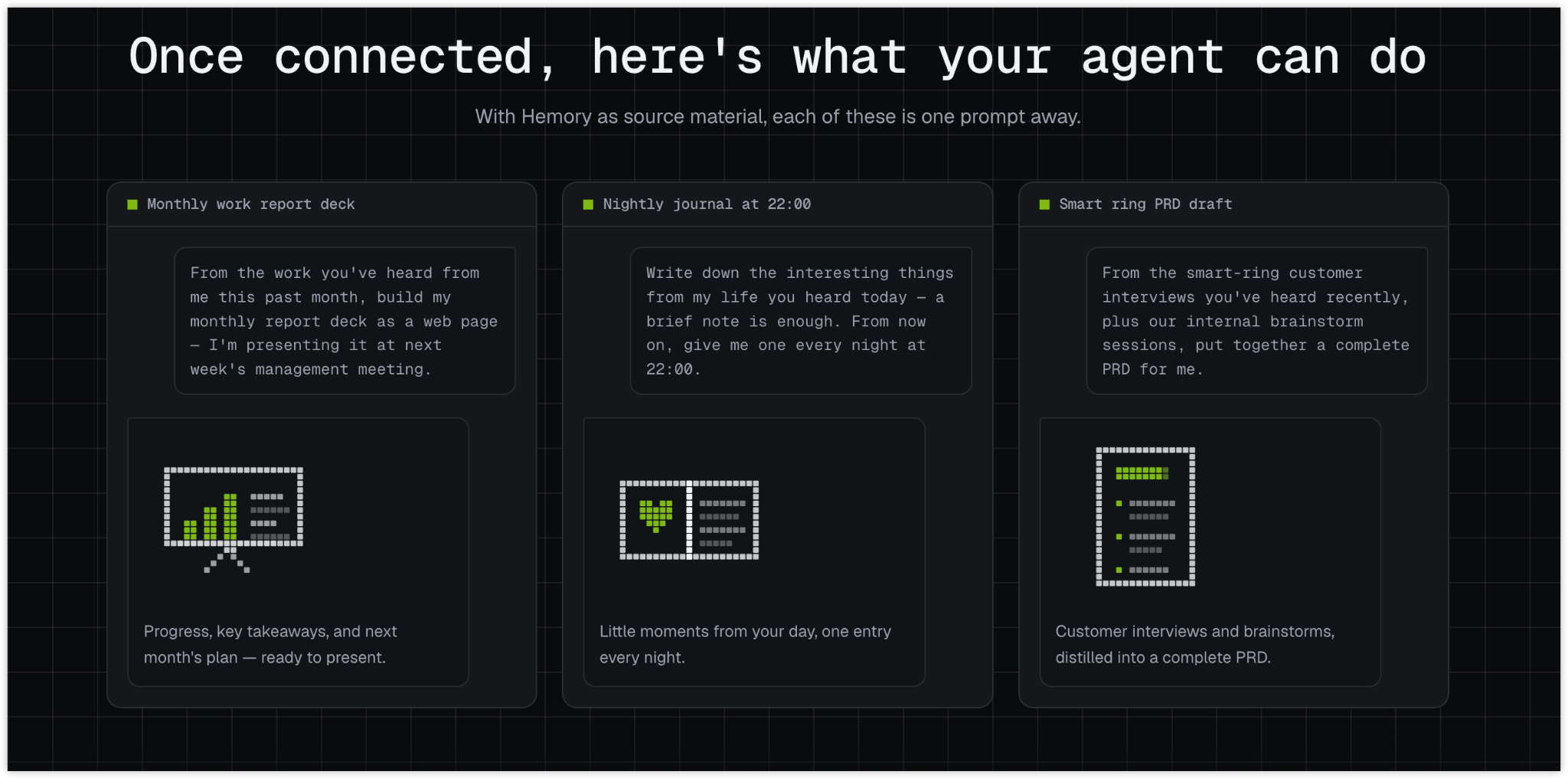
Turn saved context into reports, journals, and product requirements.
When a manual brief is still useful
Retrieval can help recover relevant captured context, but it does not replace information that exists only in a current document, an uncaptured conversation, or your own judgment. Supply the missing material when it changes the answer. For a simple question, a brief direct lookup may be enough; there is no need to build a full workflow around an agent.
The practical test is whether the context changes the output. If it does, ask for the relevant earlier discussions and review consequential details. If it does not, proceed with the information you already have.
FAQ
Do I need to summarize every previous meeting first?
No. Start with your goal and ask a supported connected agent to retrieve relevant conversations already captured in Hemory. Add current information the agent may not have. A short clue can help focus the search, but a complete chronology is not a prerequisite.
Can the agent find a conversation that was never captured?
No. Hemory-based retrieval depends on conversations having been captured and being accessible through the selected connection. If a necessary exchange is missing, use another source or ask someone to clarify it.
Should I trust a draft just because it uses past conversations?
No. Check details that affect the next action, especially attribution, conditions, decisions, and current status. Retrieval provides context; it does not establish that every relevant exchange was found or that an old statement remains current.
What if the agent does not show which conversations it used?
Ask what supports the key details and what it inferred. If you still cannot assess a consequential point, look for the source through a confirmed route or check another current record before relying on it.
Put the task first
Next time you need a follow-up or another piece of work based on earlier discussion, begin with the outcome—not a long retelling. Ask a connected agent to retrieve relevant captured context, review the details that affect the result, and provide the current information it could not retrieve. That keeps your attention on the work while preserving your responsibility for the final draft.