Hemory Team
On this page
You are about to join a customer call or a team discussion and you want it captured. You also don’t want to be the person who stops the conversation to set up a device, or who types notes instead of listening. Most of that disruption can be moved out of the conversation. Do the setup and the consent conversation beforehand, keep the conversation itself free of tooling, and do the checking afterward.
This guide describes that routine for Hemory. During a listening session, Hemory produces a timestamped transcript with Speaker labels, so your job in the conversation is to take part in it.
TL;DR
- Settle consent before the conversation starts. Starting and stopping should each take one tap once people have agreed.
- Use Manual Mode when you want to decide each start yourself. Use Schedule Mode for recurring conversations where a reminder and one-tap start help.
- During the conversation, don’t try to note down everything that might matter later. Stay in the discussion, and say commitments and key figures aloud so they are on the record.
- After you stop, check the transcript and Speaker labels yourself. Both can contain errors. Then ask Hemory’s Q&A about the content.
Before the conversation: consent, mode and placement
Get consent first
Ask the other people before you start, not after. A short request is enough for most conversations:
“I’d like to capture this conversation so I can focus on you instead of taking notes. Is that okay? I’ll stop whenever you ask.”
Two points are worth adding. First, say what is produced: a written transcript of the conversation. Second, if you use Speaker labels, mention that they are based on people’s voices.
The Hemory material this guide draws on doesn’t describe a consent step, so consent is your responsibility. Legal requirements and workplace policies differ by place and by situation, and this guide isn’t legal advice. Check your own organization’s rules before you make capture a habit with customers.
Choose how the session will start
Hemory has two ways to start listening. Choose one before the conversation so you aren’t deciding while people are waiting.
| Manual Mode | Schedule Mode | |
|---|---|---|
| How listening starts | You start and stop it yourself | You set listening times. Hemory sends a reminder when a session is due, with one-tap start and end |
| Good for | One-off or sensitive conversations, and any case where you want to confirm consent before each start | Recurring conversations, such as a weekly customer check-in or a standing team meeting |
| Your part | Start and stop each session | Tap the reminder to start, and tap again to end |
Hemory’s Features page describes Manual Mode as the one that guards the privacy boundary. If you’re unsure which to use, begin with Manual Mode. Schedule Mode’s reminder is a prompt to start. It doesn’t replace asking people each time, especially when the group changes.
Decide where the device will be
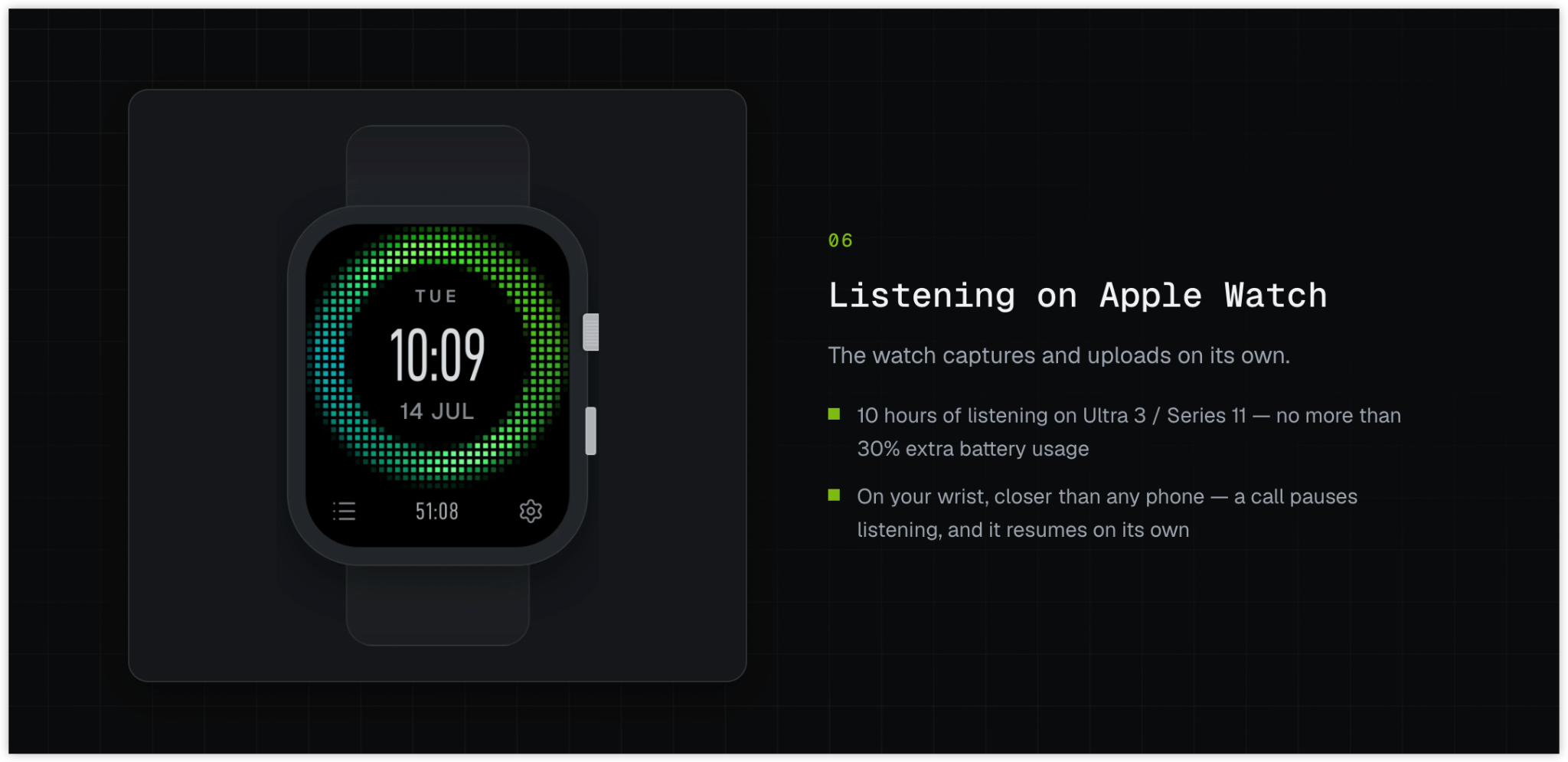
Decide where your phone or watch will be before people arrive, so you don’t handle it mid-conversation. Apple Watch can complete listening and upload on its own. If you use it, you don’t need a phone on the table.
During the conversation: start, then stay in it
Start once, at a natural moment
Once people have agreed, start the session in Manual Mode, or tap the Schedule Mode reminder. A good moment is while you’re settling in and before the first real topic. Check once that the session has started, then leave the device alone. Checking at the start costs a few seconds. Finding out afterward that nothing was captured costs the whole conversation.
Stay in the conversation
The benefit of capture is that you don’t have to predict which details will matter. Ask the follow-up question, respond to the objection, and let the transcript hold the rest. A few habits help the record without interrupting the flow:
- Say commitments aloud. “So I’ll send the revised quote by Friday” puts the commitment on the record, and the other person can correct you on the spot.
- State names, figures and dates clearly, especially ones that are easy to mishear.
- Write down only what you must act on during the conversation. Everything else can come from the transcript.
Stop when asked or when the topic changes
If someone asks you to stop, or the conversation moves to something that shouldn’t be captured, stop the session. That’s one tap in either mode, and it’s much less disruptive than a disagreement about it later. A phone call can also pause listening and resume it afterward. After a call interrupts, check that your session still covers the conversation you expected.
After the conversation: stop, check, then ask
Stop promptly
End the session as soon as the conversation ends. In Manual Mode you stop it yourself. In Schedule Mode you can use the one-tap end action on the reminder. Stopping promptly keeps hallway talk and unrelated chatter out of the record.
Check the transcript and the Speaker labels
Hemory’s transcript is automatic, with timestamps and AI cleanup. It’s a strong draft of what was said, not a guaranteed-accurate record. Review it in proportion to what you’ll do with it.
| Check | What to look for | Why it matters |
|---|---|---|
| Names, numbers, dates, product terms | Lines you plan to quote or act on | These are the details most likely to be wrong and most costly if they are |
| Speaker labels | Whether each statement belongs to the person it’s attributed to | Speakers stay anonymous until you name them. A label such as “Possibly Alex” is a confidence hint, not a confirmation |
| The summary | Whether it fits the conversation | Meetings can get structured notes with agenda items, decisions and action items. Lighter activities get a lighter summary, so don’t treat every summary as formal minutes |
For a line that matters, play it back. Hemory lets you play a transcript line on the listening device. When the transcript and the audio disagree, go with what you hear. Naming a speaker once teaches Hemory that voice, and related Speaker labels are updated across your library. A casual brainstorm needs a quick skim. A quote you’ll send to a customer needs a line-by-line check.

Ask about the content later
Once you’ve checked the parts that matter, use Hemory’s built-in Q&A to ask questions about your own Memory. It supports follow-up questions, and its answers are grounded in the transcripts. It can also retrieve across different conversations over time. For example:
- “What did the customer say about renewal timing, and what did they ask us to do?”
- “Which decisions did we reach in today’s planning discussion, and who was assigned each one?”
- “What were the open questions at the end of the call?”
Because answers come from transcripts, a transcript error can carry into an answer. If you’ll act on an answer, check the lines it points to.
What this routine saves you
Without capture, you’d take notes during the conversation, deciding in real time which details to keep, and reconstruct the rest from memory afterward. With this routine, the conversation is spoken input that is preserved as you go. Your afterward work is checking it and asking for what you need. You still do the judgment: whether people agreed, whether the transcript is right, and what to do next.
The routine as a checklist
Before
- Ask for consent. Say that a transcript will be produced, and that Speaker labels are based on voices if you use them.
- Pick Manual Mode or Schedule Mode.
- Decide where the phone or watch will sit.
During
- Start the session once people agree, and check once that it has started.
- Stay in the conversation. Say commitments, names and figures aloud.
- Stop the session if anyone asks, or if the topic shouldn’t be captured.
After
- Stop the session promptly.
- Check names, numbers and dates, and play back any line you will quote or act on.
- Check the Speaker labels. Name speakers you recognize, and treat “Possibly X” as a hint.
- Ask Hemory’s Q&A about the content, and check the source lines for anything you’ll act on.
FAQ
Do I have to tell people I’m recording?
Yes, as a working rule. The Hemory material reviewed for this guide doesn’t describe a consent step, so asking is your responsibility. Requirements differ by place and by organization, so check the rules that apply to you.
Does Hemory listen on its own?
Listening is something you control. Manual Mode starts and stops when you say so. Schedule Mode lets you set listening times and sends a reminder with one-tap start and end actions.
Can I quote the transcript directly?
Only after checking the lines you plan to quote. Names, numbers and Speaker labels can be wrong. Play the line back and confirm the speaker before using it.
What happens to the audio?
Hemory’s homepage states that audio is never stored in the cloud, is processed as a stream and destroyed when processing ends, and that raw audio stays on the listening device. That statement concerns audio. It doesn’t describe how transcripts or other Memory content are handled.
What if I forgot to start the session?
Hemory can only work with what was captured. Fill the gap from your own notes or ask the other person to confirm the details, and treat that as your recollection, not as a record of what was said.
Try it on your next conversation
Pick a low-stakes conversation, such as an internal check-in. Run through the checklist once, then review the transcript with a specific question in mind. That shows quickly whether the routine fits your work before you rely on it with customers.