

 Hemory Team
On this page
A useful idea or unexpected work conversation rarely waits for you to open an app and decide what to capture. A small routine helps you choose a mode before the moment arrives, without assuming that listening starts on its own. Hemory supports Manual Mode for moments you start yourself and Schedule Mode for predictable listening periods; Apple Watch can capture and upload listening content independently.
TL;DR
- Use Manual Mode when the moment is unpredictable and you want to start and stop listening yourself.
- Use Schedule Mode when you know roughly when you want to listen. Set the times ahead of time, then use the reminder and one-tap controls.
- Apple Watch can capture and upload listening content independently. Hemory supports iOS, Apple Watch, Android, and Wear OS.
- Afterward, review the transcript for the details you need. A transcript is useful to check, not a guarantee that every word was captured perfectly.
Choose the mode before the moment
| Situation | Mode | What to do |
|---|---|---|
| An idea might come at any time, or a conversation is unplanned | Manual Mode | Start listening when you decide to capture the moment, then stop when you are done. |
| You expect to want listening at recurring or predictable times | Schedule Mode | Set the listening times in advance. When reminded, use the one-tap action to start or stop. |
Use Manual Mode for spontaneous moments
Manual Mode fits a quick idea, an unexpected discussion, or any moment that does not follow a reliable schedule. You control when listening starts and stops, so there is no need to predict the exact time in advance. When a moment matters, start listening; when it is over, stop.
For a conversation with other people, consider consent and privacy before you start recording. Do not assume that choosing Manual Mode means listening has already begun.
Use Schedule Mode for predictable windows
If you regularly want to capture a planned work period, set listening times in Schedule Mode ahead of time. For example, you might choose a recurring window when you typically have work discussions. The reminder gives you a prompt, and the start and stop actions are one tap.

Set listening times for weekdays and weekends.
Treat the reminder as a cue to act. The supplied product information describes reminders and one-tap controls; it does not describe recording that begins without user action.
Choose a device that fits the moment
Hemory’s supported platforms are iOS, Apple Watch, Android, and Wear OS. If your phone is not convenient during a conversation or while an idea comes to you, Apple Watch can independently capture and upload listening content. Choose the device you can comfortably use at the moment; the important part of the routine is still deciding when to start and stop listening.
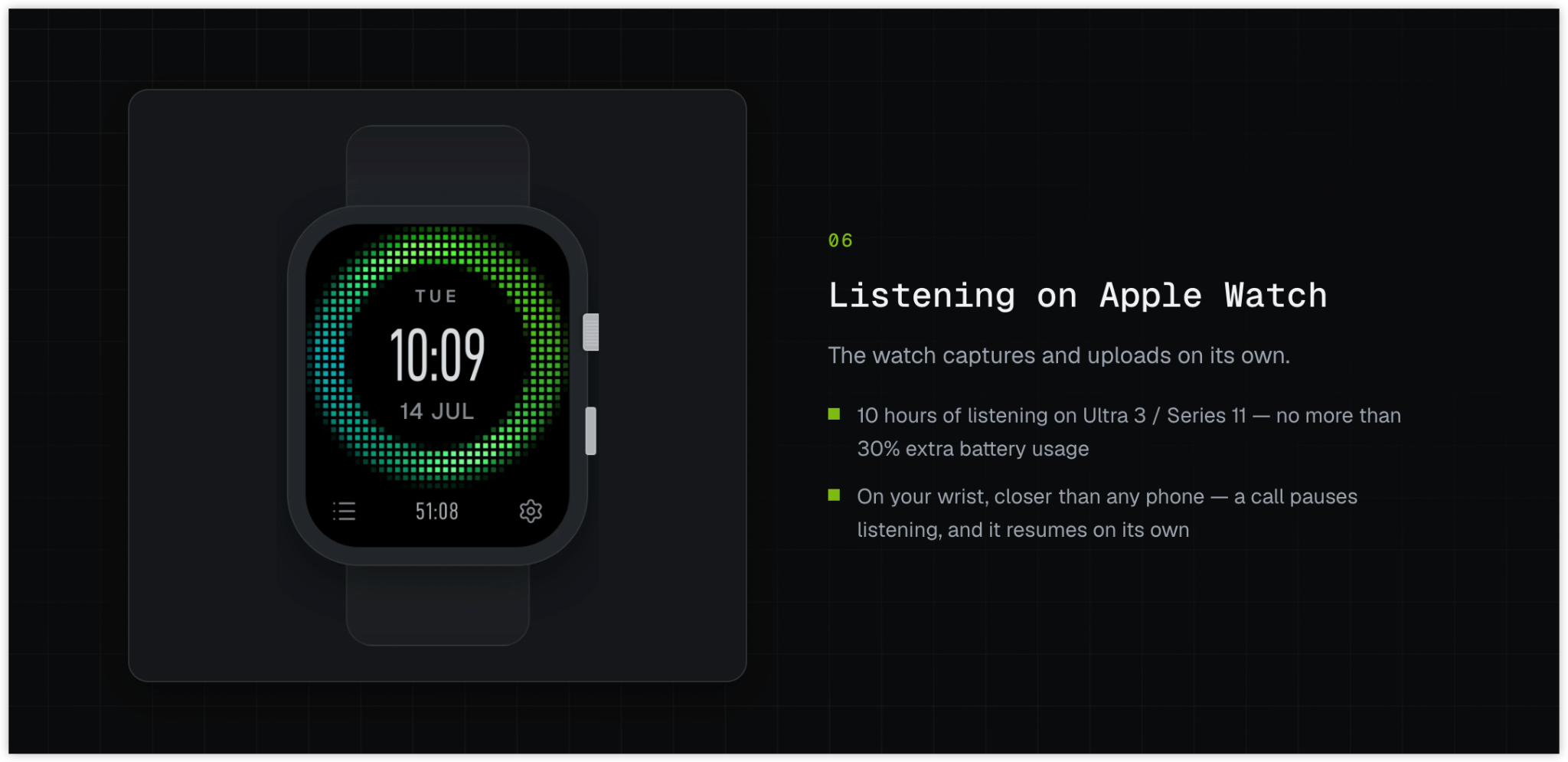
Hemory listening interface shown on Apple Watch.
Review what was captured
After listening, check that a transcript is available and scan the relevant parts for the idea, explanation, or detail you wanted to preserve. Hemory produces timestamped transcripts, but transcription is not guaranteed to be perfect. If a detail will affect a decision or follow-up, review its wording rather than relying on a quick glance alone.

Find individual statements in a searchable transcript.
A transcript can help you return to the discussion without having to write down every potentially useful detail while it is happening. If the detail you need is not in the available record, use another source or ask a focused follow-up rather than assuming it was captured.
Keep the routine simple
- For unpredictable moments, choose Manual Mode and start and stop listening when you decide to capture something.
- For predictable periods, set a Schedule Mode window in advance and respond to its reminder with the one-tap action.
- Use Apple Watch when its independent capture and upload suit the moment.
- Afterward, review the transcript for the details you may need again.
Start with one real use case—a recurring work period or a kind of spontaneous idea you often want to keep. Follow the matching routine once, then check the transcript so you know what the available record contains.