

 Hemory Team
On this page
A bot-free capture method may avoid adding a meeting bot to a client call, but that alone does not answer the important questions: will participants know capture is happening, what records will persist, and can you retrieve the details you need later? Use the checklist below to assess the actual setup before relying on it. No capture method is automatically appropriate for every client or confidentiality obligation.
TL;DR
- Decide what participants need to know and what disclosure or consent is appropriate for your situation before capture begins.
- Treat audio, transcripts, and summaries or structured Memory as separate records. Check storage, access, retention, and deletion for each.
- Test retrieval with a detail you expect to need later. A capture method is only useful for recall if the resulting record is accessible and searchable.
- “Bot-free” describes one aspect of a setup; it does not by itself establish that recording is discreet, permitted, secure, or suitable.
Questions to ask before recording
1. Will everyone know when capture is happening?
Ask how the device or software indicates that listening has started and stopped, and whether that indication is visible to the other participants. Check the specific call setup rather than assuming a tool’s “bot-free” label means recording is hidden—or that recording is apparent to everyone.
Decide how you will tell the client what you plan to capture and why. Consent and disclosure expectations depend on the circumstances and jurisdiction; this checklist is not legal advice. If you are uncertain, pause and consult the appropriate legal, privacy, or organizational guidance before recording.
2. What exactly will be captured?
Find out whether the method records audio, creates a transcript, produces summaries or structured notes, or does some combination of these. Also check whether it captures the client’s speech in the specific call format you use. A device that can listen does not necessarily capture every phone, video, or in-person conversation in the way you expect.
If you are considering Hemory, verify that your intended device and call setup can capture the conversation you need. Do not assume a particular call is captured merely because the product supports listening sessions on a platform.
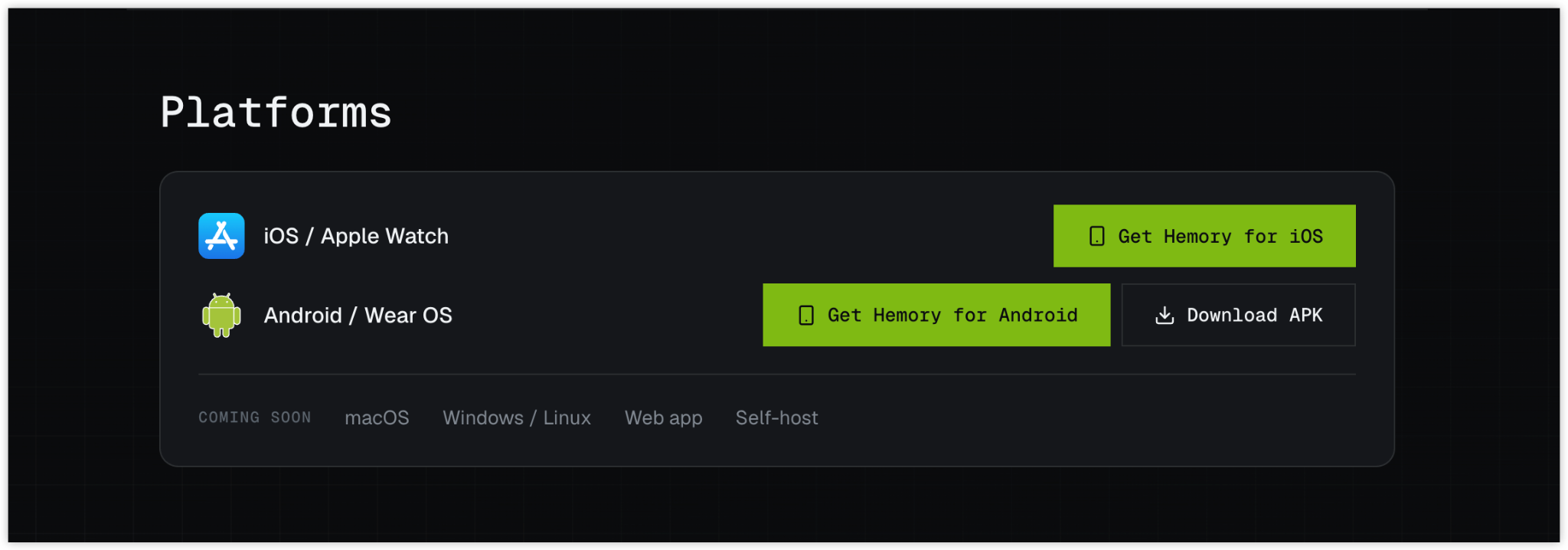
See the mobile and wearable platforms listed on the site.
3. Where does each record go, and who can access it?
Ask separately where raw audio, transcripts, and summaries or other saved Memory are stored, whether they are synced or shared, and which people or connected tools can access them. Do not treat an answer about one record type as an answer about the others.
Hemory’s stated raw-audio policy is that raw audio is stored only on the listening device and is never synced across devices. That statement does not establish where transcripts or structured Memory are stored, how they are handled, or who can access them. Confirm those details for your intended use before deciding whether the setup fits your confidentiality needs.

Privacy cards present claims about audio storage and retention.
4. How long will the records remain, and how can they be removed?
Ask about retention and deletion for each record type, including any copies or synced versions relevant to your setup. Check whether you can remove a transcript or saved Memory independently of raw audio, and whether deletion affects records that have already been used elsewhere. If you cannot establish the relevant retention and deletion terms, do not assume the records disappear when a call ends.
5. Can you find the context you will need later?
Choose a realistic follow-up task: for example, finding a client’s stated constraint or recalling the reasoning behind an agreed next step. Check whether the method lets you search or ask a question across the records you plan to keep, and whether you can inspect enough context to judge what a result means.
If a client conversation has already been captured in Hemory and is accessible in your account, its built-in Q&A is described as supporting transcript-based follow-up questions and retrieval across conversation sessions (Hemory Features). That can reduce the need to reconstruct every detail from memory or manually assemble notes. It does not guarantee complete recall or establish that a particular conversation was captured. If a detail is missing, consult another available record or ask a focused follow-up.
Make the decision from the answers
Use the checklist to decide whether the setup is suitable for this client and this type of call—not whether it is universally safe or compliant.
| If you find… | What to do next |
|---|---|
| Participants may not know capture has started, or disclosure expectations are unclear | Pause and resolve the disclosure or consent question before recording. |
| You cannot determine how relevant records are stored, accessed, retained, or deleted | Get authoritative information for the specific record types and setup; do not infer terms from a raw-audio policy. |
| The device may not capture the call format you use | Test the setup in an appropriate, non-sensitive context before relying on it for client work. |
| You can capture appropriately, understand record handling, and retrieve the context you need | Use the method only within the limits you have confirmed, and review consequential details before acting on them. |
A bot-free approach may be worth considering if it fits the call setup and your disclosure practices, but discretion is only one criterion. Choose a method only when you understand what it captures, where each resulting record goes, how long it remains, and how you will retrieve and review relevant details. If Hemory is part of that workflow, it can help preserve and retrieve captured conversation context; you remain responsible for deciding whether capture is appropriate and how to use the information.