

 Hemory Team
On this page
A product discussion can contain customer observations, ideas, decisions, and unanswered questions in the same conversation. Turning that mix into a PRD, user stories, and acceptance criteria takes more than changing the format: each step interprets the information, so an unsupported assumption can become harder to spot as it moves downstream.
TL;DR
- A PRD organizes the problem, goals, scope, constraints, and open questions. User stories express a need from a user’s perspective; acceptance criteria describe observable conditions for satisfying it.
- Treat each handoff as a review point. Keep source evidence and unresolved questions visible instead of promoting suggestions into decisions.
- If the discussion was captured in Hemory, its transcript-based Q&A or a supported connected agent can help retrieve relevant context. The external agent drafts; people review and decide what to use.
How the stages connect
The chain is a sequence of related documents, not a guarantee that every sentence in one becomes a settled commitment in the next. Each stage has a different job:
| Stage | Main input | Useful output | Typical failure to watch for |
|---|---|---|---|
| Product discussion | User feedback, product context, questions, proposals, and decisions | Evidence about needs, constraints, and what people did or did not agree to | A paraphrase blurs who said something or whether it was a request, suggestion, or decision |
| Product requirements document (PRD) | Relevant evidence plus current product goals and constraints | A reviewable account of the problem, intended outcome, scope, requirements, and open questions | An interpretation is written as fact, or an unresolved issue disappears from the draft |
| User stories | Reviewed requirements and the intended users or roles | Focused descriptions of user needs and their purpose | A story introduces a user, benefit, or commitment that the source did not establish |
| Acceptance criteria | A specific story and the expected behavior | Observable conditions that help reviewers and implementers judge whether the story is satisfied | Vague terms such as “easy” or “fast” cannot be evaluated, or criteria silently add scope |
The sequence is usually iterative. If a story reveals that a requirement is ambiguous, revisit the PRD or the source discussion instead of inventing a detail to keep moving.
1. Start with evidence, not a polished summary
First separate the material into what was reported, what was proposed, what was agreed, and what remains unresolved. These distinctions matter because a customer describing a difficulty has not necessarily requested a particular solution, and a team discussing an idea has not necessarily approved it.
A concise evidence note can preserve:
- The need or problem as described, with relevant context.
- Any proposed solution, clearly labeled as a proposal.
- Decisions and their scope, if the discussion establishes them.
- Constraints, conditions, and important exceptions.
- Questions that need a product, design, technical, or customer answer.
Do not force every observation into an immediate action. Background may become relevant when the team compares solutions, even if it does not change the current requirement.
When the relevant conversations were captured in Hemory, its built-in Q&A can answer multi-turn questions grounded in transcripts and retrieve across different conversation sessions. Hemory also describes timestamped transcripts, speaker labels, and structured meeting summaries for meeting activity. These can reduce manual searching and retelling, but they are source material—not proof that a decision was approved or that every detail was captured correctly. If a conversation was never recorded or is not accessible through the route being used, retrieve it from another available source or ask a focused follow-up.

Retrieve past commitments and draft follow-up tasks.
2. Use the PRD to make the problem and boundaries reviewable
A PRD should explain why the work matters and what it includes before it describes a solution in detail. Depending on the project, it may include:
- Problem and evidence: what users experience and what supports that understanding.
- Goal: what outcome the work is intended to improve.
- Scope: what is included and what is explicitly outside the work.
- Requirements and constraints: expected behavior, dependencies, and limits.
- Open questions and decisions: what still needs an answer, and what has actually been settled.
A draft can be incomplete and still useful if it makes gaps visible. Mark an uncertain point as an open question rather than filling it with a plausible-sounding assumption. Keep current goals or new instructions distinct from what people said in earlier discussions; they may inform the PRD, but they are not historical evidence.
Review at this handoff: Can a reader tell which claims come from evidence, which are interpretations, and which are decisions? Does the scope preserve important conditions? Are unresolved questions still visible?
3. Derive user stories from reviewed requirements
A user story expresses a need from the perspective of a user or role. A common structure is: “As a [user or role], I want [capability], so that [purpose].” It is a drafting aid, not a reason to invent a persona or benefit absent from the available information.
For example, suppose a product discussion establishes that an account administrator needs to identify which team members have access to a shared workspace. A draft story might be: “As an account administrator, I want to see who has access to the workspace, so I can review membership.” The specific story is illustrative; a real team should use the roles and purpose supported by its own evidence.
Keep one story focused enough that its need and purpose can be discussed together. If a story combines distinct users or outcomes, split it only when the evidence supports those distinctions. Otherwise, flag the ambiguity for review.
Review at this handoff: Does the story preserve the requirement’s user, need, and purpose? Has it added an unsupported role, benefit, or promise? Can a reviewer trace it back to a requirement and the evidence behind that requirement?
4. Make acceptance criteria observable
Acceptance criteria describe conditions that can be checked for a particular story. They should clarify the expected behavior without smuggling in new product decisions.
For the illustrative workspace story, criteria might ask whether an administrator can view the members currently listed for that workspace and distinguish the relevant access information. Those details are examples of questions a team could define—not claims about an established product decision. If the source discussion does not define which roles can see the list or how changes are handled, record those as questions for the team rather than silently choosing an answer.
Prefer criteria that describe an observable result over subjective judgments such as “the list is intuitive.” If a quality matters but has no agreed measure or threshold, keep it as a question until the appropriate people define it. Acceptance criteria also do not replace testing plans or approval; they give reviewers a clearer basis for evaluating the story.
Review at this handoff: Can someone assess each criterion from the story’s expected behavior? Does it stay within approved scope? Are terms, exceptions, permissions, and dependencies clear enough for the next reviewer to decide what remains open?
Where Hemory and an AI agent fit
This workflow can be done with records in a CRM, notes, transcripts, or other accessible sources; information outside a CRM does not automatically require Hemory. When the useful discussions were captured in Hemory, retrieval can reduce the work of locating and assembling relevant context. Hemory’s Features page also describes connecting its Memory to external agents through MCP. What a particular connected agent can retrieve depends on its supported connection and access; the presence of a connection does not establish that every agent has identical tools or permissions.

Review MCP connection options and access settings.
An external agent can use accessible context to draft or refine a PRD, stories, or criteria. It does not make those documents Hemory-generated product features, decide what the team approved, or automatically write them into a tracker such as Jira. The user supplies the current task and any necessary new information, reviews the draft, and carries approved work into the team’s existing process.
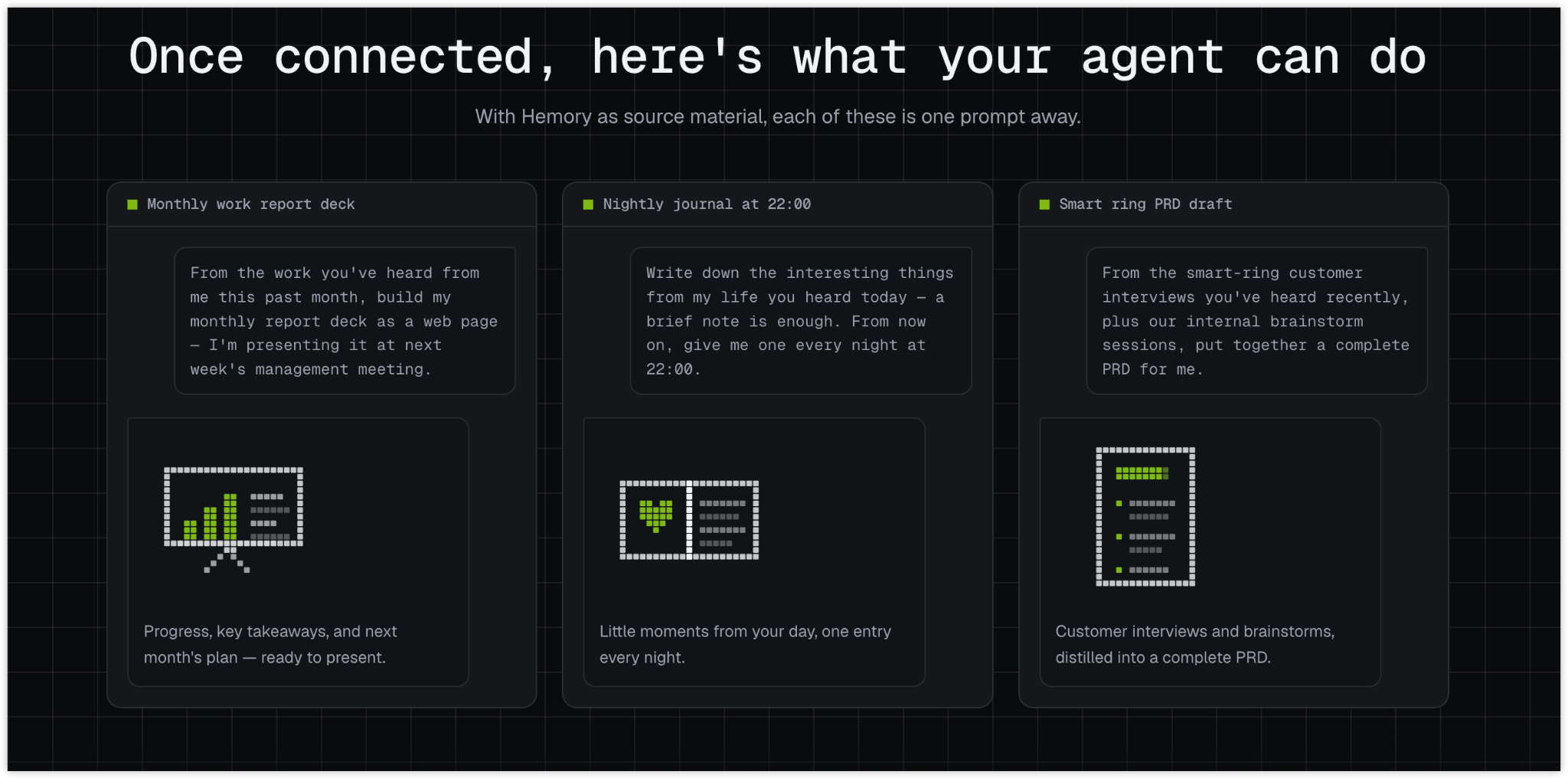
Turn saved context into reports, journals, and product requirements.
A useful request names the deliverable and the distinctions to preserve—for example, ask for a PRD draft that separates reported needs, proposals, decisions, and open questions. Do not require a complete hand-written chronology before the agent can help; review the consequential gaps in its draft against the accessible evidence instead.
Keep the chain traceable without treating every source as infallible
For each important requirement, make it possible for a reviewer to understand its basis: the relevant evidence, its scope, and any interpretation or unresolved issue. A transcript can help recover what was said, but it is not guaranteed to be complete or error-free. A current document or CRM record may also contain useful reasoning or later changes. Compare sources for relevance, scope, currency, and approval rather than assuming one format is always authoritative.
If a draft’s wording changes what the team would build or promise, inspect the relevant source and ask the responsible people to resolve the uncertainty. A later mention does not automatically revise an earlier decision, and a draft document does not establish approval. Keep the question attached to the affected requirement until it is answered.
FAQ
Does every customer comment need to become a user story?
No. A comment is evidence to interpret, not automatically a requirement or solution request. Group related evidence where useful, then decide whether it supports a product need, a question, or no action in the current scope.
Should acceptance criteria be written before the PRD is approved?
They can be drafted while the PRD is under review, but their status should be clear. Criteria based on unsettled scope or assumptions should remain proposed until the relevant decision is made.
Can Hemory create the PRD or add stories to Jira?
Do not assume either. Hemory provides captured conversation context and retrieval; an external agent may draft from context it can access. The available evidence does not establish that Hemory creates PRDs or writes stories into Jira. Review and move approved work through the team’s chosen process.
A practical next step
Take one real product need and trace it through the four stages: source evidence, PRD requirement, user story, and acceptance criteria. At each handoff, mark what is supported, what is interpretation, and what is still open. If the discussions are already captured in Hemory and available through the chosen route, use retrieval to reduce manual searching; keep human review responsible for decisions, scope, and approval.