

 Hemory Team
On this page
A PRD often draws on decisions and user needs discussed over several conversations. If you begin by rebuilding all that history in a long brief, you may spend time compiling notes before the drafting can start. A supported connected AI agent can help retrieve relevant discussions already captured in accessible Hemory Memory, then use that context to prepare a draft. Start with the goal and the document you need; review the retrieved evidence and fill in current information before relying on the result.
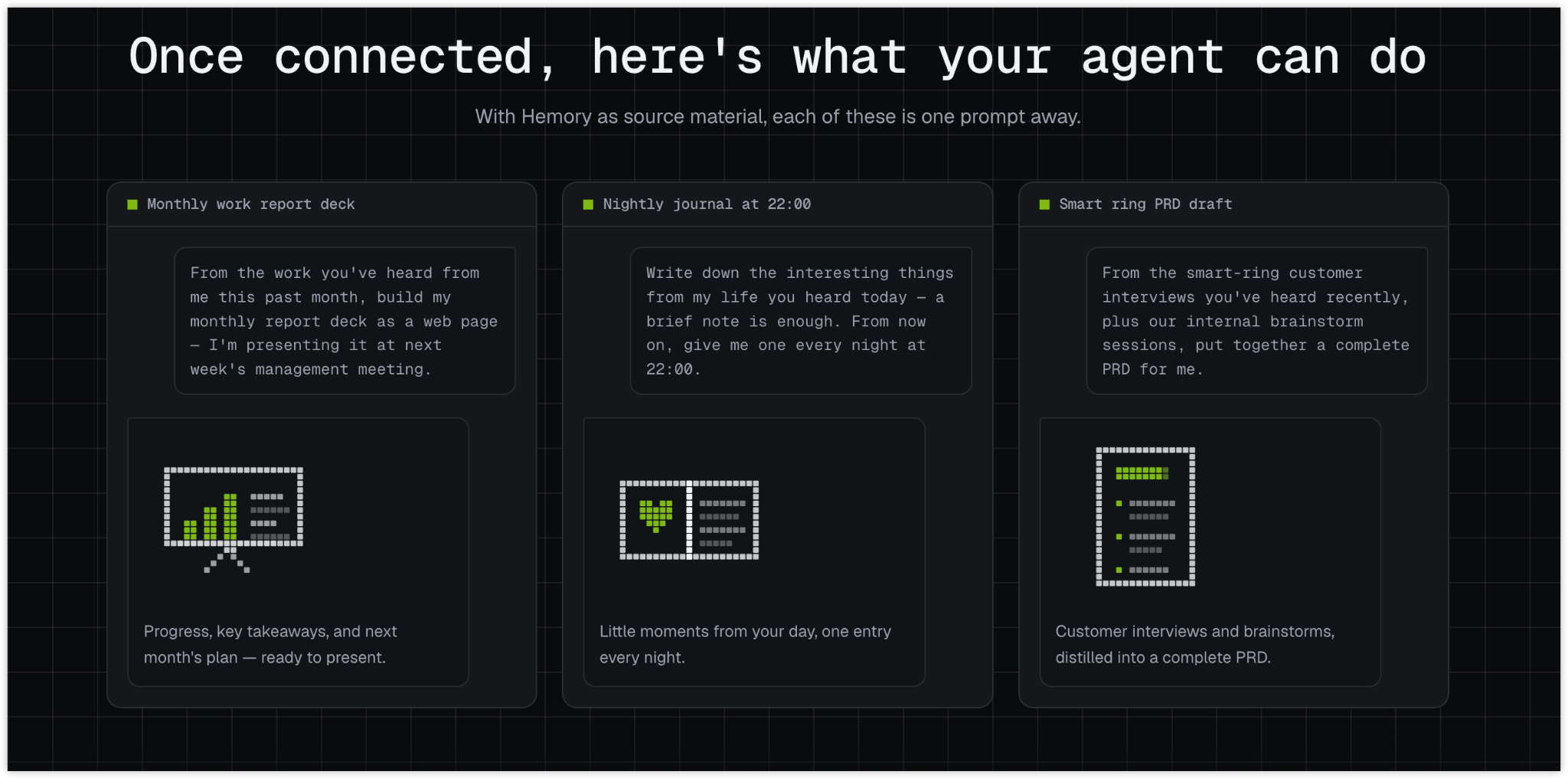
Turn saved context into reports, journals, and product requirements.
TL;DR
- State the PRD goal, scope, and any important current information. Ask the connected agent to find relevant earlier conversations in Hemory rather than preparing a complete history yourself.
- Request a draft that separates what people stated or agreed from proposals, assumptions, and open questions.
- Review the source details and the status of consequential claims. Add current facts and resolve gaps before treating the PRD as ready for team review.
1. Start with the PRD goal, not a full background brief
First define the work the PRD should support. Name the product or feature, the intended audience if known, and the result you want from the document. Include important new information that earlier discussions could not contain, such as a changed launch constraint or a decision made today.
Then ask the agent to retrieve related conversations already captured in Hemory. The agent can only use material it can access through its supported connection; it cannot reconstruct an exchange that was never recorded. You do not need to assemble a complete chronology or copy every discussion into your prompt before it begins.
A starting prompt could be:
Draft a PRD for [product or feature] to help [intended audience, if known] achieve [goal]. Search the relevant conversations already captured in my accessible Hemory Memory for user needs, decisions, constraints, and unresolved questions. Use the retrieved context to create a first draft. Separate source-backed statements from your recommendations and assumptions, and flag missing or conflicting information instead of filling it in. I’ll provide any current updates that are not in those conversations.
Keep the request focused. A distinctive feature name, customer or project name, or approximate time period can help narrow the search if you know it. Do not invent clues just to make the prompt look complete; let the retrieved material correct or refine your recollection.
2. Let retrieval inform the draft
A connected agent with access to Hemory can retrieve relevant context and use it in the same task. Hemory provides the conversation memory and retrieval access; the external agent performs its own analysis and drafting. The exact material and tools available depend on the connection, so ask for details the agent can actually return rather than assuming every client exposes the same source information.

Retrieve past commitments and draft follow-up tasks.
You can ask the agent to organize its findings into a few useful groups before drafting, or ask it to draft and show those distinctions alongside the document. For example:
For each requirement or constraint in the draft, indicate whether it comes from an explicit statement, an accepted decision, a proposal, or your inference. Where available, identify the conversation or passage behind it. List unresolved questions separately, and do not treat repeated mentions as separate decisions or evidence of agreement.
This is a request for the agent’s output, not a guarantee that every connection can provide exact quotations, dates, or source references. If it cannot identify the source for a consequential claim, treat that claim as unverified and ask a focused follow-up or consult another available record.
A PRD draft can include these sections when they fit the task:
| Section | What to include | What to leave unresolved rather than guess |
|---|---|---|
| Problem and context | The user need and relevant evidence from discussions | A problem or audience not established by the source material |
| Goals and non-goals | The intended outcome and explicit exclusions | Targets or boundaries that have not been agreed |
| Requirements | Behaviors or constraints supported by the discussions | Whether a suggestion is a committed requirement |
| Acceptance criteria | Observable conditions for considering a requirement met | Measures or thresholds nobody specified |
| Dependencies and open questions | Conditions, risks, and decisions still needed | Owners, dates, approvals, or answers not in evidence |
Do not force every section into every PRD. Include what helps the team make the relevant product decision, and mark missing information plainly.
3. Review the retrieved context before refining requirements
The agent’s draft is a starting point, not proof that every relevant discussion was found or interpreted correctly. Review the parts that could change product scope, priority, or what the team does next.
- Check relevance: Does each cited conversation concern this product or feature, rather than merely sharing a keyword or participant?
- Check the source and scope: Where the agent provides a conversation, date, passage, or other source detail, confirm that it supports the statement in the PRD. A personal recap is still a person’s account, not the original speaker’s exact words.
- Check the status: Distinguish a suggestion from an accepted decision, and a stated need from a commitment to deliver. A missing deadline does not erase an accepted commitment; an unresolved condition does not make a proposal an agreement.
- Check what is current: An earlier discussion may not reflect the present plan. Supply new facts and ask the agent to show where they change or qualify the draft.
- Check what is missing: If a search returns nothing, that does not prove a need was never raised or a decision was never made. Try a useful alternate clue, consult another available record, or ask someone who can clarify.
You do not need to replay or recheck every source. Give closer attention to claims that would change scope, acceptance, or a team commitment. For a minor detail that does not affect the next decision, a brief note that it needs confirmation may be enough.
4. Refine the PRD without turning inferences into commitments
Once you have reviewed the important evidence, ask the agent to revise the document around the PRD’s purpose. Supply any current information it could not retrieve, such as a newly approved constraint, the team’s present terminology, or a confirmed decision from another source.
For example:
Revise the PRD using these current updates: [add confirmed information]. Keep the source-backed needs and accepted decisions distinct from recommendations. Mark any proposed priority as proposed, and leave unsupported owners, dates, metrics, or approval status as open questions. Return the revised PRD and a short list of decisions the team still needs to make.
Then read the result as the person responsible for the product work. Check that each requirement is understandable and testable enough for its purpose, that important conditions have not been dropped, and that open questions have a next step. Do not let polished language make an assumption look settled. The agent can help retrieve and organize material, but you and the relevant team members determine what to accept, change, or approve.
5. When to use another route
This workflow depends on the discussions having been captured in Hemory and being accessible to the connected agent. If an important conversation is missing, use another available source or ask the participants for the needed detail. A newly written voice recap can preserve your recollection, but it is not a record of someone else’s exact words.
For a simple question about a known discussion, Hemory’s built-in Q&A may be a more direct route than asking an external agent to draft a PRD. Hemory describes its Q&A as supporting transcript-based follow-up questions and retrieval across conversation sessions. For a full document workflow, use a supported connected agent whose access to the relevant Memory is available; do not assume every client has identical tools or scope.
FAQ
Do I need to summarize every earlier discussion before asking for a PRD?
No. If the relevant conversations were captured in Hemory and are accessible to the connected agent, you can begin with the PRD goal and ask the agent to retrieve related context. Add current information that is not in those conversations, then review the draft’s consequential claims and gaps.
Can an AI agent decide which ideas are approved requirements?
It can help distinguish explicit statements, proposals, and decisions when the source material supports that distinction. It cannot establish approval that the discussions do not show. Review the evidence and confirm uncertain decisions with the people responsible.
What if the agent cannot show where a requirement came from?
Treat the requirement as unverified until you can support it with an accessible conversation or another reliable source. Ask the agent for available source details, search with a useful clue, or raise a focused question. A missing result does not prove the requirement was never discussed.
Can I use this workflow with any AI agent?
Only if the agent is connected in a supported way and can access the relevant Hemory Memory. Available tools and retrieval scope can differ by client, so do not assume a connection provides identical access everywhere.
Next step
Choose one PRD you need to draft, state its goal and current constraints, and ask a supported connected agent to retrieve the relevant captured conversations. Review the source details behind the requirements before sharing the draft. This approach can reduce the work of compiling and retelling discussion history while keeping product judgment and approval with you and your team.