

 Hemory Team
On this page
A full day of conversations can leave you with decisions, useful details, and open questions scattered across meetings and informal discussions. By evening, writing them all up can feel like another task—and relying on memory alone can leave gaps. A short journal workflow can help: gather the conversation context you can access, have an AI agent draft a dated entry, then review it before keeping it.
TL;DR
- Keep the journal brief: record the day’s main topics, decisions and conditions, and unresolved questions—not a transcript of everything said.
- Use only conversations that were captured and are accessible. A connected AI agent can retrieve context from Hemory when its connection supports that task; Hemory does not recover uncaptured discussions.
- Review the draft for missing context, unsupported conclusions, and changes in status before saving it. Any recurring schedule must be set up in the agent or automation environment, not assumed to be a Hemory feature.
Choose a format you will actually review
A useful daily journal is a compact record, not a second set of meeting minutes. Include details that help you remember what mattered or decide what to do next. Leave out routine conversation that has no lasting relevance.
A simple structure is:
| Field | What to include |
|---|---|
| Date | The day the conversations took place. |
| Topics | A few subjects worth remembering, grouped where it helps. |
| Decisions and conditions | What was agreed, what it depends on, and what remains undecided. |
| Open questions or follow-ups | Unresolved points or next steps that were actually stated. Do not invent an owner or deadline. |
| Personal note | An observation or reflection you provide yourself, rather than an emotion or intention inferred from the conversations. |
You can omit fields that do not add value on a particular day. If nothing was decided, say so only when the accessible records support that conclusion; otherwise, leave the decision field blank or mark it as not established.
Gather the day’s available conversation context
Start with the records you can actually use. If relevant discussions are already in a CRM, notes, or another accessible record, you may use that source. If you want to work from Hemory, the conversations must have been captured there and be accessible through the route you choose.
Hemory produces timestamped transcripts with speaker labels and AI cleanup for captured listening sessions. It also classifies daily activity and varies its summaries by activity type; meetings may receive structured notes, while lighter activities receive lighter summaries. These records can help you revisit the day, but they do not establish that every conversation was captured or that every detail is error-free.

Revisit daily conversations in an activity timeline.
For a connected AI agent, first confirm that its Hemory connection can retrieve the relevant captured context. If it supports retrieval by date, specify the day and ask it to use only records from that date. If it cannot isolate the date or access the needed records, do not treat the result as a complete daily account. Use another source available to you, or keep the entry explicitly limited to the context you could retrieve.
Ask the agent to draft, not to fill in gaps
Once the agent can access relevant context, give it the date and the purpose of the entry. You do not need to write out a full chronology first. Add current information the conversations cannot establish—for example, what you personally want to remember or whether a follow-up has since been completed.
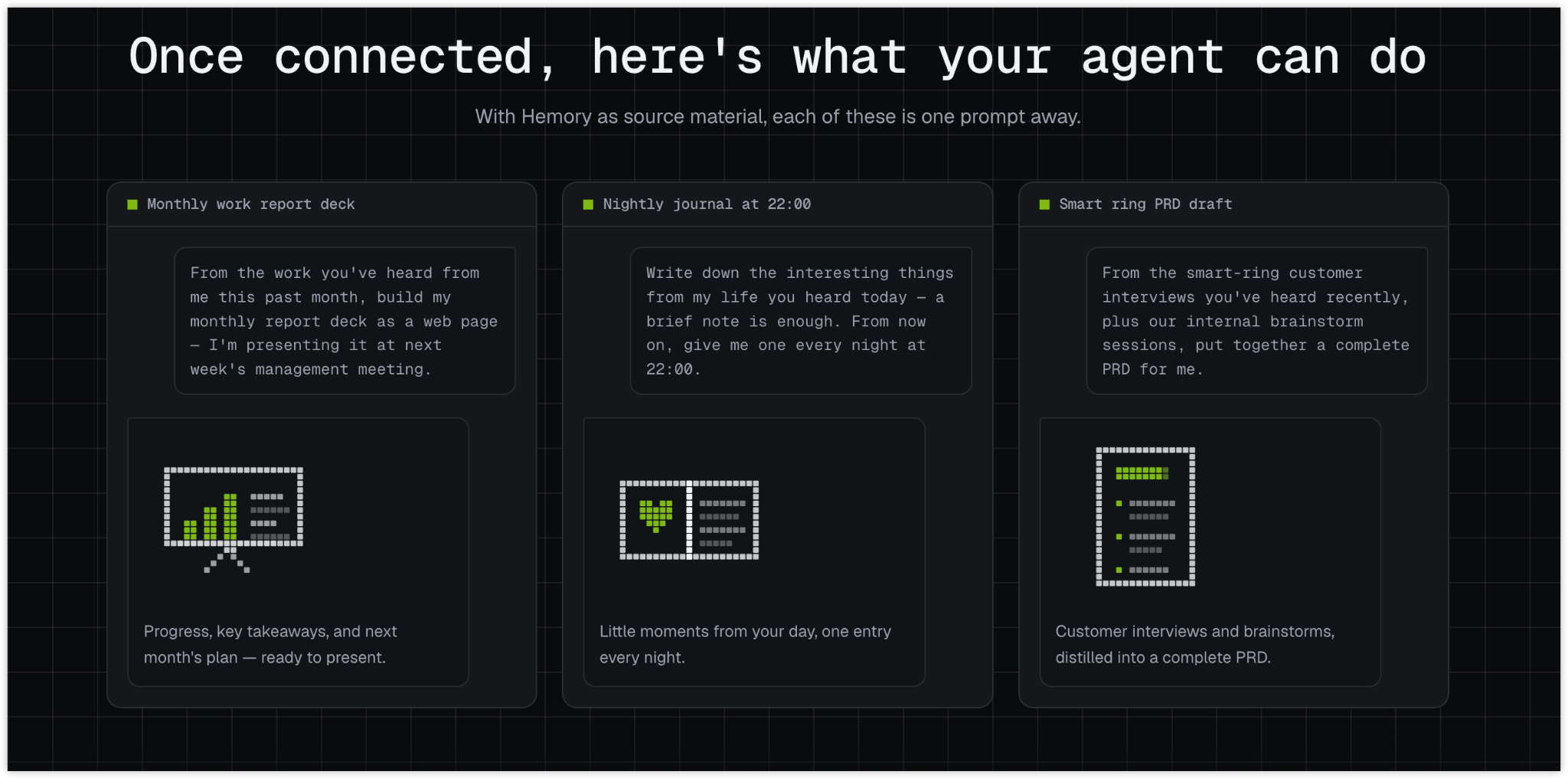
Turn saved context into reports, journals, and product requirements.
You can adapt this request for a connected agent that has access to the relevant Hemory Memory:
Draft a concise journal entry for [date] using only the captured conversations from that date that you can access in Hemory. Group related topics briefly. Separate stated decisions from proposals and unresolved questions; preserve any conditions attached to a decision. Include follow-ups only when they were actually stated, and do not invent owners, deadlines, completion, or my personal reactions. If you cannot retrieve or date-filter the relevant conversations, or if a point is unclear, say so rather than guessing. Keep the entry short enough to review quickly.
The agent drafts from the context it can access. You supply the date, purpose, and any current information needed; you decide what belongs in the final journal. If the agent cannot reach the relevant conversations, provide material through another route available in your workflow rather than assuming Hemory or the agent can access it.
Review the entry before saving it
Read the draft as a record of the day, not as a verdict about what happened. Focus your review on details that could change what you remember or do next:
- Coverage: Is the entry clear about which date and available records it uses? Does it imply that it covers conversations the agent could not access?
- Status: Are suggestions, decisions, commitments, and open questions kept distinct? A proposal should not read like an agreement.
- Conditions and next steps: Are relevant conditions preserved? Do not turn a mention of a possible action into an accepted assignment, owner, or deadline.
- Current information: If you know something has changed since the conversations, add it yourself and make the update clear. A past statement alone does not establish current progress.
- Personal reflection: Add your own observation if you want one. Do not let the agent assign you a feeling or intention that you did not state.
Then edit or remove anything that is inaccurate, unnecessary, or too detailed for a daily record. Save the entry wherever you keep your journal; the workflow does not imply that Hemory automatically writes it to another app.
Make it recurring only if you want to
Try the process manually first and adjust the format until it is useful to review. If you want a draft each evening, set the schedule through the connected agent or automation environment that supports it. Scheduling is separate from Hemory’s capture and retrieval role, and a scheduled run should still make clear when records are missing or inaccessible.
FAQ
Will the journal include every conversation from the day?
Not necessarily. It can use only conversations that were captured and are accessible to the selected tool. Retrieval may also miss relevant context, so avoid presenting the entry as comprehensive unless you have checked its coverage.
Do I need to summarize each conversation myself first?
No, not when a connected agent can retrieve the relevant captured context. Give it the date and the kind of entry you want, then review the draft. If the agent cannot access the records, use another source available to you or keep the entry limited to what you can provide.
Can Hemory send me a journal automatically every evening?
Do not assume so. Hemory can provide captured Memory for retrieval; recurring scheduling and drafting belong to a connected agent or automation environment that supports them. Review the resulting entry before relying on it.
Start with one day
Choose a day with conversations you know were captured and accessible. Ask a connected agent for a short entry, review its decisions and open questions, and keep only what will be useful to revisit. That gives you a practical journal format to refine without requiring a handwritten recap of every conversation.