

 Hemory Team
On this page
A wearable recorder stays with you; a desk recorder stays where you put it, while a phone-clip recorder depends on where you carry your phone. Those differences matter more than the form-factor labels: they affect who is near the microphone, whether you can move freely, and how much setup the recording adds to your day.
Compare the actual device in the setting where you plan to use it. Check its pickup from the positions people will occupy, how often it needs charging, whether people will know it is recording, and what you can do with the recording afterward. No form factor guarantees better audio or a smoother workflow in every situation.
TL;DR
- Choose a wearable when you move between conversations or need the recorder to stay with you. Check whether its placement works for the people you need to capture.
- Choose a desk recorder for a consistent seated setup when you can place it appropriately. A phone-clip device may suit conversations where having your phone with you is already part of the routine.
- Test pickup, charging, social acceptance, and post-capture access in your real setting. Compare specific devices, not just categories.
- Hemory is a separate capture-and-memory option, not a pendant or dedicated recorder. Don’t assume it can import recordings from a separate device; confirm that workflow before relying on it.
The practical difference: where the recorder sits
A pendant or pin stays on the wearer. That can be convenient when you walk between rooms, attend an event, or take part in informal conversations without a table or phone always within reach. But the device’s position changes as you move, and other people may be farther from it than you are.
A desk recorder stays in one place. That can make setup predictable for an interview or meeting around a table, provided the device is positioned sensibly for everyone speaking. If people sit at different distances, or the room is noisy, a central-looking position alone does not guarantee clear pickup.
A phone-clip recorder travels with the phone. It may fit a routine where the phone is already present, but its placement follows where you carry the phone—not necessarily where the clearest recording position is. Decide whether you can keep it in a useful location during the conversation.
“Wearable” and “handheld” describe broad form factors, not a device’s recording quality. Microphone design, distance, orientation, room acoustics, and handling can all affect the result. Compare the specific models in the places you expect to use them.
Compare the options on the factors that change your choice
| Factor | Worn pendant or pin | Desk recorder | Phone-clip recorder |
|---|---|---|---|
| Placement and pickup | Moves with the wearer. Consider how close other speakers will be and whether clothing or body movement affects placement. | Can be positioned for a seated group, but distance and room layout still matter. | Stays with the phone. Consider where the phone normally sits and how far that is from other speakers. |
| Portability | Can suit movement between rooms or event spaces, if wearing it is comfortable and appropriate. | Best suited to situations where you can bring and place it before recording. | Convenient if you already carry your phone; less useful if the phone is often put away or moved. |
| Charging and readiness | Check actual recording time, charging routine, and whether the device is ready for the longest session you expect. | Check its charging or power needs and whether you can set it up before the conversation. | Check the recorder’s power needs and how recording affects the phone’s availability for other tasks. |
| Privacy and social acceptance | A visible wearable may prompt questions; a small device is not automatically understood or accepted. | A device placed on a table may be easier for people to notice, but you still need to explain its purpose. | People may recognize the phone but not know it is recording. Make the recording clear rather than relying on assumptions. |
| After capture | Check how recordings are accessed, searched, retained, and shared. | Check whether you can retrieve recordings later and whether any needed transfer or transcription process is supported. | Check what happens to recordings if the phone or recorder is unavailable, replaced, or used for other work. |
For battery life, compare the manufacturer’s stated recording conditions with the length and frequency of your own sessions. Standby time is not the same as recording time. For pickup, test the device from the seats and positions people will actually use; a short recording in the real room is more informative than choosing by form factor alone.
Match the device to the setting
Meetings and interviews around a table
A desk recorder may fit a fixed, seated conversation if you can place it where the speakers are within useful pickup distance. A wearable may be more practical when you are interviewing while moving or when there is no suitable shared surface. In either case, consider how the device will capture people other than its wearer or nearest speaker.
Before using either option, make sure participants know about the recording and follow the relevant consent requirements and workplace policies. A device that is easy to carry is not automatically appropriate to use unnoticed.
Conferences and conversations on the move
A wearable can reduce the need to set down and retrieve a separate recorder as you move between sessions. It still has to be charged, positioned comfortably, and acceptable in the setting. If your conversations happen mainly at a booth, desk, or scheduled interview table, a stationary recorder may be easier to position consistently.
All-day work
Don’t choose based on the word “all-day” in a product description alone. Estimate how long you actually need to record, including breaks and gaps, then check the specific device’s recording-time claims and charging routine. Also ask whether recording throughout the day is appropriate: recurring convenience does not remove the need to respect people’s privacy and your organization’s policies.
Phone-based conversations
A phone-clip setup may be convenient if the phone stays in a useful position during the conversation. If you tend to put your phone away, carry it in a bag, or move it frequently, that convenience may disappear. Check the exact recording setup for the calls or in-person conversations you have in mind; don’t infer support for a particular call type from the word “recorder.”
Choose for what happens after recording, too
A recording is useful only if it can support the work that follows. Before choosing, find out how you will access the material, whether it can be searched or transcribed, how you will share what needs to be shared, and whether the record remains available when you need it. These are questions to verify for the specific device and workflow—not capabilities to assume from its shape.
If the recording will inform a decision, interview summary, or follow-up, consider how you will find the relevant detail later. A transcript or organized record may make that easier than replaying an entire recording, but review important wording and conditions before acting on them. Transcripts can contain errors, and a recorded statement does not by itself establish agreement or approval.
Hemory is a separate capture-and-memory option, not a pendant or dedicated desk recorder. Its currently supported platforms include iOS, Apple Watch, Android, and Wear OS. Hemory describes listening sessions that produce timestamped transcripts and a built-in Q&A Agent that can answer questions across conversation sessions. That may suit someone who wants captured conversation context to remain searchable and reusable, rather than choosing a dedicated recorder solely for its physical placement.
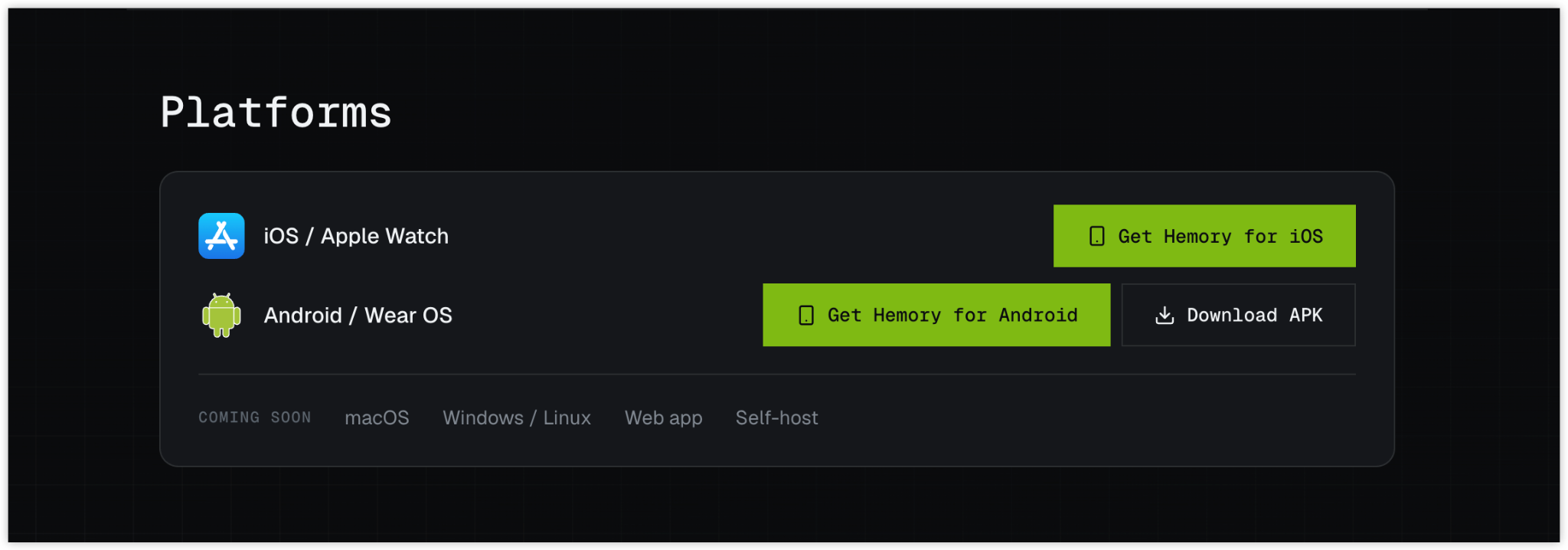
See the mobile and wearable platforms listed on the site.
That is a different decision from connecting an external recorder to Hemory. Don’t assume Hemory can import audio made by a separate handheld or desk device; confirm that exact workflow before making it part of your plan. If you use Hemory’s own supported capture route, preserving the conversation can reduce how much you need to select and write down while participating. You still need to review the resulting information and decide how to use it.
A simple way to make the choice
- Name the setting. Identify the conversation you most need to capture: a seated meeting, a moving interview, a conference, or routine work.
- Choose the likely placement. Decide whether the recorder should stay on you, stay on a shared surface, or travel with your phone.
- Check the critical constraint. Test pickup from likely speaker positions, confirm recording-time and charging details, and consider whether the device will be socially acceptable.
- Follow the record through. Confirm how you will retrieve, search, transcribe, or share what you capture. Verify any transfer or import path you depend on.
- Try the setup in context. If possible, make a short test in the actual room or routine. Listen for the details that matter to your task and adjust placement before relying on it.
Choose the option that handles your most common situation with the fewest practical obstacles—not the one that sounds most versatile in a feature list. If the right answer changes between a seated interview and a day of moving conversations, it may be more useful to choose a primary setup for each situation than to expect one form factor to do both equally well.
FAQ
Is a wearable recorder always better for conversations on the move?
No. It can stay with you as you move, but pickup still depends on placement, distance, and the recording environment. Check whether it captures the other speakers clearly enough for your purpose.
Is a desk recorder better for meetings?
Not automatically. It can work well when you can place it appropriately for a seated group. Room layout, speaker distance, and background noise still matter.
Can I use Hemory with a separate handheld recorder?
Don’t assume so. The supplied product information does not establish that Hemory imports recordings made by external recorders. Confirm the exact workflow before depending on it; Hemory is not itself a pendant or dedicated handheld recorder.
What should I test before relying on a recorder?
Test it in the setting where you plan to use it. Check whether it captures the speakers and details you need, whether the charging routine fits your sessions, and how you will access the recording afterward. Also make sure recording is appropriate and clearly communicated.
Make the choice around your real routine
Start with the conversation, where you will be, and what you need from the recording afterward. A wearable can reduce the need to carry and place a separate device; a desk or phone-clip recorder may fit better when its location is predictable or already part of your setup. Compare actual pickup, charging, privacy, and retrieval—not the form-factor label alone.