

 Hemory Team
On this page
A phone may be in your bag, buried under papers, or simply awkward to handle while you are talking. A watch, pendant, or dedicated recorder can make capture easier—but the form factor alone does not tell you whether the device will record when you need it, last through the day, or help you find the useful detail later.
The right choice depends on your work setting and the whole path from starting a recording to using it. Compare the options against the same criteria, then test the setup in the situations where you actually need it.
TL;DR
- Choose for reliable, deliberate capture—not just for a device you can wear. Check how recording starts and stops, and whether that behavior suits your work setting.
- Compare battery life under your expected recording pattern. Published figures are useful only when the model and test conditions match your use.
- Treat transcripts, speaker labels, and later retrieval as separate capabilities. Confirm which are available and how you can access them.
- Before recording, address consent, workplace policy, privacy, and what happens to the audio and transcript.
- Hemory can capture and upload listening content independently on Apple Watch, then provide transcripts and cross-session retrieval. Confirm that its supported platform and controls fit your setup.
Compare the three approaches against your workday
The categories below describe common trade-offs, not guaranteed features. Capabilities vary by device, app, operating system, and recording mode, so check the exact model and software you would use.
| Option | What may make it convenient | What to verify before choosing | Often suits |
|---|---|---|---|
| Smartwatch | It is already on your wrist, and some watch apps can capture without taking out a phone. | Whether the app can start and stop recording from the watch, whether the phone must be nearby, supported watch and phone models, battery impact, and where recordings go. | People who already wear a compatible watch and want a discreet, accessible control. |
| Pendant or other body-worn recorder | It can stay in a consistent position while your hands are occupied. | How recording is started, whether the device visibly signals recording, microphone performance in your setting, battery, transfer method, transcript options, and retrieval. | People who need a dedicated wearable form factor and can use it openly and appropriately. |
| Dedicated voice recorder | It is designed around recording and may offer physical controls or a screen. | Whether it is comfortable to carry, how quickly it can be started, recording duration under your settings, file transfer, transcription, and search. | People who prioritize explicit controls or a standalone device over wearing a watch or pendant. |
A wearable is not automatically less noticeable or more appropriate. In some workplaces, a phone placed visibly on the table may be clearer to other participants than a small device on your wrist or clothing. Consider how recording will be understood, not only how easy it is for you to start.
1. Check capture control in the situations that matter
Ask exactly how recording starts, pauses, and stops. Is there a physical button, a watch control, an app action, or a reminder that still requires you to start listening? Can you tell when capture is active? Does the device pause or stop in situations where you need it to continue?
Test the routine you expect to use: entering a meeting, moving between rooms, taking a call, or switching to a conversation that should not be recorded. A feature described as scheduled listening may still involve a reminder and a user action. Do not assume that a wearable records continuously or silently just because it can be worn all day.
For Hemory, the documented Apple Watch workflow can independently capture and upload listening content. Its Manual Mode lets users start and stop listening; Schedule Mode provides reminders and one-tap start and stop actions. That is a controlled capture workflow, not a claim of unattended recording. Check that the app and watch behave as you need on your specific setup.

Hemory listening interface shown on Apple Watch.
2. Compare battery life using realistic conditions
A battery figure is meaningful only alongside the device, recording pattern, and test conditions. Check whether a quoted duration assumes continuous listening, intermittent sessions, a particular model, or specific settings. Then compare that figure with the longest workday you need to cover and decide whether charging between sessions is practical.
Hemory’s Features page lists 10 hours of listening and at most 30% extra battery use for Apple Watch Ultra 3 and Series 11. The listed test conditions are not specified, so do not treat those figures as a guarantee or apply them to other watch models. If battery is a deciding factor, check current device-specific information and test your own expected routine.
3. Separate transcripts, speaker labels, and retrieval
Recording a conversation creates a file; it does not automatically make the important detail easy to use. Check whether the option you are considering provides a transcript, timestamps, speaker labels, and a way to review the relevant passage. Ask how you can find a detail days or weeks later: by date, topic, speaker, or a question across multiple conversations?
These are different capabilities. A transcript can help you locate wording, but it may contain errors or omissions. Speaker labels can help distinguish voices, but they should not be treated as certain identification. Search or Q&A can make past material easier to retrieve, but a result still needs review when wording, attribution, or a condition could change what you do next.
Hemory’s published Features page describes timestamped transcripts, Speaker labels, and playback from transcript lines on the listening device. Its built-in Q&A Agent supports multi-turn questions about the user’s Memory and can retrieve across conversation sessions. This can reduce the work of replaying or manually assembling every relevant discussion when you need context later. It cannot retrieve a conversation that was never captured, and you should review consequential details before relying on them.

Find individual statements in a searchable transcript.
4. Confirm platform fit before buying or changing your routine
Check the full setup, not just the wearable’s name: watch model, phone operating system, app availability, connection requirements, and where recordings are stored or accessed. If you need to start recording from the wrist while away from your phone, confirm that exact behavior rather than assuming a watch companion app can do it.
Hemory documents independent capture and upload on Apple Watch. Before choosing it, confirm current support for your particular phone-and-watch combination and that the controls fit your routine. Do not generalize one watch model’s behavior or battery figures to all smartwatches.
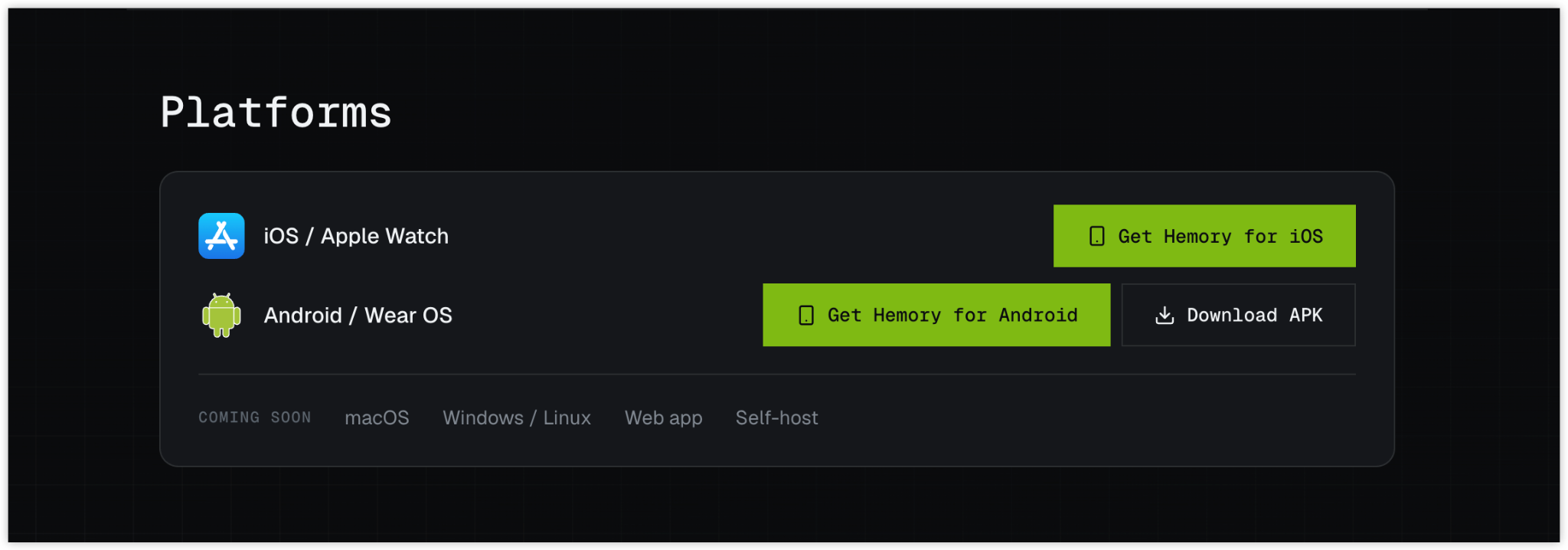
See the mobile and wearable platforms listed on the site.
5. Treat privacy and consent as selection criteria
Before recording work conversations, check applicable law, workplace policy, and the expectations of the people involved. Make consent and any required notice part of the capture plan; a small or wearable recorder does not remove those responsibilities.
Also find out what happens after capture. Check where audio and transcripts are processed or stored, who can access them, how long they are retained, and how deletion works. If speaker recognition is available, check whether it is optional and what consent and data-handling conditions apply. Do not infer privacy behavior from the device form factor or from a general statement about audio storage; audio, transcripts, and other records may have different handling rules.
6. Make the choice with a short, realistic trial
Use the same work scenario to compare your candidates. A short trial should answer the questions that matter to your job—not produce a universal accuracy score.
- Choose a representative situation. Use a typical discussion where phone access is awkward, while following your organization’s rules and getting any required consent.
- Test the whole capture routine. Start, pause, and stop using the controls you would actually rely on. Note any steps that interrupt your participation.
- Check the result. Look for the transcript or recording, speaker distinctions if needed, and whether you can locate a relevant passage later. Review important details against the available source.
- Check the workday fit. Compare battery use, charging, comfort, platform behavior, and the effort required to move useful information into your normal work process.
- Decide from the trade-offs. Choose the option that reliably fits your setting and gives you an acceptable way to review and use the record. If none does, keep a visible, controlled alternative such as phone recording or notes where appropriate.
Do not judge only by whether a recording exists. The useful outcome is a record you were permitted to make, can access later, and can review well enough for the task at hand.
Which approach should you choose?
Choose a smartwatch if you already wear a compatible model, can start and stop capture appropriately, and can find the resulting record through its app or connected service. Consider a pendant or dedicated recorder if its controls, placement, or recording workflow fit your setting better—but verify its transcript, transfer, and retrieval options rather than assuming they are included.
Hemory is a software option for Apple Watch capture, not a separate wearable-recorder category. It may fit if you want captured conversations to become searchable context for later work. Its transcripts and cross-session Q&A can reduce manual searching and retelling, while you remain responsible for choosing what to record, following consent requirements, and reviewing information before using it.
FAQ
Can a smartwatch replace a dedicated voice recorder?
Sometimes, if its app supports the capture routine you need and its battery, platform, and retrieval fit your work. Test those details on the exact watch and phone combination; a wearable form factor alone does not establish equivalent recording or transcription capabilities.
Does a wearable recorder automatically identify who spoke?
No. Speaker labeling depends on the device or service, and labels may be uncertain. Check how identities are assigned and how to review them. Treat an uncertain label as a clue, not confirmation.
Is it appropriate to record a conversation just because the device is wearable?
No. Follow applicable law and workplace policy, and address consent and notice with the people involved. A discreet form factor does not remove those responsibilities.
What should I do if the recording or transcript is incomplete?
Use another available record or ask a focused follow-up question for the missing detail. A failed search or partial transcript does not establish that no decision was made. Review the evidence that matters to the action you plan to take.