

 Hemory Team
On this page
Phones can be awkward to handle during a walk-through, a customer conversation, or a discussion where you need your hands free. A wrist- or body-worn recorder may fit better, but its form factor alone does not tell you whether it will capture the conversation, produce a usable transcript, or help you find the right exchange later.
Choose by testing the whole path: starting and stopping capture, getting through the parts of your workday that matter, reviewing transcripts and speaker labels, and retrieving a useful detail afterward. Then check whether recording is appropriate for the people and setting involved.
TL;DR
- Start with the situations where handling a phone is a real obstacle. Test capture controls and comfort in those settings.
- Compare battery performance against your actual listening needs, not a headline figure. Check transcript readability, speaker labels, and how you can retrieve a past discussion.
- Treat each device and platform combination separately. A watch, pendant, or recorder does not guarantee the same controls or capabilities.
- Hemory documents Apple Watch listening, timestamped transcripts with speaker labels, and built-in Q&A that can retrieve information across sessions. Confirm the exact model and workflow you plan to use.
- Recording unobtrusively does not remove the need to consider consent, workplace policy, and applicable rules.
Compare the complete recording workflow, not just the device
A useful wearable needs to work before, during, and after a conversation. Use the same questions for each option you consider:
| What to evaluate | What to check | Why it matters |
|---|---|---|
| Capture control | How do you start, pause, and stop? Can you tell when listening is active? Does the device require a phone nearby for the task you have in mind? | A convenient device is not useful if its controls are unclear or it cannot capture in the setting where you need it. |
| Comfort and placement | Can you wear it through the relevant activity? Does clothing or movement affect where it sits? Is the device acceptable in that setting? | Placement and social comfort affect whether the recorder fits your workday. |
| Battery | How long does it listen under the settings and conditions you will use? What happens during calls or other interruptions? | A maximum figure may not reflect a full day of your actual use. |
| Transcript | Is the text readable for your languages, work terms, and conversation style? Can you review a timestamp or return to a relevant part of the recording where supported? | A transcript is useful only if it helps you recover the details you need. No transcript should be assumed perfect. |
| Speaker labels | Does the device distinguish speakers in your typical group size and setting? How are uncertain or unnamed speakers shown? | A label can help orient you, but it should not be treated as proof of identity or agreement. |
| Retrieval | Can you find a discussion or detail later by topic, person, or other available clue? Can you ask a follow-up question across sessions if that matters to your work? | A capture that is hard to retrieve may leave you searching or reconstructing the exchange manually. |
| Compatibility and privacy | Is your specific device and operating-system combination supported? What data is captured, where is it handled, and what consent or workplace steps apply? | Compatibility and recording practices depend on the particular product and situation. |
First mark any must-haves: for example, independent capture without handling a phone, a specific device you already own, or a reliable way to review speaker-labeled text. Eliminate options that fail those requirements before weighing secondary conveniences.
Treat form factor as a starting point
A smartwatch, pendant, and dedicated recorder are different wearing options, not capability guarantees. Compare each candidate on the same dimensions rather than assuming a whole category has a particular battery life, microphone performance, or transcript feature.
- Smartwatch: Check the supported watch model, whether capture can run from the watch itself, how listening is controlled, and whether calls or other interruptions affect it. If you need to leave your phone behind, verify that the specific product supports that exact use.
- Pendant or other body-worn device: Check how it sits with the clothing and movement involved in your work, how visible it is to others, and whether its companion app or service provides the transcript and retrieval features you need.
- Dedicated recorder: Check its physical controls, recording status indicators, transfer or review process, and how transcripts and speaker labels are produced, if offered. Do not assume a separate device automatically means simpler retrieval.
If two options both seem suitable, try them in a representative work situation when you can. Compare the same kind of outcome—for example, whether you can locate who raised a particular concern and what they said—rather than judging only by how easy it was to wear.
Test capture controls and battery against your day
Write down when you would actually want to capture a conversation: a hands-on task, a walk between meetings, or a discussion where taking notes would interrupt your participation. Then check whether the recorder gives you clear control in those moments.
Look for a visible or otherwise understandable listening state. Confirm what starts capture, what stops it, and what happens if a call or another interruption occurs. Scheduled reminders and one-tap controls may suit a routine; manual start and stop may suit work that varies. Do not assume that a schedule means a device begins listening without your action.
For battery, compare the product’s stated conditions with your intended listening pattern. Ask whether the figure refers to continuous listening, a particular watch model, or a particular configuration. If you rely on a device through a full workday, a short representative trial is more informative than assuming a published maximum will match your use.
Hemory’s Features page describes Apple Watch as able to capture and upload listening content independently. It lists 10 hours of listening for Ultra 3 and Series 11, with up to 30% additional battery use. Those figures are model-specific; they do not establish the same runtime for other watches or guarantee a full day under your conditions. The page also describes listening pausing during incoming calls and resuming afterward.
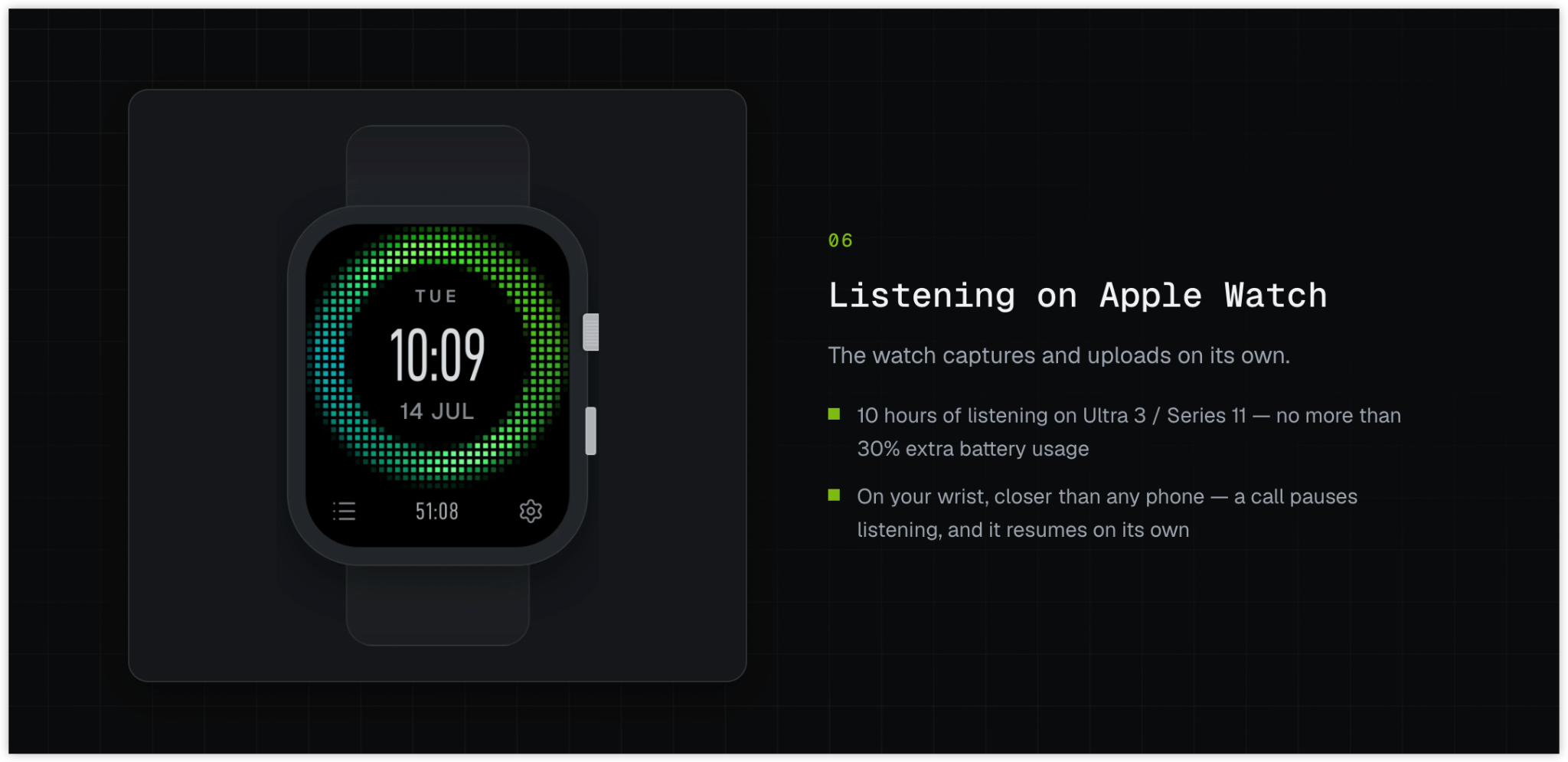
Hemory listening interface shown on Apple Watch.
Judge transcripts and speaker labels by the work they support
A transcript should make a conversation easier to review, not create a false sense of certainty. Check whether it preserves the details your work depends on: a product name, a number, a condition, or the difference between a suggestion and an accepted decision. If a transcript line can be played back on the device, use that option when a consequential phrase is unclear and playback is available.
Speaker labels can help you follow an exchange, especially when several people speak. Check how the tool handles unnamed or uncertain speakers, and be prepared to review labels where attribution changes what you will do. A name attached to a line is not, by itself, proof that the person accepted an action or made a commitment.
Hemory describes each listening session as producing a timestamped transcript with speaker labels and AI cleanup. Its Features page also describes cross-session voice recognition, with possible matches shown as confidence hints and speakers remaining anonymous until named. Treat these as aids to review, not guarantees of perfect transcription or identity.

Find individual statements in a searchable transcript.
Check whether you can find and reuse a conversation later
The recording is only one part of the workflow. Before choosing, consider the task that follows: finding an explanation from a past discussion, preparing a follow-up, or locating a detail that did not make it into your short notes.
Check how the product organizes captured sessions and what retrieval methods it actually provides. If you need to ask questions across several conversations, confirm that the relevant Q&A feature can access those sessions through the entry point you will use. A transcript archive, built-in assistant, and connected external agent may not have identical access or capabilities.
Hemory’s built-in Q&A Agent is described as supporting multi-turn questions about the user’s Memory, grounded in transcripts and able to retrieve across different conversation sessions. That can reduce manually searching and assembling context for a later question. It applies to conversations captured and accessible in Hemory; it cannot recover a discussion that was never recorded. For an essential missing detail, consult another available source or ask someone a focused question.

Retrieve past commitments and draft follow-up tasks.
Make consent and privacy part of the selection
A recorder that is easy to wear can also be easy for others to overlook. Do not use discreetness as a substitute for consent. Consider who is present, whether recording is appropriate, what your workplace requires, and which laws or policies apply to the situation. When needed, explain that you are recording and why, and follow the relevant rules before starting.
Also check what the product records, how audio and transcripts are handled, who can access them, and how you can stop listening or remove material. Do not infer a product’s privacy practices from its shape, a setting name, or another device’s policy. If speaker identification is involved, look specifically for how it works and what choices or consent it requires.

Privacy cards present claims about audio storage and retention.
Choose the option that passes your must-haves
Use your evaluation to make a conditional choice:
- Choose a watch-based setup when a supported watch fits your workday and its capture controls, battery, and phone-independence meet your actual needs.
- Choose a pendant or other body-worn option when its placement is more comfortable for the work you do and it provides the transcript and later retrieval you need.
- Choose a dedicated recorder when its controls and transfer or review process suit your work better than a wearable you already own.
- Keep using your phone or existing note system if it already captures the necessary discussions appropriately and is practical to handle. A wearable is not automatically an improvement.
For any candidate, the decision is incomplete until you have checked the exact model, platform, capture behavior, transcript and speaker-label workflow, retrieval route, and recording practices. If a feature is central to your choice but the product information does not settle it, ask the vendor or test that specific step rather than treating an assumption as a capability.
Hemory is one option to consider if Apple Watch capture and later access to captured conversations fit your workflow. Its documented transcripts and cross-session Q&A may support review and recall; they do not make every watch or wearable equivalent. Choose based on the device and process that work for your conversations, and preserve time to participate rather than trying to write down every potentially useful detail.
FAQ
Can a wearable recorder transcribe and label speakers automatically?
Some products describe transcript and speaker-label features, but availability and behavior vary by product, device, language, and setting. Check the exact workflow and review a representative transcript; do not assume every label or phrase is correct.
Is a smartwatch better than a pendant or dedicated recorder?
Not in every situation. Compare the specific device’s controls, comfort, battery, transcript quality, speaker labels, retrieval, compatibility, and privacy practices against your must-haves. The form factor alone does not establish which one will work better.
Can I use Hemory on an Apple Watch without carrying my phone?
Hemory’s Features page says Apple Watch can independently capture and upload listening content. The setup and model details still matter, so confirm the current requirements for the watch you plan to use before relying on it away from your phone.
Are speaker labels reliable enough to treat as confirmed identity?
Treat labels as useful orientation, not automatic proof. Review uncertain attribution when it affects an action, and distinguish a person being named in a transcript from that person accepting responsibility or making a commitment.
The practical test is whether the recorder lets you take part in the conversation, then recover the details you need without rebuilding the discussion from memory. Compare candidates on that complete path, and choose the one that meets your real work and consent requirements.