

 Hemory Team
On this page
A quick idea can be easy to say and surprisingly hard to capture without interrupting your train of thought. A phone recorder, voice dictation in an AI chat, and a dedicated conversation-capture tool all approach the task differently. Compare them by what they preserve, how you’ll find the result later, and how much control you need—not by assuming one is best for everyone.
TL;DR
- Use a phone recorder for a straightforward one-off recording, AI voice mode when you want to speak directly into a chat, and a dedicated capture tool when you also need to revisit and retrieve conversations over time.
- Check whether each tool keeps audio, a transcript, or only a generated response. Those are different records, with different uses.
- Before adopting any option, try its start-and-stop controls, retrieval, consent practices, and fit with the device you actually use.
Compare the three approaches
| Approach | Often suits | What to check before relying on it |
|---|---|---|
| Phone voice recorder | A private brain dump or a single recording you can handle later | Whether it saves audio, creates a transcript, supports useful organization, and makes recordings easy to locate |
| Dictation in an AI chat voice mode | Speaking a request or idea when you want an immediate chat response | Whether the original speech or transcript remains available after the response, and how the chat stores and retrieves it |
| Dedicated conversation-capture tool | Spoken ideas or discussions you expect to revisit as part of ongoing work | How capture starts and stops, what record is kept, how sessions are organized, and whether later search or Q&A fits your needs |
These are broad patterns, not guarantees about every app. Features and retention vary by product and settings. Check the exact workflow you plan to use.
Use these criteria to choose
1. How much effort does it take to start?
For spontaneous thoughts, friction matters. If opening an app, choosing a mode, or preparing a prompt makes you lose the idea, the tool may not fit your everyday use. Try the actual start-and-stop sequence on the device you carry. Include what happens when you’re interrupted and how you know capture has ended.
A recorder may offer a direct way to make a standalone recording. Voice mode may be convenient when you already have an AI chat open. A dedicated capture tool may suit repeated use if its controls fit your routine. Confirm these details in the specific product rather than assuming from the category name.
2. What does the tool preserve?
Separate the possible outputs:
- Audio: a recording you may be able to replay, if the tool retains it and makes playback available.
- Transcript: text representing spoken words. It can be easier to scan, but it may contain errors or omissions.
- Summary or chat response: generated text that may organize or respond to what was said, but is not the same as the original audio or a complete transcript.
Ask what remains after you finish: the audio, a transcript, a summary, a chat exchange, or some combination. Also check how long the material is retained and whether it can be exported or deleted in the way you need. Don’t treat a generated response as a complete record unless the product clearly provides that record.
3. Can you find and reuse the result later?
A capture method is more useful for ongoing work if you can locate the right idea or discussion when you need it. Consider how you expect to search: by a phrase, topic, date, speaker, or a question about what was discussed. Then check whether the tool supports that route and whether you can review the underlying material.
For a one-time personal note, a clear filename or a place you already check may be enough. If you want to connect an idea to later work, look for an organization and retrieval process that supports that use. Don’t assume that a transcript automatically means cross-session search, or that an AI response will be easy to find again.
4. Do the controls fit your situation and consent needs?
Know when listening starts and stops, how that is indicated, and how to stop it promptly. For conversations with other people, explain the capture and follow applicable rules and workplace expectations. A private brain dump and a recorded group discussion are not the same consent situation.
Compare the controls the product actually offers. If a tool supports scheduled listening or one-tap controls, confirm how those actions work on your device. Do not assume that scheduling means the microphone starts without user action. Choose a setup you can operate deliberately and explain to others.
5. Does it work on the device you use?
Check the specific phone, watch, operating-system version, and usage setting—not just a general platform label. A tool that fits your everyday device may be easier to use consistently; a feature that is unavailable on that device should not factor into your choice.
Hemory’s supplied current product information lists iOS, Apple Watch, Android, and Wear OS as supported platforms; macOS, Windows/Linux, Web, and self-hosting are listed as coming soon. Confirm current availability and your exact device fit before making a decision.
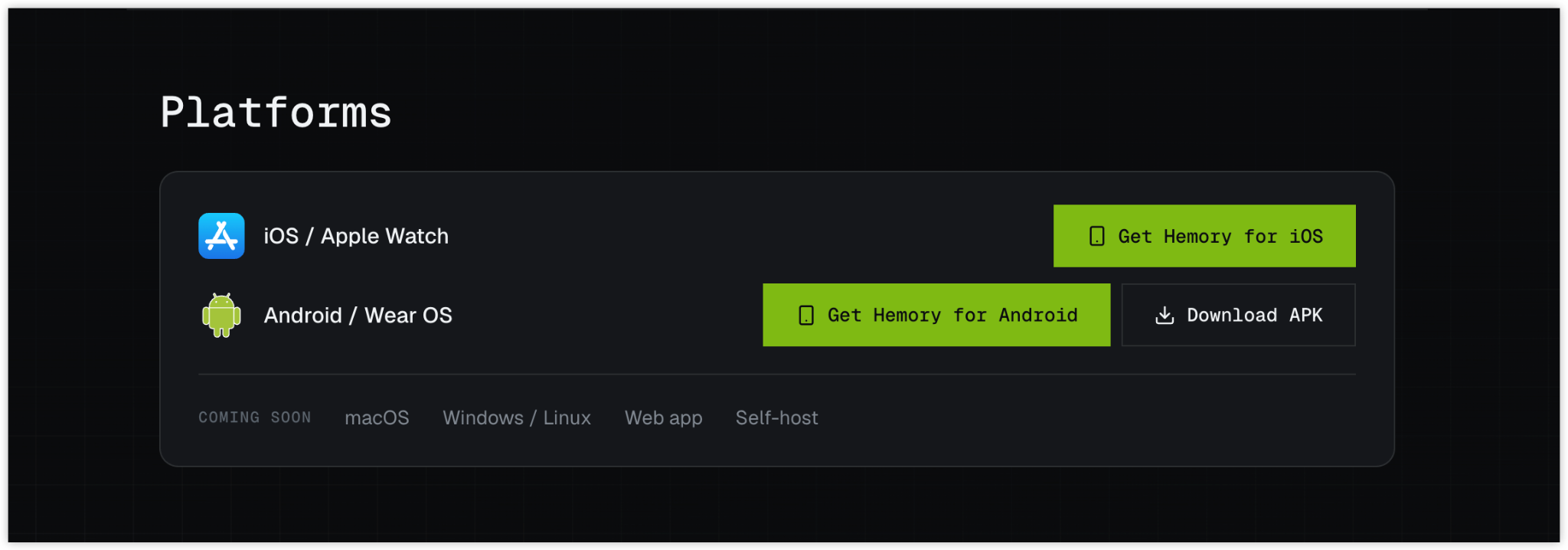
See the mobile and wearable platforms listed on the site.
Match the method to the job
- Choose a phone recorder when you mainly need to capture a standalone idea and have a workable way to name, store, and review the recording afterward.
- Choose AI voice dictation when your goal is to speak an instruction or question into a chat and use its response. First establish whether you can return to the original words or transcript later.
- Consider a dedicated conversation-capture tool when you want to preserve spoken material for later review and retrieval, rather than only get an immediate response. Evaluate its capture controls, retained records, and search or Q&A for your actual use.
For example, if you’re thinking aloud about a product idea, a dictation chat may be enough when you want a response now. If you expect to return to that idea alongside discussions from other days, prioritize a tool that organizes captured sessions and supports later retrieval. If the idea is fleeting and you need only a one-off recording, a recorder may be the simpler fit.
Where Hemory may fit
Hemory is a dedicated conversation-capture option for people who want to revisit captured spoken material. Its product information describes timestamped transcripts with speaker labels and AI cleanup, activity-based summaries, and built-in Q&A grounded in transcripts across sessions. That can reduce the need to select and re-enter every potentially useful detail when you later search your captured Memory. It cannot retrieve an exchange that was never captured, and transcript or summary content should still be reviewed when the exact wording matters.

Review transcripts with speaker labels and timestamps.
This is a fit to evaluate, not a universal recommendation. If you only need to dictate a thought into a chat or make a single recording, another approach may better match the task. If you need recurring capture and later retrieval, check whether Hemory’s controls, platform support, and available records meet your requirements.
Try the workflow before choosing
Run a small, low-stakes comparison using the kind of idea you expect to capture:
- Start and stop each candidate using its normal controls.
- Check what remains afterward: audio, transcript, summary, chat response, or a combination.
- Return to the material later and try to find it using the clues you would realistically remember.
- Review how the tool signals capture and what you need to communicate to other people.
- Confirm that the workflow works on your device and in the setting where you plan to use it.
Decide which criteria are essential before comparing options. If keeping a transcript is essential, an immediate chat response without a retrievable transcript may not fit. If a low-friction start matters most, prefer a workflow you can begin reliably without assembling or formatting the idea first. The result should be a method you can actually use, with records you can revisit when needed.
FAQ
Is dictation the same as recording a voice note?
No. Dictation turns speech into text or sends it into another workflow; a voice recording preserves audio if the tool retains it. Some products offer both, so check what is saved after you finish.
Should I capture audio or keep a transcript?
It depends on what you need later. Audio may help when you need to replay the spoken exchange; a transcript can be easier to scan and search. Neither guarantees a complete or error-free record.
Can an AI voice chat serve as a long-term idea archive?
It can if its history and retrieval features support that use. Check whether you can find the original spoken material later, not just the response, and whether the way the chat organizes past sessions works for you.
What should I check before recording a conversation with other people?
Check the tool’s start-and-stop controls, make capture clear to participants, and follow applicable rules and workplace expectations. Requirements vary by situation, so do not treat a tool’s recording controls as a substitute for consent.
Choose the simplest approach that preserves the material you need and lets you retrieve it in the context where you’ll use it. If you need more than a one-off note, try the full capture-to-retrieval workflow before relying on it for work.