

 Hemory Team
On this page
A wearable recorder can look convenient on paper and still be awkward in your daily routine. Before buying, test the situations you actually need it for: whether it captures usable speech, feels comfortable to wear, lasts long enough, and leaves you with notes you can use later.
TL;DR
- Choose a few representative situations before the trial, and compare the recorder with your current method.
- Judge capture quality, comfort, battery use, and the usefulness of the resulting notes—not just whether the device turns on.
- Check the exact model, platform support, recording controls, and any limits that affect your intended use.
- If you are considering Hemory, include the later retrieval step in your trial: captured conversations should help with a real follow-up task, not just produce a transcript.
1. Define what the recorder needs to do
Start with the job, not the device’s feature list. Are you trying to remember details from in-person conversations, capture ideas while moving, or create a record you can refer to when writing follow-ups? The answer determines what a useful trial should test.
Write down the conditions that matter to you. For example:
- Where you expect to record: a quiet room, a shared office, or a busy public space.
- How you will wear or carry the device, and whether it needs to stay unobtrusive.
- How long a typical recording period lasts.
- What you need afterward: a readable transcript, a summary, searchable details, or material for a specific task.
- Any practical requirements, such as a particular phone, operating system, or recording control.
Separate essential requirements from preferences. A recorder that captures speech clearly but is uncomfortable for your usual setting may not suit your routine. Likewise, a readable transcript may not be enough if you need to find a detail weeks later.
2. Check compatibility and recording conditions first
Before planning a trial, confirm that the specific device and app work together in the way you need. Check the current official support information for the exact model and platform; a general mention of a wearable category does not establish that every device in that category is supported.
Also understand how recording starts and stops. Confirm what action is required, whether reminders or schedules are involved, and how you can tell that listening is active. Follow applicable consent and workplace rules before recording other people. If a feature or compatibility detail is unclear, treat it as an open question to verify rather than assuming it works.
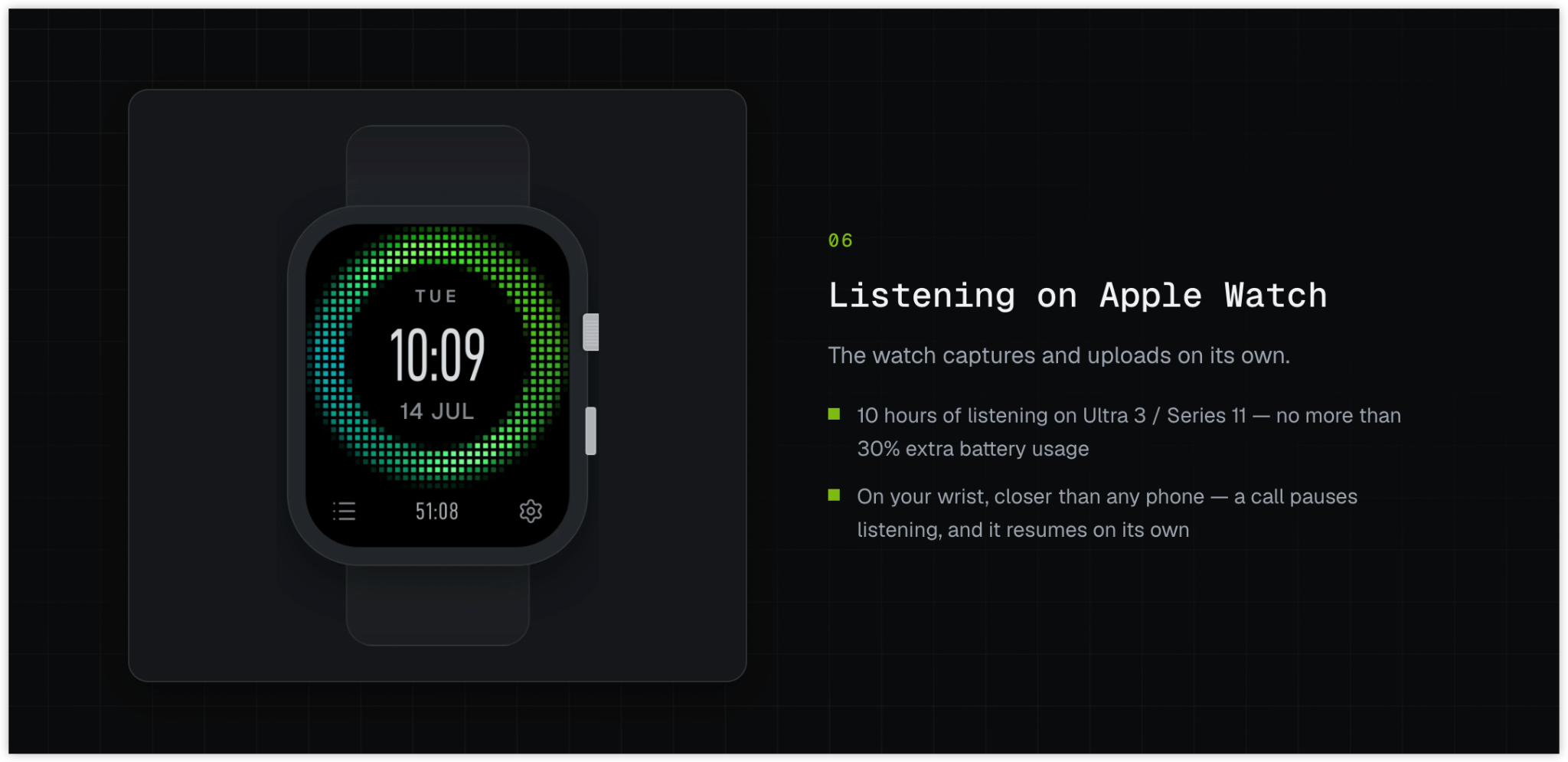
Hemory listening interface shown on Apple Watch.
If Hemory is one of the options, its current Features page lists iOS, Apple Watch, Android, and Wear OS support, and says Apple Watch can capture and upload independently. Check the page and your exact setup before relying on a particular wearable model; the listing does not establish compatibility with every device. Hemory Features
3. Run a short trial in representative situations
Try the device in situations that reflect your actual use, rather than recording only a quiet test sentence. Select the conditions that would affect your choice—for example, a normal conversation, a noisy environment, or a longer session if battery life matters. You do not need to test every possible setting.
For each trial, note:
| What to assess | What to observe |
|---|---|
| Capture reliability | Did recording start when expected? Were important parts of the conversation usable, or were there gaps, clipping, or distracting noise? |
| Wearability | Was the device comfortable and practical in the setting? Could you operate it without disrupting the conversation or your activity? |
| Battery use | Record the charge before and after a comparable period of use. Compare it with your normal routine and device baseline; do not assume a published figure will match your conditions. |
| Output quality | Are the transcript or notes understandable enough for the task? Check names, key details, and speaker labels when they affect what you will do next. |
| Later usefulness | Can you find or reuse a relevant detail when you need it, or does the output still require substantial manual sorting and re-entry? |
Keep the test fair: use comparable situations when comparing a wearable with a phone or your current recording method. If the conditions differ, record the difference instead of treating the results as a direct comparison.
4. Test the handoff into real work
A recording is useful only if its output supports something you need to do. After a trial conversation, try one realistic follow-up task: locate a detail, prepare a short recap, or identify a next step. Notice whether the source material is accessible and clear enough for that task.
If you are evaluating Hemory, test the full path from capture to reuse. Hemory describes timestamped transcripts, activity-based summaries, and a built-in Q&A Agent that can answer questions about a user’s Memory, including across conversation sessions. Use a conversation that was captured and is accessible to the feature you are trying. Then see whether the retrieved context helps with a concrete task. Transcripts and speaker labels can still need review; do not assume every detail is captured perfectly. Hemory Features
This step helps distinguish a recorder that merely produces a file from a workflow that lets you return to useful context. It also shows how much selection, searching, and copying you would otherwise need to do manually.
5. Decide against your requirements
Review the trial notes against the essential requirements you set at the beginning. A simple decision table can keep the conclusion grounded:
| Requirement | Result from the trial | Decision |
|---|---|---|
| Captures usable speech in my usual setting | Note what worked and what did not | Pass, uncertain, or fail |
| Comfortable and practical to wear | Record any friction during normal use | Pass, uncertain, or fail |
| Battery supports my routine | Compare observed use with the period you need | Pass, uncertain, or fail |
| Output supports a real follow-up task | Note what you could reuse and what still took manual work | Pass, uncertain, or fail |
| Works with my exact device and platform | Confirm against current official information | Confirmed or unresolved |
Choose the recorder only if it meets the requirements that matter most to you. If an essential point remains uncertain—such as exact model support or whether the output can enter your existing workflow—resolve that before buying. A failed test in one setting does not prove the device is unusable everywhere; it does tell you whether that limitation matters in your routine.
FAQ
How long should I test a wearable recorder?
Test long enough to cover the situations and recording periods that matter to your decision. There is no universal trial length: a short conversation may reveal comfort or setup issues, while battery use requires a period closer to your normal routine.
Should I compare it with my phone?
Yes, if your phone is a realistic alternative. Compare similar situations and evaluate the same outcomes, such as usable capture, convenience, battery impact, and how easily you can use the notes afterward.
How do I know whether the transcript is good enough?
Judge it against the task. Review important names, details, and speaker attribution when they affect a follow-up or decision. A transcript can be useful without being perfect, but consequential gaps may mean you need another source or a focused clarification.
Does Hemory support every wearable recorder?
Do not assume so. Check Hemory’s current official platform information and confirm support for your exact device and setup before relying on it. A listed platform does not guarantee that every model works.
Next step
Before you buy, write down your essential requirements and run a small trial under representative conditions. If later retrieval matters, include a real follow-up task in the test. That will show whether the device fits both your recording routine and the work you want to do with the captured information.