

 Hemory Team
On this page
A recorder can appear to work while still missing the details you need: a name may be attributed to the wrong person, a call may interrupt capture, or the transcript may be hard to search afterward. Test the setup before using it for a consequential meeting. A short, low-stakes session can reveal what works, what needs review, and where you need a backup.
TL;DR
- Start with a short session and confirm how recording starts, stops, and pauses. Tell participants what you plan to capture and follow applicable workplace and local requirements.
- Judge transcript quality and speaker labels separately. Check a few details that matter, rather than assuming polished text is complete or exact.
- Test playback and a later question about the captured conversation. Retrieval is part of the workflow, not an optional extra.
- Record battery use and interruptions on the device and setup you intend to use. A trial result applies to that setup, not every recorder or situation.
Run a short, low-stakes trial first
Choose a brief conversation with participants who know you are testing capture. Use the same device, placement, recording mode, and language you expect to use at work. Avoid confidential or high-stakes topics until you understand the controls and have checked your organization’s requirements.
Before the conversation, note a few details you can verify afterward, such as a product name, a number, or a clear next step. You do not need to write a full transcript. The aim is to have a small reference for checking whether the recording and transcript preserve details that matter to your work.
For each criterion below, mark Pass, Needs follow-up, or Not tested. Add a short note about the condition—for example, “screen locked” or “call interrupted capture.” That makes the result useful when you change devices, placement, or settings.
Check the controls and consent process
Before recording, make sure participants understand what you plan to capture and how you will use it. Follow applicable law and workplace or customer policies; a device’s start button does not settle consent requirements. If you are unsure whether a real conversation is appropriate for a trial, use a non-sensitive test instead.
During the session, confirm that you can tell when capture is active, start and stop it as intended, and recognize what happens if you pause or end listening. Also consider whether the control method fits the setting: can you operate it without disrupting the conversation, and can you avoid capturing when you do not intend to?
If you are evaluating Hemory on Apple Watch, its product page describes Manual Mode for starting and stopping listening directly and Schedule Mode for reminders with one-tap start and stop actions. Try the mode you expect to use and confirm that its steps are clear to you. Do not assume the behavior of one device or mode applies to every recorder.
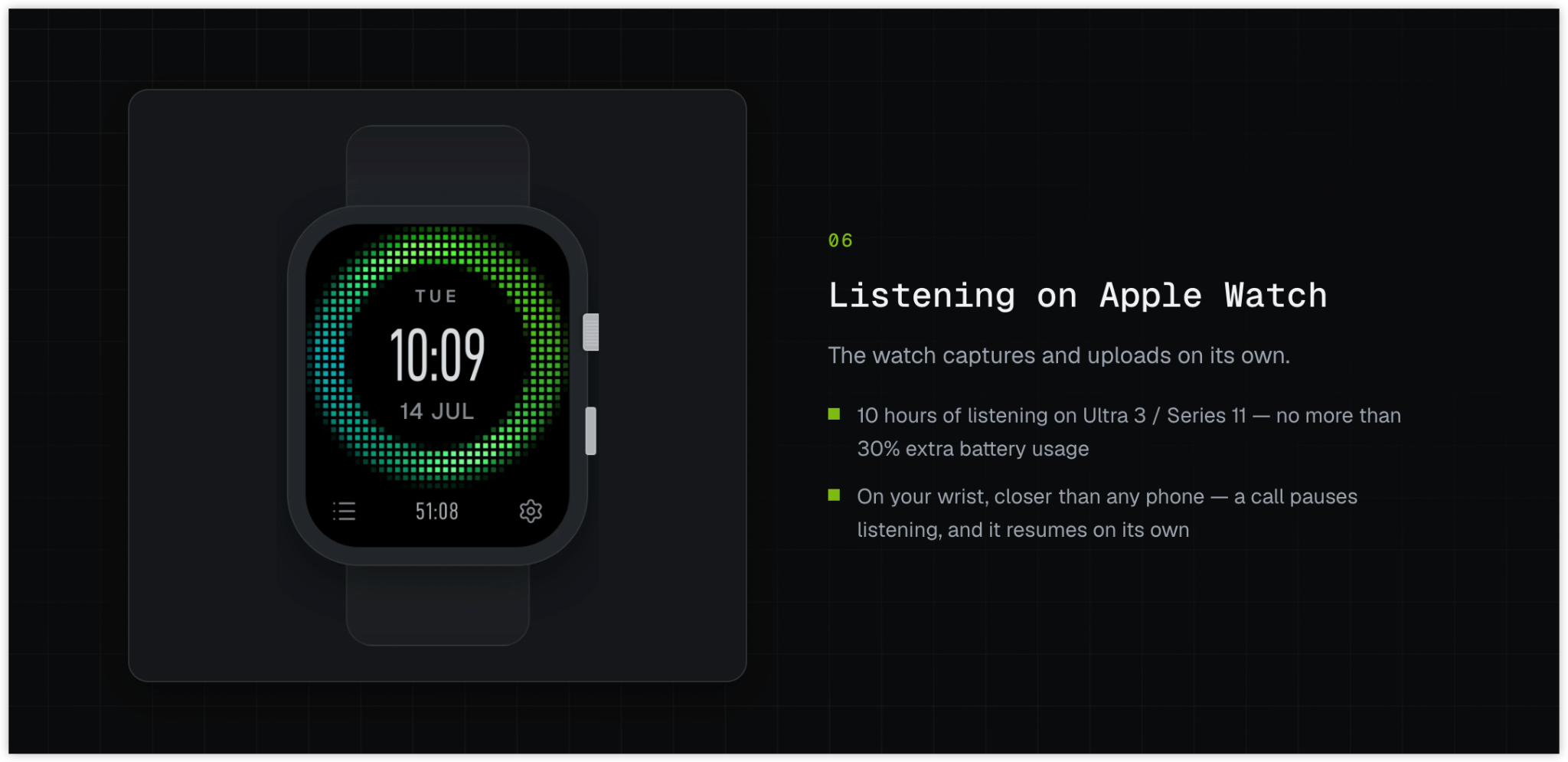
Hemory listening interface shown on Apple Watch.
Review transcript quality separately from speaker labels
Once the transcript is available, compare it with the details you noted or can otherwise verify. Check a small sample that includes the kinds of information your work depends on: names, product terms, numbers, negations, and decisions. A transcript can be readable but still get a critical detail wrong, so judge those separately.
Pay attention to timestamps and whether the relevant passage is easy to locate. If your work depends on exact wording, treat the transcript as a finding aid and confirm important quotations against available source material. Do not assume a cleaned-up transcript preserves every spoken word.

Find individual statements in a searchable transcript.
Then assess Speaker labels on their own. Check whether people are distinguished consistently and whether uncertain or anonymous labels are clear enough for your use. A label is a useful clue, not proof of who said something or whether they accepted a task. If attribution affects a decision, verify it before acting.
Hemory’s Features page describes timestamped transcripts with Speaker labels and AI cleanup, support for 100 transcription languages, and line-by-line playback on the listening device. It does not promise perfect transcription or absolute speaker accuracy. During a trial, check the language and terminology you actually use, and review any details that could change a work decision. Hemory Features
Test playback and later retrieval
A transcript is more useful when you can return to the passage behind a detail. Try opening a few transcript lines and playing them back. For Hemory, the product page specifies line playback on the listening device, so test it there rather than assuming the same behavior on another device.
Then test a later lookup. Once the trial conversation is available in Hemory Memory, use its built-in Q&A to ask a specific question about something discussed—for example, “What concern did we raise about the proposed launch date?” Follow up if the first answer is incomplete. The Q&A is described as working with a person’s Memory across conversations, but a test can only retrieve information from conversations that were captured and are accessible. If a detail is missing, check another available source or ask a focused follow-up; a failed search does not prove the conversation was never recorded.
Assess whether the answer helps you find and understand the relevant detail, not just whether it sounds plausible. For an important action, review the supporting passage and distinguish what was proposed, agreed, or left open.
Observe battery use and interruptions
Record the battery level before and after the trial, along with the session length and any other conditions that could affect the result. Compare the change with the demands of your actual workday; one short test cannot establish how every device will perform over a full day.
If calls or other interruptions are part of your work, observe what happens when one occurs. Hemory’s product page describes Apple Watch listening as pausing during calls and resuming afterward. If that behavior matters to your setup, confirm that the pause and resumption fit your needs. Do not generalize that behavior or any model-specific battery figure to other devices.
Decide what the trial tells you
Use the notes to make a conditional decision rather than assigning a single overall score. A setup may be suitable for finding discussion points but not for producing exact quotations without review. It may handle ordinary conversations well while needing a different placement, language check, or backup plan for noisy rooms or customer calls.
| Trial result | What to do next |
|---|---|
| Controls are clear, key details are findable, and retrieval works for your task | Try the setup in another representative, low-risk situation before relying on it for consequential work. |
| A critical name, number, or decision is wrong or hard to attribute | Change the setup or keep a separate confirmation step for that information. |
| Playback or later retrieval is difficult | Check whether a different supported device, placement, or workflow makes the needed passage accessible. |
| Battery or call behavior disrupts the session | Test a more representative period or choose a setup that better fits those conditions. |
| You cannot establish a suitable consent process | Do not use the setup for that conversation until the requirements are clear. |
The goal is not to prove that a recorder never misses anything. It is to learn which work it can support, what needs human review, and what conditions require another source or a different process.
FAQ
Does a clear transcript mean the recording is accurate enough for work?
Not necessarily. Check the details that matter to the task, especially names, numbers, negations, and decisions. A readable transcript can still contain errors or omissions.
Should I trust a speaker label as confirmation of who made a commitment?
No. A label can help you find a speaker, but it does not establish that the person accepted an action. Review the relevant passage and confirm consequential attribution before acting.
Do I need to listen to the whole recording after every trial?
No. Review passages that affect the next action, such as a disputed name, condition, or decision. Use playback when available and relevant; do not treat a transcript as a guarantee of exact wording.
Start with one real work need
Before using a recorder in an important meeting, run one short, consent-aware trial that resembles the work you expect to do. Check the controls, a few consequential transcript details, speaker labels, playback, later retrieval, battery use, and any interruption that matters to your setup. Hemory can preserve and organize a captured conversation for later review and Q&A, reducing the need to reconstruct every detail from memory. Your results should guide where you can rely on that record—and where you still need confirmation or another source.