

 Hemory Team
On this page
Informal conversations can surface useful ideas without producing formal meeting notes. If you want to find those details later, choose a listening mode that fits when these conversations happen—and remember that scheduled listening prompts you to act; it does not silently record.
TL;DR
- Choose Manual Mode for unpredictable conversations and start and stop listening yourself.
- Choose Schedule Mode for recurring time windows. Hemory sends reminders with one-tap start and stop actions; it does not begin recording silently.
- A captured lunch or casual chat gets a lighter record than a formal meeting. Later, ask Hemory’s built-in Q&A about your Memory and review the source when a detail matters.
Choose a mode that fits your routine
Use Manual Mode when a conversation might happen at any time—a hallway exchange or an unplanned walk, for example. You decide when to start listening and when to stop.
Schedule Mode suits a regular window, such as a recurring lunch break. Set the listening times that fit your routine. Hemory sends a reminder, and you use the one-tap action to start or stop listening. A schedule is not a hands-free recording window, so do not rely on it to capture a conversation unless you start listening.

Set listening times for weekdays and weekends.
Hemory lists iOS, Apple Watch, Android, and Wear OS as supported platforms. Its macOS, Windows/Linux, Web app, and self-hosted options are marked as coming soon, not currently available.
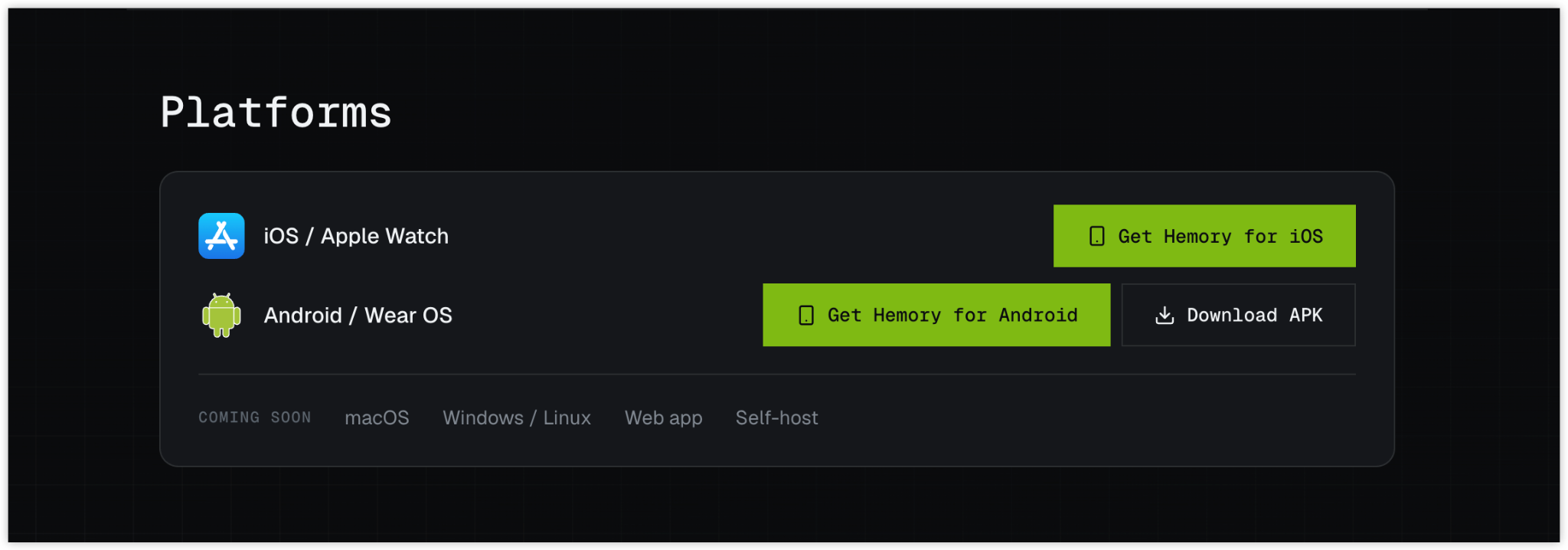
See the mobile and wearable platforms listed on the site.
Start and stop listening around the conversation
For an unpredictable conversation, start Manual Mode when you decide the exchange is worth keeping. Stop listening when it is over. For a recurring window, respond to the Schedule Mode reminder to start; stop listening when the conversation or window ends.
For example, if a new idea comes up during lunch, start listening before discussing it and stop when you are finished. For an unplanned conversation on a walk, Manual Mode lets you choose whether to start at that moment. Be considerate about recording people and follow applicable rules and workplace policies.
This habit also leaves you freer to take part in the conversation rather than writing down every possible detail. A recording can only help with later recall if listening was active while the conversation took place; Hemory cannot recover an exchange that was never captured.
Know what record to expect
Hemory automatically classifies daily content by activity. A lunch or casual chat may be classified as Meal or Chit-chat and receive a lighter summary, rather than formal meeting minutes. A listening session also produces a timestamped transcript with speaker labels and AI cleanup. Transcripts can contain errors or omissions, so treat them as a record to review—not a guarantee that every detail is exact.

Find individual statements in a searchable transcript.
Revisit a captured conversation
When you need to recall something later, ask Hemory’s built-in Q&A a specific question about your captured Memory. For example: “What idea did we discuss over lunch about the onboarding flow?” The Q&A supports follow-up questions and can retrieve across conversation sessions.
Use the answer as a starting point. If a detail could change what you do next, review the relevant transcript when available. You can play transcript lines on the listening device to check the wording. If the conversation was not captured, or the answer does not resolve the question, use another available source or ask someone who was there.
Make the setup fit your day
Start with the mode that matches your routine: Manual Mode for conversations that happen unpredictably, or Schedule Mode for recurring windows when reminders are useful. Start and stop listening yourself, then use Hemory’s Q&A to revisit details from captured conversations. That gives you a practical way to preserve useful ideas without assuming every informal exchange becomes a formal meeting record.