

 Hemory Team
On this page
A memory MCP server can give an AI agent access to information from earlier conversations, but products that share that label may differ in where data is stored, how conversations get captured, and whether a team can use the same memory. Those differences matter more than a vendor’s feature checklist when you are choosing between hosted and self-hosted approaches.
TL;DR
- Compare capture, storage, and agent retrieval separately. An MCP server may retrieve information without capturing the conversations in the first place.
- Self-hosted and hosted are deployment choices, not guarantees about privacy, team sharing, or total cost. Verify the actual data flow and operating responsibilities.
- Hemory is one candidate to assess: its public materials describe conversation capture, Memory retrieval, MCP access, and plan prices. The available evidence does not settle its storage location, team-sharing terms, license, or every target client’s compatibility.
- Use the checklist below to build a shortlist from documented facts. Don’t treat a vendor-maintained comparison as an independent test.
Start with the information you need the agent to remember
“Long-term memory” can refer to several different jobs. Before comparing servers, write down what should be remembered and how it reaches the agent:
- Capture: How does a conversation enter the system? Is it recorded by a separate app, imported from another source, or supplied manually? Does the user need to start capture or take another action?
- Organization: Does the system create transcripts, summaries, or other structured records? Can a person review or correct them?
- Storage: Where do audio, transcripts, and derived memories reside? Who operates the infrastructure, and what controls retention and deletion?
- Retrieval: Does the agent search memory when asked, or does the system insert context another way? Which records can the connected client access?
- Use: What does the agent do with retrieved information? The server may provide context, while the agent handles reasoning and drafting. Review the result before relying on it.
These layers are easy to conflate. A self-hosted retrieval service does not necessarily capture meetings. A hosted recorder does not necessarily expose its history to every MCP client. And connecting an agent does not, by itself, show that it can access every record or act in another system.
Hosted or self-hosted: compare the responsibilities
| Decision dimension | Hosted service | Self-hosted service | What to establish before choosing |
|---|---|---|---|
| Infrastructure | The provider operates some or all of the service. | Your organization or a chosen operator runs some or all of it. | Which components run where? Check audio, transcripts, embeddings or indexes, backups, and logs separately. |
| Capture | May be included, separate, or unavailable. | May require a separate recorder, connector, or manual input. | How does a real conversation become searchable memory? Do not infer capture from an MCP connection. |
| Maintenance | The provider may manage service operations; the exact scope varies. | The operator may need to handle deployment, updates, availability, backups, and access controls. | Which responsibilities belong to your team, and which to the vendor or host? |
| Team use | A plan may or may not provide shared spaces or team controls. | A shared deployment may or may not include suitable multi-user access controls. | Can colleagues access the same records? How are permissions, ownership, and offboarding handled? |
| License and cost | Pricing may depend on users, usage, or plan limits. | Software licensing and infrastructure or maintenance costs may be separate. | Check the license for the actual deployment and calculate costs for your expected usage and operating model. |
| Agent connection | Connection steps and available tools can vary by client. | Configuration and maintenance can depend on the server and client. | Test the exact MCP client, tools, permissions, and retrieval scope you plan to use. |
Neither model is automatically more private, cheaper, or easier to govern. Self-hosting gives you operational responsibility; it does not prove that every component stays on your own machine. A hosted service may expose data-handling controls, but you still need to check their scope and terms.
A cautious candidate to investigate: Hemory
Hemory is a relevant candidate if you want conversation capture and later agent access in the same product. Its public Features page describes timestamped transcripts, automatically organized activity records, a built-in Q&A agent, and MCP access for external agents. The page names Claude Code and Codex among adapted agents; verify compatibility, setup, tools, and permissions for the specific client and configuration you intend to use. A public listing is not the same as an independent compatibility test.
Hemory’s described workflow starts with a listening session on a supported platform. Capturing a conversation and later retrieving it through MCP are different steps: the relevant discussion must have been captured and be accessible before an agent can use it. Hemory provides capture, organization, and retrieval; the connected agent performs its own reasoning or drafting, and you review the result.
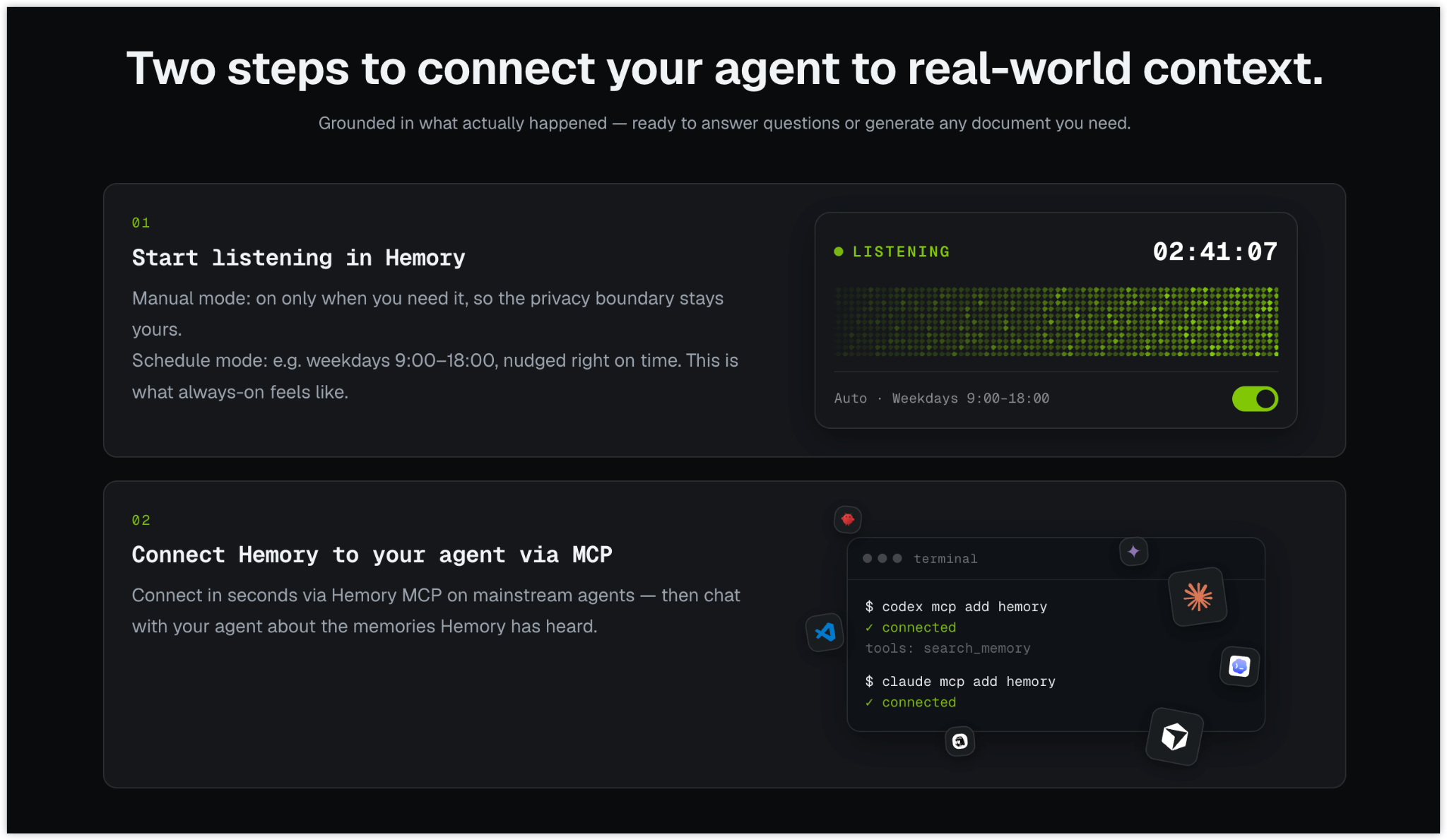
Connect an AI agent to Hemory through MCP.
The available public material does not establish where Hemory stores transcripts and Memory, whether team members can share a Vault or Memory, or what license applies to its MCP server. It also does not establish identical client permissions or retrieval scope across Claude Code, Codex, and Cursor. Treat those as selection questions, not assumed capabilities. Hemory’s self-hosting is listed as coming soon in the supplied product information, so do not treat it as a currently available self-hosted option.
The supplied Features-page pricing snapshot lists a one-time free trial with 10 listening hours, Starter at $10 per month for 20 hours, Pro at $20 per month for 60 hours, and Max at $50 per month with unlimited listening subject to a daily cap. Prices and plan terms can change; confirm current pricing and whether it fits your expected capture volume. Those figures alone do not establish team or infrastructure costs. Hemory Features
Build a shortlist without trusting a vendor ranking
The evidence available for this comparison supports a documented Hemory candidate and a way to assess deployment models, but it does not support naming or ranking two other specific products. Rather than inventing a three-tool roundup, use these three shortlist slots:
- A hosted conversation-memory service: Consider Hemory as one candidate if its capture workflow matches your needs. Resolve storage, sharing, license, current price, and the exact agent connection before deciding.
- A self-hosted MCP memory server: Identify a specific project, then check its license, release and maintenance status, data flow, capture source, retrieval behavior, and hosting requirements. A self-hosted label alone answers none of those questions.
- Another hosted MCP memory service: Select a specific vendor only after finding documentation for its capture method, storage and deletion, team access, client support, license, and pricing. Treat vendor-authored comparisons as claims to verify, not independent evidence.
For each candidate, keep a record with three states: documented, unclear, and tested by your team. Use “documented” only for a current source that addresses the specific claim; use “tested” only after trying the exact setup. A vendor listing or a general MCP claim does not prove that a particular client works with the tools and permissions you need.
Check these questions before you commit
Where does each kind of data go?
Ask separately about audio, transcripts, summaries, indexes, backups, and logs. Find out what is stored locally, what is sent to a provider, how deletion works, and whether the answer differs by plan or configuration. Avoid broad conclusions such as “self-hosted means local” unless the data flow confirms them.
How does the system capture conversations?
Write down the actual path from conversation to searchable record. Confirm which devices or sources are supported, what action starts capture, what the system generates automatically, and whether existing records can be brought in. Don’t assume an MCP server imports history or records meetings simply because it can retrieve memory.
What can each agent retrieve and do?
Check the connection instructions for each target client—Claude Code, Codex, and Cursor—and ask which tools and data scopes are available. Distinguish access to retrieved context from permission to change Memory or take actions in external systems. If your workflow depends on a capability, confirm it in current documentation or a controlled trial.
Can a team share the same memory safely?
Look for explicit documentation of shared access, roles, permissions, and what happens when someone leaves. A colleague’s ability to read a generated brief does not mean they can access the underlying archive. If team access is not documented, mark it unclear and request a direct answer before adopting the service for shared work.
What does the license and full cost cover?
For self-hosted options, check the license attached to the server and any required components; distinguish license terms from hosting and maintenance costs. For hosted plans, check usage limits, billing basis, and whether team features cost extra. Compare against your expected use rather than relying on a headline price.
Choose by the constraint that matters most
A hosted service may suit you if you want a provider-operated option and its documented capture, data handling, agent support, and price meet your requirements. A self-hosted server may suit you if your team can operate it and its actual license, capture path, data flow, and maintenance burden fit. If you need shared team memory, make confirmed access controls a gate—not an assumption based on deployment type.
Keep Hemory on the shortlist when its conversation-capture and retrieval workflow is relevant, but don’t select it—or any other product—until the unresolved requirements that matter to you are answered. Compare the same dimensions for each candidate, attach the supporting source to each claim, and run a small trial only when documentation cannot settle a consequential question.
FAQ
Is a memory MCP server the same as a meeting recorder?
No. A recorder or capture app gets conversations into a system; an MCP server can expose supported information to an AI client. One product may provide both, but confirm the capture source and the agent’s retrieval access separately.
Does self-hosting guarantee that conversation data stays private?
No. It changes who operates some infrastructure, but data may still pass through other services or be stored in components you do not control. Trace each data type through capture, processing, storage, and retrieval.
Can I assume a server works the same way in Claude Code, Codex, and Cursor?
No. Client listings and MCP support do not establish identical setup, tools, permissions, or behavior. Check the current connection instructions and test the specific workflow you need for each client.
Should I choose a tool based on its listed price?
Use price as one part of the comparison. Check usage limits, team terms, hosting or maintenance costs, and whether the product captures and retrieves the information your workflow needs. Confirm current terms before purchase.
Next step: Choose one real workflow—such as retrieving a decision from a past discussion—and use it to evaluate the same capture, storage, sharing, retrieval, license, and cost questions for each candidate. Keep unknowns visible until documentation or a trial resolves them.