

 Hemory Team
On this page
If you want to record an in-person meeting without a meeting bot, the first question is how to start listening—and what Hemory will give you afterward. Choose a supported device, start and stop listening yourself with Manual Mode, or use Schedule Mode reminders to make those actions easier to remember.
TL;DR
- Hemory supports iOS, Apple Watch, Android, and Wear OS. Choose a device and platform you can use for the conversation.
- In Manual Mode, start listening when the meeting begins and stop when it ends. Schedule Mode sends reminders with one-tap start and stop actions; it does not silently record.
- A listening session produces a timestamped transcript with Speaker labels. Meetings may also receive structured notes with agenda, decisions, and action items.
Choose a supported device
Hemory currently supports iOS, Apple Watch, Android, and Wear OS. macOS, Windows/Linux, the web app, and self-hosting are listed as coming soon, so do not plan on using them as current options.
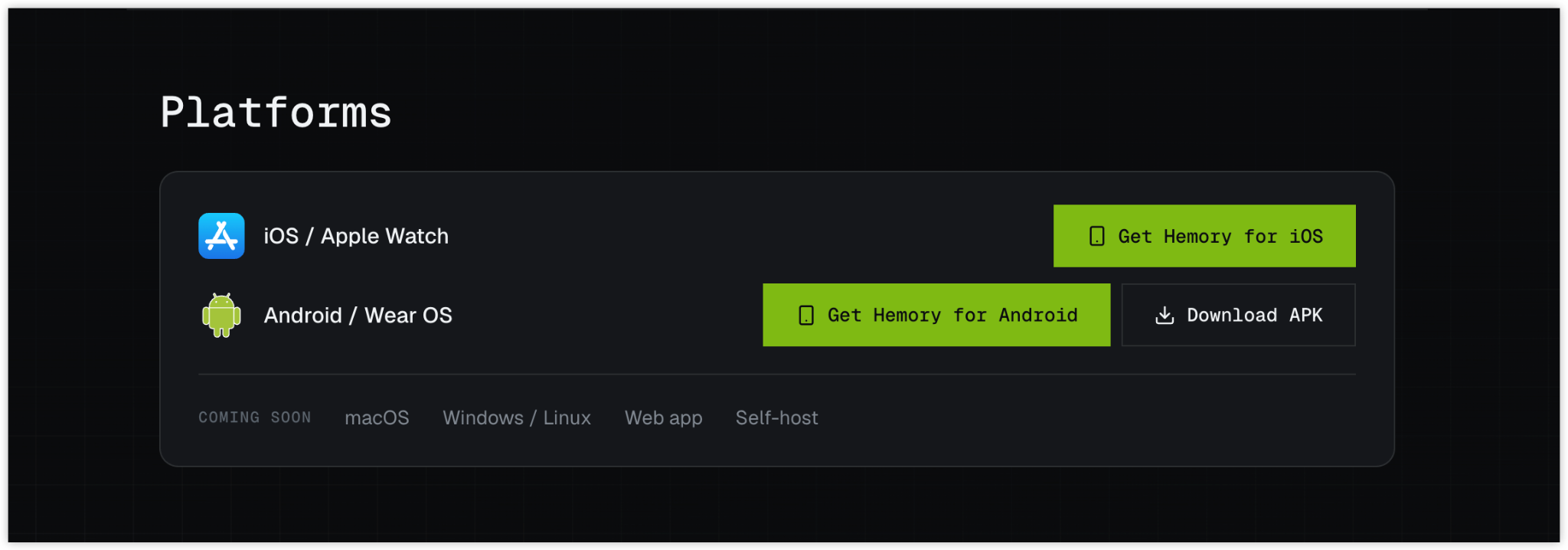
See the mobile and wearable platforms listed on the site.
For an iPhone or Android phone, use the supported phone platform that fits your setup. Apple Watch can capture and upload listening content independently. If you are considering another Wear OS watch, confirm that your device and setup are supported before relying on it for a meeting; this guide does not cover device-specific setup or pairing.

Hemory listening interface shown on Apple Watch.
Start and stop listening with Manual Mode
Manual Mode puts you in control of when listening begins and ends:
- Open Hemory on your supported device and choose Manual Mode.
- Start listening when you are ready to capture the conversation.
- Stop listening when the meeting is over.
The exact screen labels or setup steps may differ by platform. The essential check is that listening has started before the discussion you want to keep, and that you stop it when you are finished. If you join late or need to capture only part of a meeting, start when you are ready; do not assume Hemory can recover conversation that was never recorded.
Use Schedule Mode for reminders
If you often capture meetings at predictable times, set listening times in Schedule Mode. Hemory sends reminders with one-tap actions to start or stop listening. The reminder does not mean the device is already recording: you choose whether to begin or end the session.

Set listening times for weekdays and weekends.
Schedule Mode can help you remember the action, while Manual Mode is a straightforward choice for a one-off or unpredictable meeting. If the meeting time changes, use the controls available to you rather than assuming a scheduled reminder will follow the change automatically.
What you get after a session
A listening session produces a timestamped transcript with Speaker labels and AI cleanup. Hemory can also play back individual transcript lines on the device that captured the session. Transcription and speaker labeling are not guaranteed to be perfect, so review details that affect a decision or follow-up.

Find individual statements in a searchable transcript.
Hemory automatically classifies daily content by activity type. When a session is classified as a meeting, it may receive structured notes covering the agenda, decisions, and action items. Other activity types can produce lighter summaries, so do not expect every recording to become formal meeting minutes.

See how a meeting summary highlights decisions and follow-ups.
Speaker labels can help you follow a conversation, but a label is not proof of who said something. Unnamed speakers may remain anonymous, and a possible speaker match should be treated as a confidence hint rather than a confirmed identity.
Before you start
Recording rules and workplace policies can vary by location and situation. Check the requirements that apply to you and communicate with participants as appropriate before capturing a meeting. This guide does not determine what consent is required in your circumstances.
Frequently asked questions
Does Schedule Mode record automatically?
No. It sends reminders with one-tap start and stop actions. You still choose when listening begins and ends.
Can I rely on Speaker labels as confirmed identities?
No. Treat labels as aids, not certainty. Hemory may leave a speaker anonymous or show a possible match; review consequential attribution before acting on it.

Review a suggested speaker match before confirming it.
What should I do if a detail is missing from the transcript?
Check the relevant passage and, if useful, play back its line on the listening device. If the conversation was not captured or a consequential point remains unclear, consult another available record or ask a focused follow-up question.
To try the workflow, choose a supported device and make a short test capture when you are ready. Start and stop listening yourself, then review the transcript and any meeting notes to see whether they contain the details you need for your next step.