

 Hemory Team
On this page
An AI agent can give a better-informed answer when it has relevant background from earlier conversations. But connecting it also means relying on a specific client’s access and tools—not granting an abstract, identical level of access everywhere. The practical choice is to connect only when the context is useful, the scope is clear, and you can review what the agent produces.
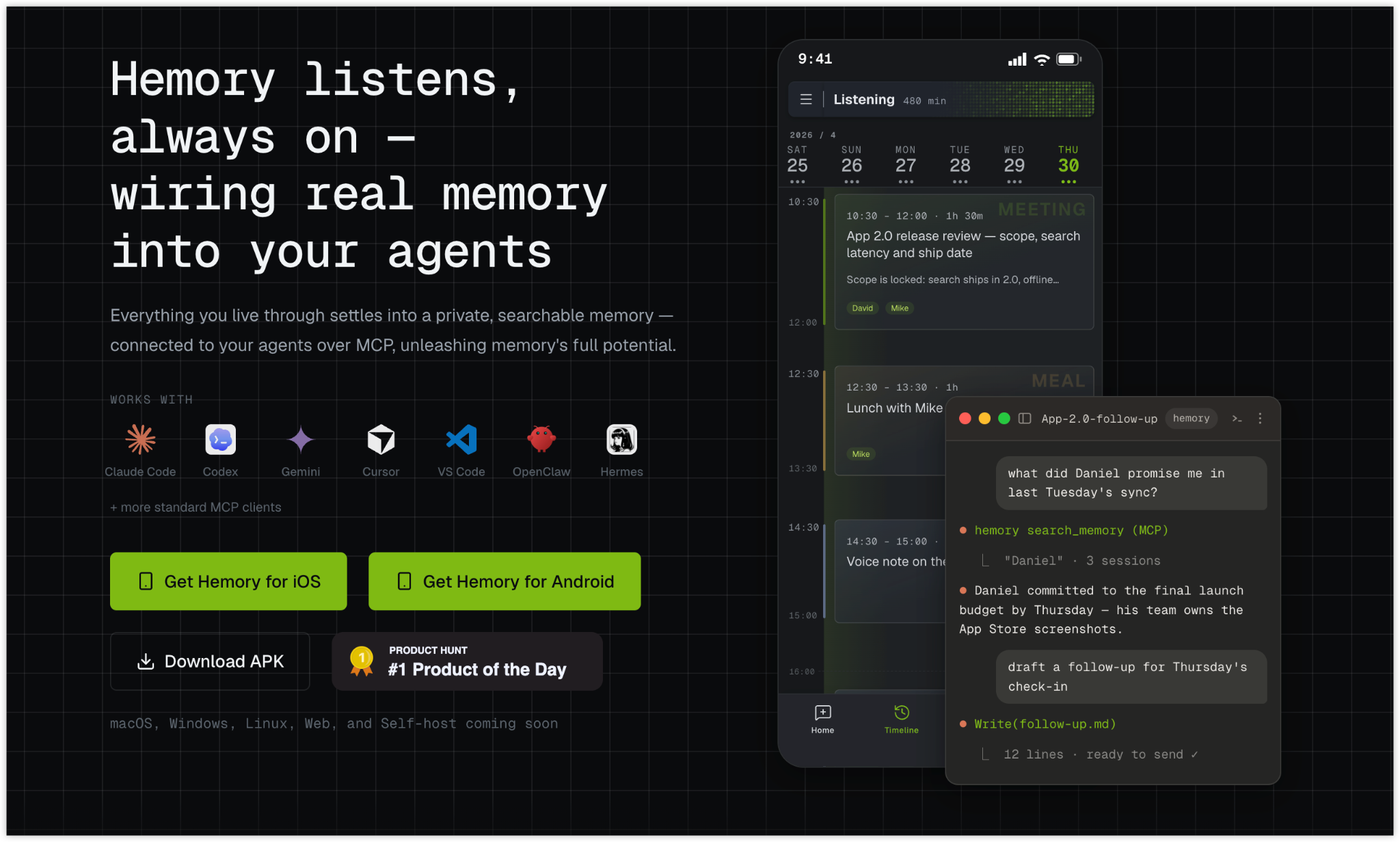
Bring past conversations into AI workflows with searchable memory.
TL;DR
- Connect when relevant conversations have already been captured and could materially improve the task or save you from retelling their background.
- Check what the particular agent client can retrieve and what tools it can use. Hemory documents Memory retrieval and Speaker labeling and management through MCP; that does not establish arbitrary Memory edits or actions in other systems.
- Treat the agent’s answer as a draft or aid. Review important details and make your own decisions before relying on the result.
What changes when an agent can use conversation memory?
Without access to past discussions, you may need to remember which conversation matters, find the record, summarize it, and provide that context to the agent. A supported connection can let an external agent retrieve relevant context from Hemory Memory for a task, reducing that preparation and retelling.
The benefit depends on the source: the conversation must already have been captured and be accessible through the supported connection. Memory cannot supply an exchange that was never recorded. Other records—such as a CRM entry, notes, or a transcript archive—may already contain the context you need, so a connection is not automatically necessary.
Also separate three roles. Hemory captures, organizes, and makes Memory available through documented tools. The connected agent uses the tools its client exposes and performs its own reasoning or drafting. You decide whether the result is accurate and suitable for your work.
The case for connecting
It can reduce repeated preparation
When an answer depends on earlier explanations, constraints, or ideas, you may otherwise have to reconstruct the discussion and enter it into the agent yourself. Retrieval can supply useful background that you forgot or did not think to mention, without requiring you to prepare a complete chronology first.
For example, when drafting a follow-up based on previously captured product discussions, relevant context may help the agent produce a more grounded draft. You still need to supply the current goal or any new information that changes what the follow-up should say.
It can make the conversation useful beyond the original meeting
Hemory organizes captured conversations into searchable, reviewable Memory. Its built-in Q&A also supports multi-turn, transcript-based questions across conversation sessions. With a supported external connection, an agent can use accessible context as part of a separate task, such as preparing a draft for your review.

Retrieve past commitments and draft follow-up tasks.
That can be useful when the work has moved on from the conversation itself. The point is not simply to replay a transcript; it is to make relevant background available for a task that would otherwise require manual searching and retelling.
The case for holding back
The actual scope may be unclear
A connection does not establish that every conversation, data type, or tool is available to every agent client. Connection steps, exposed tools, and permissions can vary. Confirm what the particular client can access before assuming the scope is narrow—or that it can retrieve everything you expect.
Retrieval is not the only documented capability
Hemory’s documented MCP capabilities include Memory retrieval and Speaker labeling and management. That means it would be inaccurate to describe the entire MCP capability as read-only. At the same time, these documented tools do not establish arbitrary editing of Memory or permission to act in other systems.
If your decision depends on a retrieval-only connection, check the tools and permissions exposed by the specific client. Do not assume you can limit access to a particular conversation or tool unless that behavior is documented for your setup.
A useful-looking answer still needs review
Retrieved context can be incomplete, and the agent may misunderstand what a conversation means for the current task. A transcript records speech; it does not guarantee perfect transcription or establish that a statement was approved, completed, or still current. Review the parts of the result that affect what you will do next.
The connection may not be worth the added setup
If you need only one simple fact, or the relevant information is already in a document you can provide directly, connecting an agent may add little value. For a sensitive task, unclear access scope is also a sound reason to wait until you can establish what the client can use.
Decide with these questions
| Question | If yes | If no or unclear |
|---|---|---|
| Would relevant, captured conversations change the answer or save meaningful context preparation? | The connection may be useful for this task. | Use the information already at hand or provide a focused excerpt. |
| Can you establish what the specific client can retrieve and which tools it exposes? | Compare that scope with what the task requires. | Do not infer permissions from another client’s setup; resolve the scope first. |
| Are you comfortable with the documented tools, including any management capability? | Connect only if those tools suit your needs. | Hold off if you cannot establish that the available tools fit your intended boundary. |
| Can you review the output before acting on it? | Use the agent’s work as a draft or input to your judgment. | Do not rely on it as an unchecked decision or action. |
A defensible choice can be “not for this task.” You might use a connection for work that benefits from background across captured discussions, while supplying a short, relevant excerpt manually for a one-off lookup. If you cannot determine the client’s scope, decide after that information is clear rather than treating the choice as all-or-nothing.
Review the result before relying on it
When the agent returns a draft or answer, check the details that could change your next step:
- Does the response reflect the relevant discussion, rather than merely matching a shared keyword or participant?
- Are proposals, accepted decisions, conditions, and completed actions kept distinct?
- Is a missing detail genuinely absent from the available record, or does it need a focused follow-up from you?
- Does the response account for current instructions or documents you supplied separately?
If an important point is uncertain, consult the accessible source record or ask a focused clarification. Do not treat an unanswered search as proof that a discussion, decision, or progress never existed. Before using a draft in a shared work process, review it and carry the approved content through your normal workflow; the connection does not itself authorize arbitrary external actions.
FAQ
Does connecting an agent give it access to every conversation?
Not necessarily. Access depends on the tools and scope available through the specific connection. Confirm what that client can retrieve; do not infer universal access from an integration listing or from another client’s behavior.
Can the agent change my Hemory Memory?
The documented MCP scope includes Speaker labeling and management as well as Memory retrieval. That does not establish arbitrary Memory editing. Check the specific client’s exposed tools and permissions rather than assuming the connection is entirely read-only or broadly writable.
Can the connected agent send messages or update another system?
The Hemory connection does not establish that. Hemory provides documented capture, organization, retrieval, and context access; an external agent’s other actions depend on that agent and its tools. Review any proposed external action and use your normal approval process.
What if I only need one detail from a past conversation?
A connection may be unnecessary. Use a suitable existing record or provide the relevant material directly. Consider an agent connection when retrieving background from captured conversations would meaningfully help with the task.
If relevant captured discussions would change the work, and the specific client’s access and tools are clear, connecting can reduce searching and retelling. If the scope is unclear or the context adds little, wait or use a narrower manual route. Either way, review the agent’s output before relying on it.