

 Hemory Team
On this page
The right transcription tool depends on more than the number of languages in a feature list. If you record conversations in person and also need transcripts from meetings at your laptop, first check where each tool can capture audio. Then verify that it lists the languages your participants actually use. A published language count or list is a starting point, not evidence of how well a tool handles your meeting.
TL;DR
- Choose first by capture setting: Hemory’s public Features page lists iOS and Apple Watch support; desktop platforms are listed as coming soon.
- Hemory describes transcription in 100 languages, but the supplied page names only examples. Check whether your specific languages and variants are included.
- Treat another tool’s language list as a vendor claim, not an independent performance result. Test both the capture workflow and transcripts from your own meeting conditions.
Compare capture fit before language counts
A tool that supports the right language may still be a poor fit if it cannot capture the meeting in the place where it happens. Make a list of your actual settings before comparing transcription claims:
| Meeting situation | What to establish | What the supplied information says |
|---|---|---|
| In-person conversation away from a desk | Which supported device will capture it, and what steps you must take to start listening | Hemory’s Features page lists iOS and Apple Watch support. It describes Apple Watch as able to listen and upload independently. |
| Meeting at a laptop | Whether the tool has a currently available desktop capture route, not just a planned one | Hemory lists macOS and Windows/Linux as coming soon, not as currently available desktop platforms. |
| Desktop transcription tool | Which operating systems, meeting sources, and languages its current product documentation covers | Check the tool’s own published documentation. No specific competing tool or product listing was provided for this comparison. |
Hemory’s public platform information does not establish that it can capture a laptop meeting through a desktop app today. Nor does the available information establish that every capture surface behaves identically. If desktop capture is essential, do not treat a coming-soon platform as a current option. Confirm the exact workflow with the vendor before choosing.
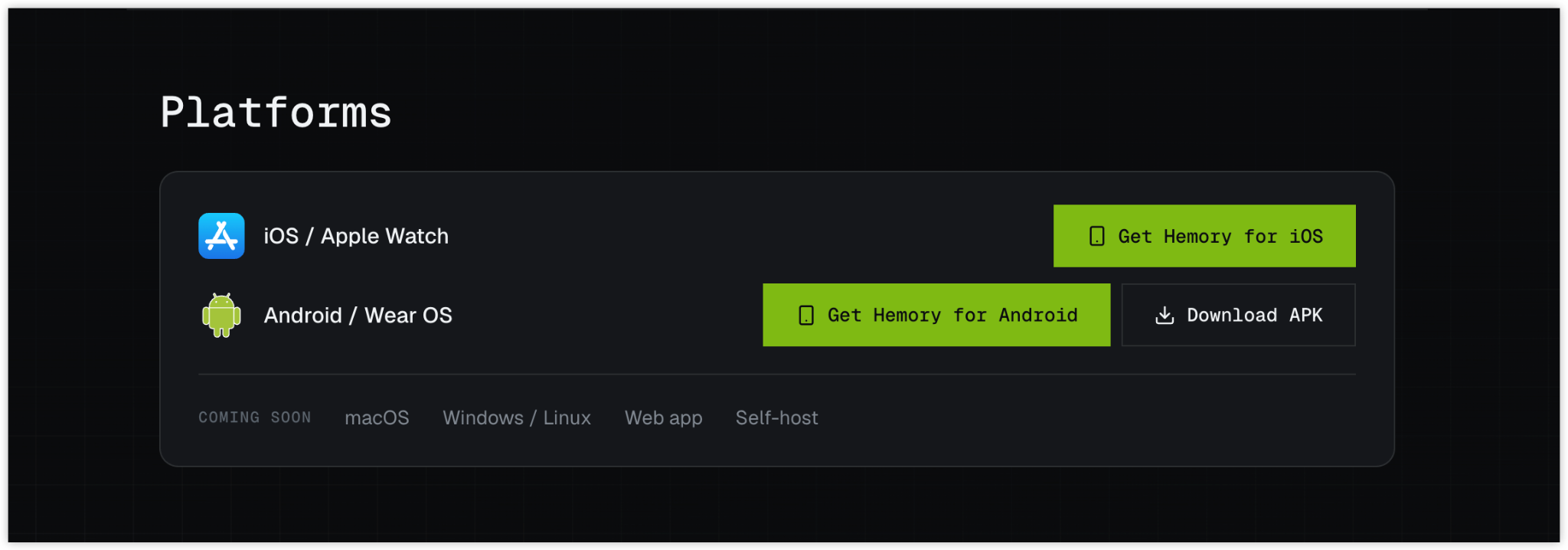
See the mobile and wearable platforms listed on the site.
Hemory’s Features page describes timestamped transcripts and support for 100 transcription languages. It gives examples including English, Japanese, Korean, Chinese, German, Italian, French, and Spanish, but the supplied page does not show the full language list or per-language accuracy figures. See Hemory’s Features page. A count of supported languages cannot tell you whether a particular regional variant, mixed-language conversation, or noisy room will produce a usable transcript.
Compare language claims on the same terms
For each candidate, record what its published information actually establishes. Separate a language being listed from a quality result observed in a test.
| Question | What to look for | Why it matters |
|---|---|---|
| Is my exact language listed? | The language name and, where relevant, its regional or written variant | A broad label may not answer whether the version your team speaks is covered. |
| What kind of support is claimed? | Transcription, translation, captions, or another language feature | These are different capabilities. A general “multilingual” label may not specify which one is included. |
| Which capture route is covered? | The device or desktop workflow described for the language feature | A tool’s language claim may not establish identical behavior across every device or capture surface. |
| Is there evidence of performance? | A method, sample, or result that matches your use case | A vendor’s language listing is not an independent accuracy assessment. |
Avoid comparing a specific “100 languages” statement with a competitor’s broad “multilingual” wording as if they were equivalent measurements. Record each claim as stated, note what is missing, and use a practical test to answer the questions the documentation leaves open.
Test the workflow you would actually use
Choose a short, representative meeting or an appropriately permitted recording. Test the devices and settings you expect to use, rather than judging from a language list alone. Follow applicable consent and recording rules, especially when other people are present.
- Confirm the capture route. Check that the product currently supports the device and meeting setting you need. Note any start, stop, or upload steps required from you.
- Check the exact languages. Include the languages and variants spoken in your real meetings. If participants switch languages, include a sample with that pattern when you can do so appropriately.
- Use representative conditions. Consider the usual number of speakers, background noise, distance from the device, and speaking pace. Do not assume a quiet single-speaker sample predicts a busy group discussion.
- Review the transcripts against the source. Look for errors that would change a name, number, commitment, technical term, or next step. A transcript is a record that needs review, not guaranteed ground truth.
- Decide what result is usable. Set this criterion before comparing: for example, whether you need searchable topic coverage, reliable names and figures, or wording precise enough to quote. The required level depends on the task.
Keep the result narrow: “This sample was usable for our purpose” is a more defensible conclusion than a general claim that one tool is more accurate in a language. The available information here contains no independent accuracy results for either option.
Make the choice by your meeting mix
- Choose a desktop tool for a desktop-dependent workflow if its current documentation confirms the capture route and language coverage you need, and your own test meets your requirements.
- Consider Hemory for supported iOS or Apple Watch capture if those devices fit your in-person conversations and its published language support covers the languages you use. Hemory can organize captured discussions into timestamped transcripts; that can reduce the need to take down every spoken detail while participating. It cannot retrieve a conversation that was never captured.
- If you need both settings, verify both separately. Do not assume that an in-person capture workflow also covers a laptop meeting, or that language support works identically across devices. You may need separate tools unless a vendor confirms a suitable, currently available workflow.
The practical choice is the tool—or combination of tools—that supports your actual capture settings, lists your languages, and produces transcripts usable for your work in a representative trial. If the deciding point is desktop capture or performance in a particular language, treat it as unresolved until the vendor’s current documentation or your own test answers it.
FAQ
Does support for 100 languages mean a tool will transcribe my language accurately?
No. A supported-language count or list identifies a vendor’s stated coverage; it does not establish accuracy for your language, variant, speakers, or meeting conditions. Check the exact language and test a representative sample.
Can I use Hemory to transcribe a meeting on my laptop?
The supplied Hemory Features page lists macOS and Windows/Linux as coming soon, not currently available desktop platforms. It does not establish a present-day desktop capture workflow. Confirm current availability before relying on one.
Should I choose the tool with the longer language list?
Not by that measure alone. First confirm that it captures the meeting where it happens and covers the languages you use. Then compare transcripts against your own requirements; a longer list does not demonstrate better performance.
Is a vendor’s published language list independent verification?
No. It is the vendor’s published claim. Use it to identify what to check, and rely on an appropriate test or independent evidence if you need to assess performance.