

 Hemory Team
On this page
A monthly allowance can leave you unsure whether a recording will still be available if it has not been transcribed yet. That uncertainty makes it hard to decide which conversations to prioritize or whether you need a backup. The key is to confirm what the limit controls before relying on a tool’s handling of pending recordings.
TL;DR
- A listening-hour or transcription allowance does not, by itself, explain what happens to unprocessed audio.
- Ask the vendor whether the limit stops capture, transcription, or both—and whether pending audio is retained, can be processed later, or can be selected.
- Prioritize conversations by the consequence of losing detail, the uniqueness of the discussion, and how soon someone needs to act.
- For Hemory, the supplied Features page describes listening-hour plans and transcripts from listening sessions; it does not establish what happens when an allowance runs out.
First, clarify what the monthly limit measures
A plan may measure listening time, transcription, storage, or another unit. Those are not interchangeable. A “monthly transcription limit” might be a user’s shorthand for a listening allowance, so check the plan’s exact wording and what event consumes the allowance.
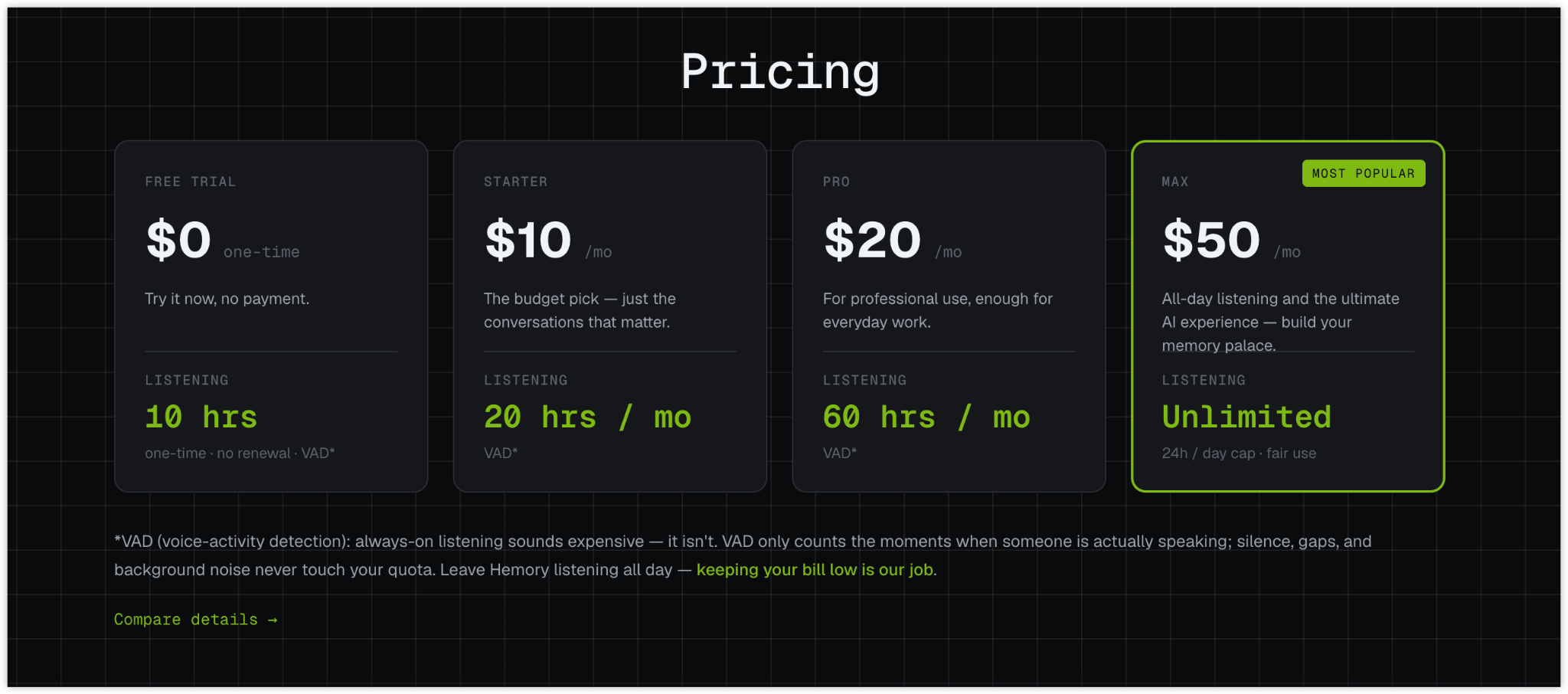
Compare listening plans and their advertised allowances.
Hemory’s Features page lists monthly listening hours for some plans and says that VAD—voice activity detection—counts detected speech, rather than silence and gaps. It also describes a transcript for each listening session. That information does not say whether reaching the allowance stops listening, prevents transcription, or affects audio that has already been captured but not processed. Do not infer that a backlog is saved or that recording continues past the limit.
Questions to ask the vendor
Ask for answers that distinguish capture, processing, and retention. If a support response uses broad terms such as “recordings are available,” ask what that means for audio that has not yet been transcribed.
- What exactly does the allowance measure? Is it listening time, transcription time, stored audio, or something else? When is usage counted, and when does the allowance reset?
- What happens when the allowance is reached? Does new listening stop, does transcription stop, or are both affected? Does the answer differ for audio already captured?
- How long is unprocessed audio retained? Is it deleted after a set period, when a billing period ends, or under another condition? Ask where the current retention rule is documented.
- Can pending audio be processed later? If so, when can processing resume, and does it use a new allowance or involve an additional charge?
- Can users choose which recordings to process? If selection is possible, ask how to identify a recording and whether selection happens before or after the limit is reached.
- What happens if you change or renew a plan? Confirm whether that changes access to pending audio or only changes future allowance.
Keep the vendor’s reply with the plan details you relied on, including the date you checked. Limits and policies can change, and a general product page may not answer an account-specific question.
Prioritize conversations before you approach the limit
Use a lightweight priority list rather than assuming you will be able to process everything later. Rank a conversation higher when it contains a decision, a specific commitment, a detail that is hard to recover elsewhere, or information needed for an imminent action. Rank it lower when a reliable, accessible record already exists or the discussion is unlikely to affect a decision.
For each upcoming conversation, ask:
- What could change because of this discussion? A decision or time-sensitive next step usually deserves more attention than a routine update.
- Can I recover the important details elsewhere? A current document may cover the same information, but check that it is accessible and includes the relevant conditions.
- When will someone need the result? A conversation needed for an upcoming handoff may be more urgent than one with no immediate follow-up.
If your tool shows remaining usage, review it before scheduling or relying on additional listening. Do not assume you can choose recordings for transcription unless the vendor confirms that option. For a critical discussion, keep brief notes on decisions, conditions, and next steps as a backup until you know how the tool handles pending audio.
What this means if you use Hemory
Hemory’s published Features page describes listening sessions that produce timestamped transcripts and lists monthly listening-hour allowances for some plans. The supplied information does not establish whether audio that has not been transcribed is retained after an allowance runs out, whether processing can be deferred, or whether users can choose which recordings to process. Confirm those points with Hemory before treating it as a dependable backlog or planning around a particular limit behavior.
When a listening session is within your allowance, Hemory can organize the captured conversation into a transcript and related Memory. That can reduce the need to write down every detail while participating. But it cannot resolve what happens to audio that the product has not processed, and it cannot recover a conversation that was never captured. Until the limit behavior is clear, keep an independent note of any decision or commitment that would be costly to lose.
Make the decision before the limit becomes urgent
Before choosing a plan or relying on a recording workflow, get clear answers on the unit counted, the effect of reaching the limit, pending-audio retention, deferred processing, and user control over selection. If a vendor cannot confirm a point that matters to your work, treat it as an unresolved risk and keep a suitable backup for high-consequence conversations.
FAQ
Does a monthly listening limit mean untranscribed audio is deleted?
Not necessarily. A usage limit alone does not establish a retention rule. Ask the vendor how long unprocessed audio remains available and what event, if any, deletes it.
Can I save a recording for transcription after the allowance resets?
That depends on the product’s processing and retention rules. Confirm whether already-captured audio can be processed later, when it can resume, and whether the vendor lets you select specific recordings.
Does Hemory say what happens to audio after the monthly allowance runs out?
The supplied Hemory Features page lists monthly listening-hour allowances but does not specify the handling of unprocessed audio after the limit is reached. Confirm retention, deferral, and selection behavior directly rather than assuming a particular outcome.