

 Hemory Team
On this page
A promising thought can disappear while you unlock a phone, find an app, and work through its controls. In an unexpected conversation, even a short delay can mean missing the opening point. There is no universal number of seconds that makes a recorder “fast.” What matters is whether you can start from the device at hand, capture the thought or discussion before it moves on, and stop without extra setup.
TL;DR
- “One-tap” describes a simple start action; it does not, by itself, guarantee that recording begins instantly.
- Evaluate the whole path: starting steps, available starting surfaces, time to capture, stopping, and what happens to the recording afterward.
- Hemory’s Manual Mode lets you start and stop listening. Schedule Mode provides reminders with one-tap start and stop actions; that is not silent automatic recording.
What does “one-tap recording” mean?
It means the user can begin recording with one deliberate action from an available control, rather than navigating through multiple menus or setup screens. The phrase describes the interaction, not a measured response time. A single tap can still be followed by a delay before capture begins, and a fast start can still be inconvenient if the control is hard to reach.
For a fleeting idea, the practical question is whether the recorder starts in time to catch the part you want to keep. For an unexpected discussion, consider whether you can begin appropriately and with the necessary consent before important details pass. A tool should not be treated as recording before the user has actually started it.
How should you judge whether a recorder starts quickly?
Consider the whole capture path rather than looking for one headline speed figure.
| What to assess | What to look for | Why it matters |
|---|---|---|
| Actions to start | How many deliberate steps are needed from the current screen or device state? | Extra navigation can get in the way when an idea arrives unexpectedly. |
| Starting surface | Can you begin from a device or control you already have at hand, such as a phone or supported watch? | A one-action control is useful only if it is accessible in the moment. |
| Time to actual capture | After you start, does capture begin soon enough to preserve the opening words? | A quick-looking button does not tell you when the recorder actually starts listening. |
| Stopping | Can you end listening clearly and without searching through settings? | A simple stop action makes the recording session easier to control. |
| What follows | Is there a transcript, playback, or another usable record after capture? | Starting quickly is less useful if the resulting material is difficult to review or reuse. |
There is no single time threshold that works for every situation. A brief delay may be acceptable when recording a personal thought; the same delay may miss a key sentence in a live conversation. Judge the start against the moment you are trying to capture, and assess it on the device and in the conditions you expect to use.
Check the start, stop, and result—not just the button
If you are evaluating a recorder, try the same short scenario on each device or app you are considering. Notice how you reach the start control, whether the first words are captured, how you know listening has begun, and how you stop. Then review what the tool produces. For example, can you replay a passage or find the substance of the idea later?
Keep the observations separate: a short route to the control is not proof of immediate capture, and a clear recording indicator is not proof that the opening words were preserved. If a tool does not make its start state clear, treat that as a usability concern rather than assuming it was recording.
What this looks like in Hemory
Hemory’s Manual Mode lets the user start and stop listening. Schedule Mode lets users set listening times and receive reminders with one-tap start and stop actions. A reminder can make a planned listening period easier to begin, but it is not a claim that Hemory starts recording silently or without user action.

Set listening times for weekdays and weekends.
Hemory’s documented supported platforms are iOS, Apple Watch, Android, and Wear OS. That platform list does not establish that the start control or number of steps is identical everywhere, nor does it establish a universal one-tap control on every platform. Check the start route on the device you intend to use rather than assuming the same interaction across devices.
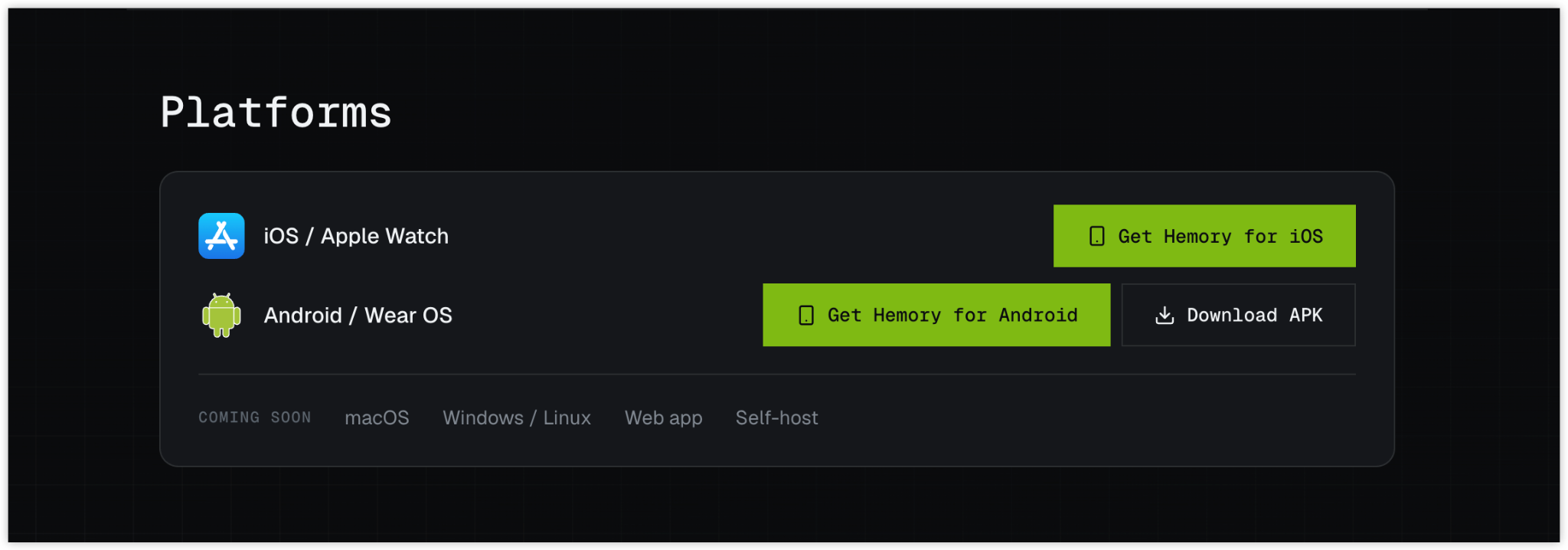
See the mobile and wearable platforms listed on the site.
After a listening session, Hemory produces a timestamped transcript and organizes content into activity-based records. That can make an idea or conversation easier to revisit without relying on a handwritten note made while you were trying to participate. The transcript and resulting record are for later use; they do not mean an unstarted or uncaptured conversation can be recovered.

Find individual statements in a searchable transcript.
The practical standard
A recorder starts quickly enough when its available control is easy to reach, capture begins in time for the situation, and stopping and reviewing the result are straightforward. “One tap” is a useful interaction criterion, not a complete measure of speed. Compare the actual experience on the device you will use, and choose a tool whose controls fit how you capture ideas and conversations.