

 Hemory Team
On this page
A long capture can stop being useful if the device runs out of power, the wrong listening mode is selected, or you assume a schedule starts listening on its own. A quick preflight helps you confirm the basics without treating any setup as a guarantee against interruption.
TL;DR
- Check the battery on the device that will actually listen. Hemory does not document battery-level monitoring or a pre-capture battery warning.
- Manual Mode lets you start and stop listening yourself. Schedule Mode provides reminders and one-tap start and stop actions; do not assume the schedule starts capture silently.
- Compare your planned session with your plan’s published listening allowance. Hemory’s public information does not document a remaining-time display, a low-allowance alert, or what happens when an allowance runs out.
- If using an Apple Watch, account for its battery separately: it can capture independently of the paired phone, and incoming calls pause listening until the call ends.
Preflight checklist for a long Hemory capture
1. Choose the device that will listen
Decide which supported device you will use and make sure it is the one you will have with you for the session. Do not treat a paired phone as a backup power source for an Apple Watch capture: Hemory describes the watch as able to listen and upload independently.
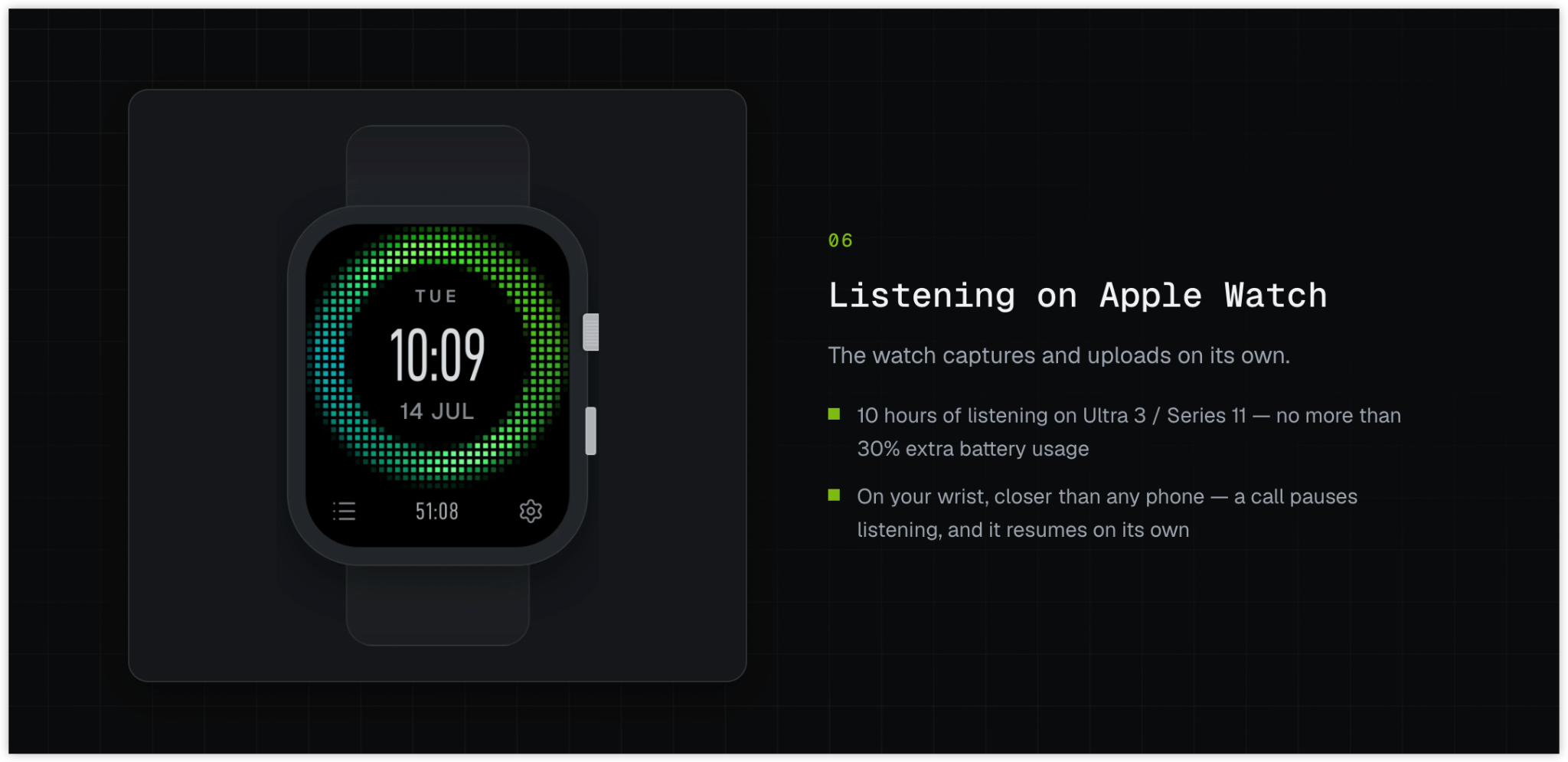
Hemory listening interface shown on Apple Watch.
If you plan to use an Apple Watch, check the watch’s own battery. The Hemory Features page lists up to 10 hours of listening for Apple Watch Ultra 3 and Series 11, with up to 30% additional battery consumption. Those figures are model-specific; they are not a promise for every watch or every session.
2. Check device power before you start
Check the battery on the device that will capture the session. Charge it beforehand if its current level may not cover the planned duration. If you intend to use an external power source, follow the device maker’s guidance and make sure your setup suits the location.
Hemory’s public information does not describe a battery monitor or a warning that tells you whether the device has enough charge. A preflight check is a precaution, not a guarantee: battery depletion or another device event can still interrupt capture.
3. Select the listening mode and know what it requires
Choose the mode that fits how you will start and end the session:
| Mode | What Hemory documents | What to do before a long session |
|---|---|---|
| Manual Mode | You start and stop listening. | Plan to start listening yourself, then stop it when the session is over. |
| Schedule Mode | You can set listening times and receive reminders with one-tap start and stop actions. | Set a window that fits the session and act on the reminder. Do not assume the schedule starts listening without your action. |
If the timing is uncertain, consider whether you can reliably respond to the reminder or start and stop listening manually. The documented controls do not establish that a session will continue through every device event.

Set listening times for weekdays and weekends.
4. Compare the session with your listening allowance
Before a long capture, compare its expected duration with the listening allowance for your plan. The Features page lists a 10-hour one-time allowance for the free trial, 20 hours per month for Starter, 60 hours per month for Pro, and a 24-hour daily cap for Max. It also says voice-activity detection counts speech, not silence, gaps, or background sound, toward the allowance.
Those published limits do not tell you how much allowance remains on your account. The page does not document a remaining-time display, a warning when allowance is low, or what happens to capture when an allowance is reached. Avoid relying on an undocumented alert or assuming that silence will make a long session fit within a limit.
5. Account for known device interruptions
For Apple Watch capture, Hemory documents that an incoming call pauses listening and that listening resumes after the call ends. If an uninterrupted record matters, plan for the possibility of a pause and decide whether you need another way to confirm or clarify anything that may have been missed.
This checklist lowers avoidable setup risks; it cannot ensure a session will run without interruption. If a detail is critical, use a suitable backup or follow up afterward rather than assuming the capture is complete.
FAQ
Does Schedule Mode automatically start a long recording?
Hemory documents reminders and one-tap start and stop actions. Do not treat a scheduled time as silent, automatic capture.
Does my phone need to stay near me when I capture with Apple Watch?
Hemory describes Apple Watch as able to listen and upload independently of the paired phone. Check the watch’s battery separately, and keep in mind that an incoming call pauses listening until the call ends.
Will Hemory warn me if the device battery or listening allowance is running low?
The supplied product information does not document a battery warning, a low-allowance alert, or what happens when an allowance runs out. Check device power yourself and plan around the published allowance rather than relying on an undocumented warning.
Before you begin
Confirm the capture device, its battery, the mode and actions required to start and stop listening, and whether the planned session fits the published allowance. Hemory documents useful controls, but not battery monitoring or a guarantee against interruption. For consequential details, leave room to clarify anything the capture may not preserve.