

 Hemory Team
On this page
A useful conversation can happen between scheduled meetings, during a hallway chat, or in a quick customer call. Choosing how to capture it means balancing attention, control, consent, and the effort of finding details later. The right choice depends on the conversation and what you need from the record—not on which device sounds most convenient.
TL;DR
- Choose handwritten notes when you need a selective reminder and can write without losing the thread.
- Choose a recorder when preserving more of the spoken exchange matters and you can manage consent, recording controls, and later review.
- Consider a listening app when you want capture to lead into transcripts, organized records, or retrieval—not just an audio file.
- Before choosing, check how quickly you can start, how visible and controllable capture is, and how you’ll find the information again.
Compare the capture methods by the work they create
The options overlap: a phone or wearable may run a listening app, and you can take notes alongside a recording. Compare the whole process—from starting capture to using what you saved—rather than treating the device alone as the solution.
| Method | Often suits | Main trade-off to assess | Check before relying on it |
|---|---|---|---|
| Handwritten notes | A short exchange where a few decisions, questions, or names matter | You choose what to write, which can interrupt listening or leave out useful detail | Can you capture the essentials and still participate? How will you organize and find the notes later? |
| Phone recorder | A conversation where you want an audio record and can keep the phone available | Starting and managing a recording can draw attention; an audio file may take time to review | Can you start and stop it deliberately? Where is the file kept, and how will you locate a specific passage? |
| Wearable recorder | Situations where reaching for a phone would be inconvenient | A wearable may be easier to keep at hand, but its controls, visibility, and recording status need to be clear to you and others | Can you tell when it is recording and stop it promptly? Is this device suitable for the setting and the people involved? |
| Listening app | Repeated conversations where you want a path from capture to transcripts, summaries, or later retrieval | What it produces and how you can search or review records depend on the app and supported setup | What does it capture, how can you control it, and what can you retrieve from a saved conversation? |
These are decision criteria, not claims that every phone, wearable, or app behaves the same way. Check the specific device and app you plan to use; do not assume an audio recording automatically comes with a transcript or searchable archive.
Start with the moment you need to capture
For unplanned discussions, start-up friction matters. If taking out a notebook or phone would make you miss the opening, ask whether a method you can start promptly is available and appropriate. A wearable can be convenient to have on hand, but convenience does not establish that recording has started or that others know it is happening. Confirm the controls and recording status rather than assuming either.
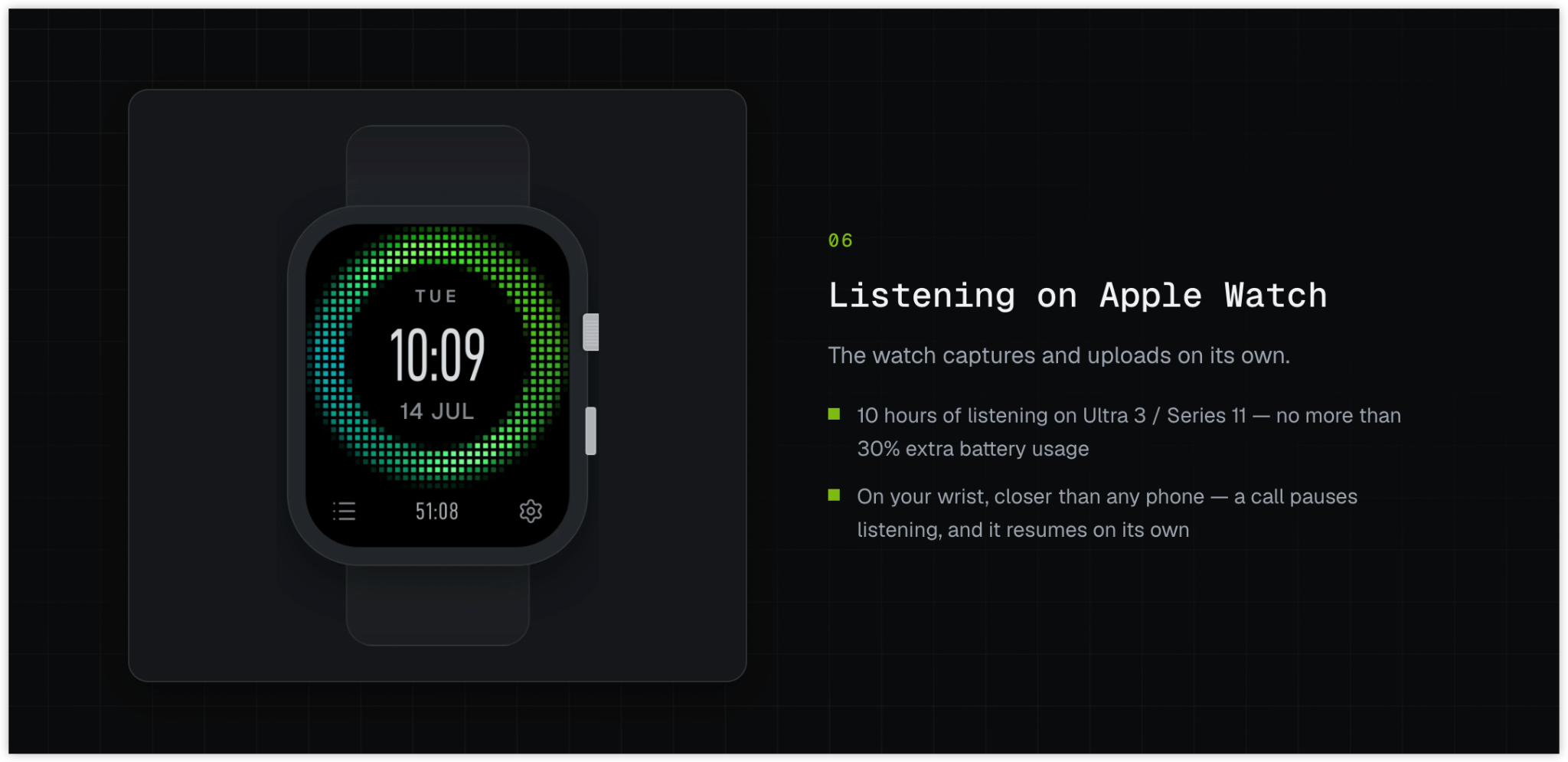
Hemory listening interface shown on Apple Watch.
Handwritten notes give you immediate control over what enters the record. That can be useful when you only need a few points, but deciding what to write competes with listening. If an idea, qualification, or change in direction may matter later, selective notes can leave you reconstructing what was said.
A recorder preserves more of the spoken exchange, but you still need to manage the recording and review it for the detail you need. Consider whether you will realistically revisit audio, and how you’ll get from a long file to the relevant moment. If that step is unlikely to happen, capturing more speech may not produce a more usable record.
Make consent and control part of the choice
Before recording, consider the setting, participants’ expectations, and applicable rules. Explain what you intend to record and why, and obtain any required agreement. Don’t use a discreet device to avoid a conversation about recording.
Compare methods by how clearly you can tell that capture is active, how easily you can start and stop it, and what options you have if someone objects. A method that is easy to control may be a better fit than one that is simply easy to carry. If recording is not appropriate or someone does not agree, use notes or ask whether a different way of documenting the discussion is acceptable.
Check whether the saved record will be useful later
Ask what you expect to retrieve: a decision, an explanation, an exact phrase, or a general reminder. The answer determines how much structure you need.
- For a short reminder: Notes may be enough if you record the point and enough surrounding detail to understand it later.
- For details that may need review: An audio recording can preserve more of the exchange, but you need a practical way to find the relevant passage.
- For recurring conversations: Consider whether the app organizes records and supports the kind of later search or questions you expect to ask. Check what it actually provides rather than assuming every app can search across sessions.
A transcript can make spoken material easier to scan, but it is not a guarantee that every word is correct or that the record contains the whole story. Review important wording, attribution, and conditions against the available record before using them to make a consequential decision.

Find individual statements in a searchable transcript.
A listening app can reduce some of the work between capture and later use. For example, Hemory’s Features page describes timestamped transcripts, speaker labels, AI cleanup, automatic activity classification, and a built-in Q&A Agent that can retrieve across captured conversation sessions. Those features do not guarantee perfect transcription or that an uncaptured exchange can be recovered. Check the current Hemory Features page and confirm the supported setup for your device and task.
If a discussion is already captured in Hemory, its records can help you revisit details without first writing a complete manual recap. Hemory organizes and makes captured material available for retrieval; its built-in Q&A Agent can answer questions about your Memory. You still need to provide the current question or goal and use your judgment about whether the result reflects the situation accurately. If a needed detail was never captured or is not available through the selected route, consult another source or ask a focused follow-up.
Choose by your real constraints
Use this checklist for a decision you can test in your own work:
- How quickly must you start? Choose a method you can activate in time without missing the conversation’s opening.
- How much attention can you spare? If writing would pull you out of the discussion, consider a method that lets you stay engaged while preserving more material—but account for review afterward.
- Can you explain and control recording? Check what participants will understand, how capture is indicated, and how to pause or stop it.
- What do you need to retrieve? A handful of decisions may call for concise notes; repeated questions about details may justify a searchable, organized record.
- Will you actually use the output? Consider the work required to revisit audio, scan a transcript, or search saved conversations. A record only helps if it supports the next task.
A practical choice might be notes for brief exchanges where you only need a few points, a phone recorder for a suitable conversation when you can manage recording and review, or a listening app when you want a repeatable path from captured discussion to later retrieval. A wearable may fit when it is easier to keep available, provided its controls and use are appropriate. These choices are conditional; no one method wins for every conversation.
FAQ
Is a wearable recorder automatically more discreet than a phone?
Not necessarily. Form, placement, recording indicators, and the setting all affect how visible it is. Prioritize clear control and appropriate consent rather than trying to make recording unnoticed.
Does recording mean I can skip taking notes?
Not always. A recording can preserve more of the exchange, while a short note can highlight what you need to act on. You may use both, or rely on one method when it gives you a usable record without distracting you.
What if I can’t record the conversation?
Take notes if that is appropriate, or ask whether the other person is comfortable with another form of documentation. Capture the key point and enough context to interpret it later; don’t treat a brief recap as a verbatim record.
Choose for the whole capture-to-retrieval process
Try your preferred method in a routine, appropriate conversation. Notice whether you can start and stop it confidently, stay engaged, handle consent clearly, and find the detail you need afterward. If you use Hemory, consider whether having captured discussions organized for later retrieval reduces the need to reconstruct them from memory. Choose the method that fits those real constraints, and adjust when the conversation or required level of detail changes.